

Comparing Hosted PBX vs On-Premise Systems for SMBs
The hosted PBX vs on-premise decision impacts SMB operational efficiency, cost management, and scalability for years to come.
- Hosted solutions deliver immediate deployment and predictable monthly costs but create internet dependency and limit customization control.
- On-premise systems provide complete management control and potential long-term savings while requiring significant upfront investment and technical expertise.
- Scalability advantages favor cloud-based hosted PBX with instant capacity adjustments versus hardware-dependent on-premise expansion.
- SIP compatibility enables flexible connectivity options regardless of your choice, supporting future technology integration and hybrid strategies.
Choose hosted PBX for rapid growth and distributed teams, or select on-premise systems when regulatory compliance and complete infrastructure control outweigh convenience factors.
For small and medium-sized businesses evaluating communication setups, the choice between hosted PBX vs on-premise systems directly impacts operational efficiency, cost management, and competitive positioning. Gartner predicts that global enterprise IT spending will reach $5.4 trillion by 2028, demonstrating continued investment in communication infrastructure despite economic uncertainties.
Looking deeply into a SIP PBX comparison enables informed decisions that align communication capabilities with business objectives and growth strategies, particularly as 87% of startup companies are using or planning to use VoIP phone systems to enhance business performance.
What Is the Difference Between Hosted PBX and On-Premise Systems?
Hosted PBX is a cloud-based communication solution where your phone system operates entirely through internet connectivity. The service provider manages all hardware, software, and infrastructure from their data centers, delivering calling features through Voice over Internet Protocol (VoIP) technology. Your business accesses the system through desk phones, softphones, or mobile applications without maintaining any on-site equipment beyond network connectivity.
On-premise PBX systems function as privately owned communication networks installed and operated within your business location. These systems require dedicated hardware, including servers, switches, and specialized telecommunications equipment housed in your facility. Your IT team assumes responsibility for system configuration, maintenance, updates, and troubleshooting while maintaining direct control over all communication features and data.
When comparing hosted PBX vs on-premise systems, the main distinction lies in ownership and management responsibility. Hosted solutions transfer technical complexity to specialized providers, while on-premise systems retain complete organizational control over communication infrastructure and operations. This choice becomes increasingly important as cloud-based UC&C deployments replace on-premises deployments due to improved security and data integrity capabilities.
How Do Costs Compare Between Hosted PBX vs On-Premise Systems?
Analyzing the cost of PBX for small businesses requires examining both immediate financial commitments and long-term operational expenses. Hosted PBX solutions typically require minimal upfront investment, with businesses paying monthly subscription fees based on user count and selected features. These predictable costs include system maintenance, software updates, security monitoring, and technical support within the service agreement.
On-premise systems demand significant initial capital expenditure for hardware purchase, software licensing, installation, and network infrastructure development. Organizations must budget for server equipment, telecommunications hardware, professional installation services, and often dedicated facility space for equipment housing.
However, long-term cost implications favor different scenarios depending on organizational size and communication requirements. The Voice over Internet Protocol market is projected to grow from $161.79 billion in 2025 to $415.20 billion by 2034, with hosted IP PBX solutions expected to see the fastest growth due to lower initial costs and reduced hardware requirements.
Operational cost considerations include maintenance contracts, software licensing renewals, hardware replacement cycles, and specialized technical support. On-premise systems often require dedicated IT personnel or contracted technical services for ongoing management, while hosted solutions typically include comprehensive support within monthly service fees.

Which PBX System Offers Better Scalability for Growing Businesses?
Scalability is an attractive advantage for hosted PBX solutions in supporting business growth and varying communication requirements. Cloud-based systems enable immediate capacity adjustments through administrative interfaces, allowing organizations to add or remove users, features, and phone numbers without hardware modifications or service interruptions.
Hosted solutions accommodate seasonal variations, project-based teams, and rapid expansion through flexible service agreements. Organizations experiencing growth can instantly provision new users with full feature access, while companies facing contraction can reduce services without equipment disposal or contract penalties. This flexibility proves valuable for businesses with uncertain growth trajectories or project-based operations.
Small and medium-sized enterprises are increasingly drawn to hosted PBX for cost-effectiveness, with 44% of SMEs using cloud-hosted PBX in 2024 compared to 32% in 2021. The data shows clear preference trends toward solutions that can adapt to changing business requirements without significant infrastructure investments.
On-premise systems require hardware capacity planning to accommodate future growth, often necessitating initial investment in excess capacity to avoid frequent system upgrades. Expansion typically involves hardware procurement, installation scheduling, and potential system downtime during implementation phases. However, organizations with predictable growth patterns may find on-premise solutions more cost-effective over extended periods.
Geographic expansion considerations also differ between approaches. Hosted PBX for small businesses enables seamless multi-location connectivity through internet-based infrastructure, while on-premise systems may require complex networking configurations or duplicate hardware investments for multiple facilities.

What Are the Control and Management Differences?
In many PBX system comparisons, management control stands out as one of the most impactful operational differences.
Complete Control and Management with On-Premise PBX
On-premise systems provide complete administrative control over system configuration, feature implementation, security protocols, and integration capabilities. Organizations can customize calling features, modify routing rules, implement specialized applications, and maintain direct oversight of all communication data.
This control extends to security implementation, compliance adherence, and integration with proprietary business applications. Companies in regulated industries often require on-premise solutions to maintain data sovereignty and implement specific security protocols that meet industry compliance requirements.
Reduced Responsibility with Hosted PBX
Hosted PBX systems transfer management responsibility to service providers, reducing internal IT workload while limiting customization capabilities. Organizations access system administration through provider-designed interfaces, operating within predefined feature sets and configuration options. While this setup reduces technical complexity, it may restrict specialized implementations or unique business process integration.
Service provider relationships are vital for hosted solutions, as organizations depend on external technical expertise for advanced configuration, troubleshooting, and feature development. Response times, service level agreements, and provider technical competency directly impact communication system performance and business operations.
How Does AI Fit Into Both Systems?
The trend toward artificial intelligence affects both approaches differently. AI-enabled videoconferencing and telephony solutions help improve productivity and business outcomes, with hosted providers typically deploying AI features more rapidly through centralized updates, while on-premise systems require manual updates and potentially hardware upgrades for AI capabilities.
How Do Reliability and Security Compare?
Reliability considerations differ between hosted and on-premise PBX implementations, with each approach presenting distinct advantages and vulnerabilities. Hosted solutions depend entirely on internet connectivity for communication services, creating potential single points of failure if network services experience disruption. However, reputable providers implement redundant data centers, automatic failover systems, and geographically distributed infrastructure to minimize service interruptions.
On-premise systems maintain communication capabilities even during internet disruptions through traditional phone line connections or backup connectivity options. Organizations retain direct control over backup power systems, redundant network paths, and disaster recovery procedures. This independence proves valuable for businesses in areas with unreliable internet or companies requiring guaranteed communication availability.
How to Achieve Enterprise-Grade Security
Cloud-based PBX adoption reached 68% in 2024, with advanced platforms supporting AI-powered call routing and analytics. Security enhancements remain a key focus for modern PBX deployments, with vendors increasingly implementing encrypted voice communication and advanced fraud detection capabilities as standard features.
Security implementation varies, with on-premise systems enabling customized security protocols tailored to specific requirements. Companies can implement proprietary encryption methods, access controls, and monitoring systems while maintaining complete oversight of data storage and transmission.
Hosted providers typically implement enterprise-grade security measures, including encryption, intrusion detection, and regular security auditing. However, organizations must trust external providers with sensitive communication data and depend on their security competency rather than internal control measures.
What Implementation and Integration Factors Should You Consider?
Implementation timelines favor hosted PBX solutions, with most organizations achieving full operational status within days or weeks compared to months required for on-premise installations. Hosted implementations primarily involve network configuration, phone provisioning, and user training, while on-premise projects require hardware procurement, facility preparation, installation coordination, and extensive system configuration.
Integration capabilities vary based on organizational requirements and existing technology infrastructure. Hosted solutions often provide pre-built integrations with popular business applications, customer relationship management systems, and unified communications platforms. However, specialized or proprietary application integration may require custom development or may not be supported by provider platforms.
Which PBX System is Better for Unified Communications?
The integration of UC solutions with contact center platforms continues as buyers seek to simplify technology stacks and work with unified providers of UC, CC, and CPaaS capabilities. This trend affects both hosted and on-premise decisions, as organizations prioritize seamless integration capabilities.
On-premise systems enable unlimited integration possibilities through direct system access and custom development capabilities. Organizations can implement specialized applications, modify system behavior, and integrate with any compatible technology platform without provider restrictions or additional service fees.
Training requirements differ, with hosted solutions typically requiring minimal technical knowledge for daily administration and user management. On-premise systems often necessitate specialized technical training for IT personnel responsible for system maintenance, troubleshooting, and advanced configuration tasks.
How Should SMBs Decide Between Hosted PBX vs On-Premise?
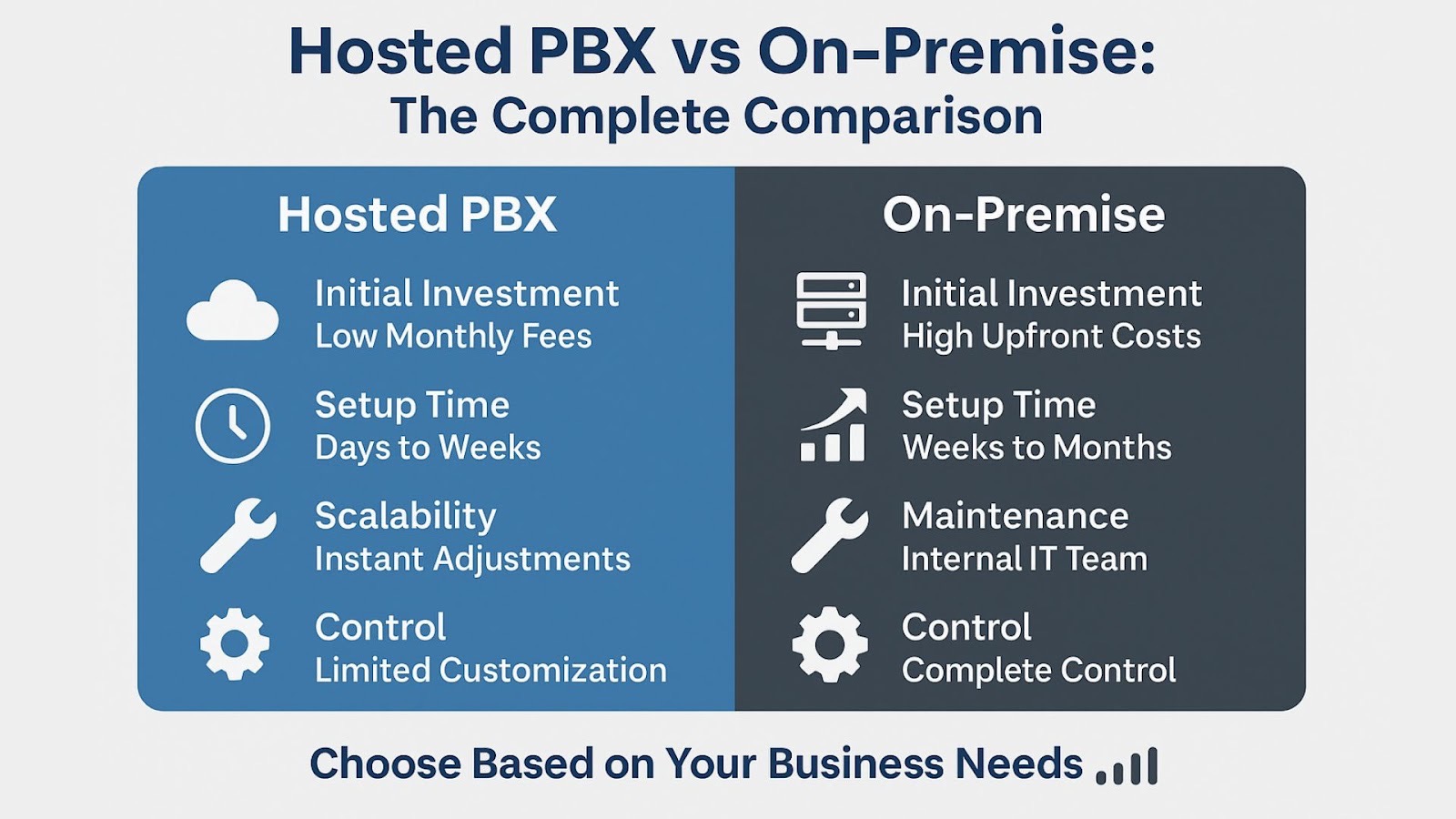
Decision-making should consider organizational priorities, technical capabilities, and long-term business objectives to determine which PBX system is right for your company. Consider these critical factors when comparing the best PBX system for your specific requirements:
| Factor | Hosted PBX | On-Premise PBX |
| Initial Investment | Low monthly fees | High upfront costs |
| Implementation Time | Days to weeks | Weeks to months |
| Technical Expertise Required | Minimal | Significant IT skills |
| Scalability | Instant adjustments | Hardware-dependent |
| Customization | Limited to provider features | Unlimited possibilities |
| Maintenance Responsibility | Provider managed | Internal IT team |
| Internet Dependency | Critical requirement | Optional enhancement |
| Geographic Flexibility | Excellent for remote teams | Complex multi-site setup |
| Regulatory Compliance | Provider-dependent | Full organizational control |
| Long-term Costs | Predictable monthly expenses | Variable maintenance costs |
Organizations with limited IT resources, rapid growth requirements, or distributed workforce operations typically benefit from hosted PBX solutions. Companies requiring specialized features, regulatory compliance control, or possessing strong internal technical capabilities may prefer on-premise implementations.
Small businesses experiencing growth uncertainty should consider hosted solutions for their flexibility and predictable cost structure. Established organizations with stable communication requirements and existing IT infrastructure may find on-premise systems more economically efficient over extended periods, particularly as the IT and telecommunications industry holds a 42.5% market share in IP PBX software due to their specific requirements for flexible, cost-effective communication systems.
How Does SIP Compatibility Factor Into Your Decision?
Session Initiation Protocol (SIP) compatibility is an important consideration for both hosted and on-premise PBX systems, as SIP trunking enables businesses to transmit calls over internet connections while maintaining existing infrastructure investments. Modern PBX systems, whether hosted or on-premise, should support SIP protocols to enable flexible connectivity and future technology integration.
Hosted PBX providers typically include SIP trunking capabilities within their service offerings, enabling organizations to maintain existing phone numbers while accessing advanced calling features. This integration simplifies vendor relationships and reduces technical complexity for businesses without extensive telecommunications expertise.
On-premise systems benefit from SIP compatibility by enabling flexible connectivity options through multiple SIP trunk providers. Organizations can implement redundant SIP services, negotiate competitive pricing, and modify service providers without hardware changes. This flexibility proves valuable for businesses seeking to optimize communication costs while maintaining service quality.
SIP compatibility also enables hybrid communication strategies where organizations can combine on-premise PBX systems with cloud-based services for specific functions such as remote worker connectivity or disaster recovery capabilities. This approach provides operational flexibility while maintaining primary system control.
How to Choose a SIP Trunking Provider
When evaluating SIP PBX comparison factors, consider provider network quality, geographic coverage, feature compatibility, and integration capabilities with existing business applications. Quality SIP trunk providers offer enterprise-grade reliability, advanced features, and responsive support that enable immediate productivity gains regardless of your chosen PBX approach.
The importance of SIP compatibility continues growing as businesses transition from traditional systems to IP-based communication, with modern solutions supporting both current needs and future technology evolution without requiring complete system replacements.
Frequently Asked Questions
How much bandwidth does a PBX system require?
Both hosted and on-premise PBX systems typically consume 85–100 kilobytes per second for each concurrent call when using standard audio codecs. Organizations should calculate total bandwidth needs by multiplying maximum concurrent calls by 100 kbps and ensuring adequate internet capacity for other business operations.
Can I switch from on-premise to hosted PBX later?
Yes, migration from on-premise to hosted PBX systems is possible and increasingly common. The process typically involves number porting, feature mapping, user training, and parallel system operation during transition periods. However, switching may require contract negotiations and potential equipment write-offs.
Which PBX system works better for remote employees?
Hosted PBX systems generally provide superior remote work capabilities through mobile applications, softphone options, and cloud-based feature access. On-premise systems can support remote workers but often require VPN connections and additional network configuration for optimal functionality.
How do I ensure my chosen PBX system meets compliance requirements?
Compliance requirements vary by industry and regulation type. On-premise systems provide complete control over data handling and security implementation, while hosted providers should demonstrate compliance certifications and provide detailed security documentation. Always verify specific regulatory requirements before implementation.
Making the Right Choice for Your Business Communications
The hosted PBX vs on-premise decision ultimately depends on balancing immediate operational needs with long-term business objectives, technical capabilities, and cost management priorities. Organizations prioritizing rapid deployment, predictable costs, and minimal technical complexity typically find hosted solutions align with their operational requirements and growth strategies.
Companies requiring specialized features, regulatory compliance control, or possessing established IT infrastructure may benefit from on-premise implementations that provide unlimited customization capabilities and long-term cost optimization potential. The key lies in honest assessment of organizational capabilities, growth projections, and communication requirements rather than pursuing theoretical advantages that may not align with practical business needs.
SIP.US provides the connectivity and support that enables immediate operational improvements and long-term communication success. Get started today to modernize your communication with flexible, reliable SIP trunking solutions that work with any PBX system.

Mitch leads the Sales team at BCM One, overseeing revenue growth through cloud voice services across brands like SIPTRUNK, SIP.US, and Flowroute. With a focus on partner enablement and customer success, he helps businesses identify the right communication solutions within BCM One’s extensive portfolio. Mitch brings years of experience in channel sales and cloud-based telecom to every conversation.
Free SIP Trunk in 60 Seconds
Related Posts
Understanding the Different Types of PBX Systems
Choosing the right phone system shapes how your business communicates for years to come. If…

Cost-Effective SIP Trunking for Small Businesses
Discover cost-effective communication solutions for small businesses to boost growth & efficiency. Explore tech tools & strategies for better engagement.

Business SIP Line: What It Is and Why It Matters
Discover the benefits of a business SIP line with our comprehensive guide. Learn how it enhances communication, cuts costs, and scales with your company. Dive in now!