

Voice over IP Services Explained: Everything You Need to Know
Voice over IP services transform business communication.
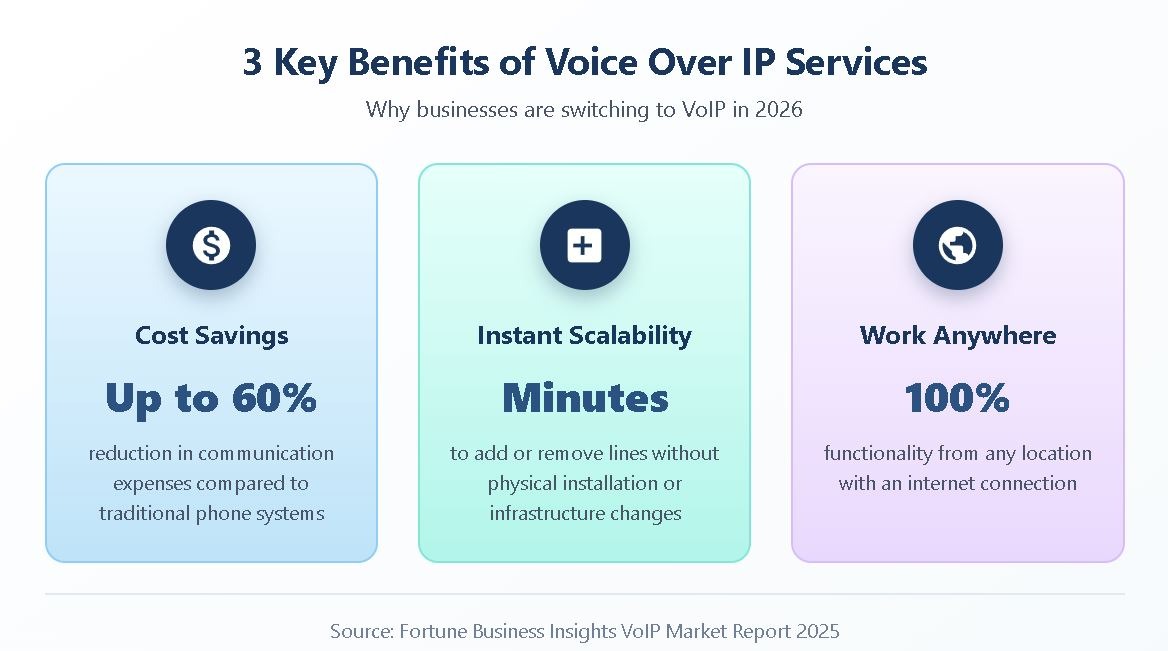
- VoIP converts voice into digital signals transmitted over the internet, eliminating expensive traditional phone lines and reducing costs by up to 60%.
- The technology supports advanced features, including call recording, custom caller ID, voicemail-to-email, and seamless remote work capabilities.
- AI-powered advancements in 2026 enable real-time transcription, intelligent call routing, and automated sentiment analysis.
Businesses seeking flexible, scalable communication should evaluate SIP trunking providers that offer reliable infrastructure with transparent pricing.
Voice over IP services have upgraded how businesses communicate by providing a flexible, affordable, and feature-rich alternative to traditional phone systems. The global VoIP market reached $176 billion in 2025, with projections indicating growth to nearly $389 billion by 2034 as organizations prioritize modern communication infrastructure. For business owners and IT directors evaluating their communication options, understanding how VoIP works and what it offers has become essential for maintaining a competitive advantage.
How Do Voice Over IP Services Work?
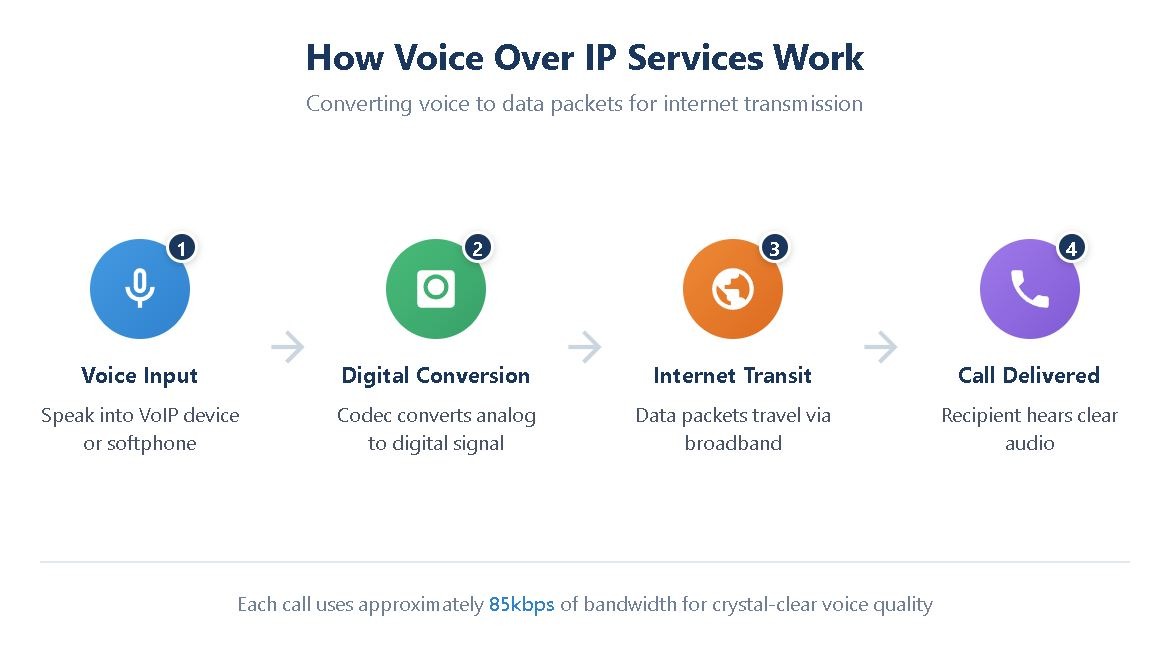
Voice over Internet Protocol is a technology that allows voice calls using a broadband internet connection rather than traditional phone lines. Unlike legacy phone services relying on analog signals, VoIP converts voice into digital signals that travel over the internet as data packets. The FCC defines VoIP as technology enabling voice communication through internet connections, making it accessible through computers, specialized VoIP phones, or traditional phones equipped with adapters.
How Does VoIP Convert Voice to Digital Signals?
When speaking into a VoIP-enabled device, the technology transforms voice from analog signals into digital data. A codec encodes and decodes these digital data streams, compressing and decompressing signals for efficient internet transmission. The process segments voice data into small chunks called data packets, each containing a portion of voice data along with routing information. These packets traverse the internet to reach recipients, where they reassemble into the original voice signal. For calls to traditional phones, the digital signal converts back to analog before reaching the recipient.
What Components Are Required for VoIP?
Three primary components enable VoIP functionality.
- A stable broadband internet connection through cable, DSL, or metro ethernet provides the foundation for transmitting voice data.
- VoIP-compatible devices, including IP phones, softphones on computers or mobile devices, or traditional phones with VoIP adapters, capture and transmit calls.
- A reliable VoIP service provider handles call routing, number management, and connection to the public switched telephone network when needed.
The quality of your internet connection directly impacts call clarity and reliability. Each concurrent call typically consumes approximately 85kbps of bandwidth, making it important to ensure adequate capacity for expected call volumes while maintaining quality for other business applications.
What Are the Main Types of VoIP Services?
Organizations evaluating Voice over IP services encounter several deployment models, each offering distinct advantages based on business requirements, technical capabilities, and growth objectives.
Cloud-Based VoIP Services
Cloud-based VoIP services operate on remote servers accessed via the internet, eliminating the need for on-premise hardware maintenance. This model offers exceptional scalability, allowing businesses to add or remove users without infrastructure changes. Cost-effectiveness improves since organizations avoid significant hardware investments, and access remains available from anywhere with an internet connection. The primary consideration involves reliance on stable internet connectivity and data security protocols managed by the service provider.
On-Premises VoIP Systems
On-premises VoIP installations place all hardware and software at the business location, with internal IT teams managing the entire infrastructure. This approach provides complete control over system customization and security protocols, with data remaining within organizational networks. Higher upfront costs for equipment and ongoing maintenance requirements make this option more suitable for larger organizations with dedicated technical resources and specific compliance needs.
Hosted VoIP Solutions
Hosted VoIP services position a third-party provider as the manager of servers, maintenance, and system upgrades. This model reduces internal IT burden while delivering professional-grade communication capabilities. Providers typically offer high uptime guarantees and handle technical complexity, though organizations accept some limitations in system customization. Monthly subscription costs provide predictable budgeting compared to capital expenditures for on-premises equipment.
What Is Unified Communications as a Service (UCaaS)?
UCaaS integrates multiple communication tools into a single platform, combining voice calls, video conferencing, instant messaging, file sharing, and collaboration capabilities. This comprehensive approach streamlines workflow efficiency by eliminating the need to manage multiple disparate tools. The unified communications market continues to expand as organizations recognize productivity gains from consolidated communication platforms that support modern workforce requirements.
What Are the Latest Advancements in VoIP Technology?
VoIP technology has evolved beyond basic voice calling, with 2026 bringing transformative capabilities that enhance business communication effectiveness, security, and operational efficiency.
How Is AI Transforming Business VoIP?
Artificial intelligence integration is the most prominent advancement in modern VoIP systems. AI-powered features automate routine tasks and provide insights previously unavailable to most organizations. Real-time transcription converts spoken conversations into searchable text during calls, improving accessibility and creating accurate records without manual note-taking. This capability proves valuable for compliance requirements, training purposes, and capturing action items from customer conversations.
Intelligent call routing analyzes caller information, conversation history, and business rules to automatically connect customers with the most appropriate representatives. Rather than relying on simple menu selections, AI-driven systems assess context and intent to reduce transfer rates and improve first-call resolution. Sentiment analysis examines customer tone and language patterns during calls, providing immediate feedback to agents and supervisors while identifying at-risk interactions before they escalate.
Automated call summaries eliminate post-call documentation burden by generating concise summaries of key discussion points, decisions made, and follow-up items. This feature allows representatives to focus entirely on customer conversations rather than dividing attention between engagement and note-taking.

What Impact Does 5G Have on VoIP Quality?
The expansion of 5G networks delivers substantial improvements to VoIP performance, particularly for mobile users. Ultra-fast speeds, reduced latency, and increased bandwidth enable VoIP providers to deliver crystal-clear voice and video calls even in high-traffic areas or during network congestion. Businesses operating in locations with 5G coverage experience improved call quality that supports effective communication with clients, partners, and distributed team members.
Mobile VoIP benefits from 5G infrastructure, with projected market growth exceeding $87 billion by 2031. The combination of widespread smartphone adoption, affordable data plans, and 5G availability creates conditions for high-quality voice and video calling from virtually any location.
What Is WebRTC and How Does It Simplify VoIP?
WebRTC technology enables users to make voice and video calls directly through web browsers without requiring additional plugins or software installation. This advancement reduces deployment complexity and costs by leveraging existing web infrastructure. Organizations benefit from streamlined onboarding since employees access communication tools through familiar browser interfaces rather than installing separate applications.
Integration capabilities expand with WebRTC, enabling direct calls within CRM systems, help desk platforms, and other web-based business tools. Click-to-call functionality embedded in applications improves workflow efficiency and reduces friction in customer communications.
How Are Security Protocols Advancing?
Enhanced security measures address evolving threats facing VoIP systems. End-to-end encryption protects conversations from unauthorized access, while multi-factor authentication adds verification layers beyond passwords. Secure Real-Time Transport Protocol (SRTP) encrypts voice and video data, ensuring confidentiality even if network traffic is intercepted.
Advanced fraud detection systems monitor calling patterns in real time, identifying suspicious activity and blocking unauthorized calls before they generate charges. Proactive VoIP security is vital as cyber threats become more sophisticated, with organizations investing in comprehensive security controls that protect both communications and business continuity.
What Are the Key Benefits of VoIP for Businesses?
Voice over IP services deliver measurable advantages across cost reduction, operational flexibility, and communication capabilities that directly impact business performance.
How Much Can Businesses Save with VoIP?
Cost reduction remains a primary driver of VoIP adoption. Organizations switching from traditional phone systems report savings of 60% on communication expenses. Local call costs decrease, while long-distance and international calling become more affordable since charges are not calculated by distance. The elimination of physical phone line installation and maintenance reduces both upfront investment and ongoing operational expenses.
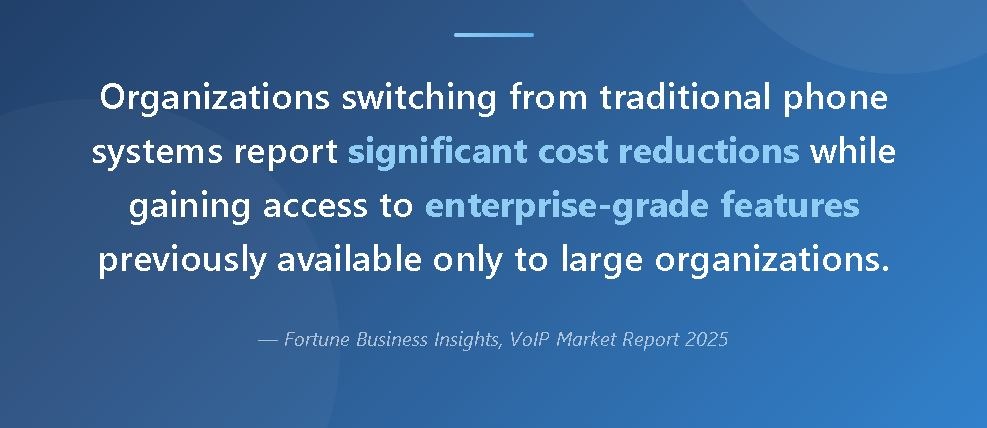
Cloud-based systems further reduce costs by eliminating hardware purchases and maintenance requirements. Predictable monthly subscription pricing replaces variable telephone bills, improving budget forecasting accuracy. Small and medium businesses gain access to enterprise-grade features previously available only to large organizations with substantial technology budgets.
What Features Support Remote and Hybrid Work?
VoIP technology enables seamless communication for distributed workforces, addressing the challenges inherent in remote and hybrid work arrangements. Employees access full business phone system functionality from any internet-connected device, maintaining a professional presence regardless of physical location. Mobile applications extend VoIP functionality to smartphones and tablets, allowing team members to make and receive calls using business numbers while working remotely.
Call forwarding automatically routes calls to appropriate devices based on employee availability and location. Voicemail-to-email delivers messages to inboxes for convenient review and response. Video conferencing integrations support virtual meetings that maintain team collaboration across geographic distances.
What Advanced Features Come with Business VoIP?
Modern VoIP systems include capabilities that enhance both internal efficiency and customer experience:
- Call Recording: Captures conversations for training, quality assurance, and compliance documentation
- Custom Caller ID: Displays business identity consistently across all outbound communications
- Auto Attendant: Directs callers to appropriate departments without requiring receptionist involvement
- Voicemail Transcription: Converts voice messages to text for quick scanning and prioritization
- Call Analytics: Provides insights into communication patterns, peak calling times, and performance metrics
- CRM Integration: Synchronizes customer information with phone systems for personalized service
These features combine to create communication systems that improve customer satisfaction while reducing operational burden on staff.
What Should Businesses Consider Before Adopting VoIP?
While VoIP offers substantial benefits, successful implementation requires attention to infrastructure requirements and potential limitations.
What Are the Internet Requirements for Quality VoIP?
VoIP performance depends on the quality of the internet connection and the available bandwidth. Organizations should assess current bandwidth utilization and ensure capacity exists for expected call volumes. Quality of Service (QoS) configuration prioritizes voice traffic over other data types, reducing the risk of audio degradation during periods of heavy network usage.
Latency below 150 milliseconds and minimal jitter provide optimal call quality. Conducting network assessments before implementation helps identify potential issues and establish baseline performance expectations.
How Do Power Outages Affect VoIP Systems?
Unlike traditional phone lines that often maintain functionality during power outages, VoIP requires electricity for network equipment. Organizations should implement uninterruptible power supplies for critical network components and establish failover systems that route calls to mobile devices when primary systems become unavailable. SIP trunking solutions often include automatic failover capabilities that maintain communication continuity during disruptions.
What Security Considerations Apply?
Internet-based communication systems require appropriate security measures. Encryption protocols protect voice data during transmission, while strong authentication prevents unauthorized access to communication systems. Regular software updates address security vulnerabilities, and employee training reduces risks from social engineering attacks. Working with providers that prioritize security and offer comprehensive protection features minimizes exposure to threats.
How Does VoIP Compare to Traditional Phone Systems?
Understanding the differences between VoIP and traditional phone systems helps organizations evaluate which approach aligns with their communication requirements and operational priorities.
| Factor | VoIP | Traditional Phone |
| Cost | Lower ongoing expenses, minimal hardware | Higher installation and per-minute charges |
| Scalability | Add/remove lines instantly | Requires physical line installation |
| Features | Advanced capabilities included | Limited features, additional charges |
| Mobility | Full functionality from any location | Tied to physical location |
| Maintenance | Provider-managed updates | Internal IT or vendor service calls |
| Call Quality | Dependent on internet quality | Consistent but limited to voice |
The differences between SIP trunking and traditional VoIP further expand options for organizations seeking specific capabilities or maintaining existing infrastructure while modernizing communication capabilities.
What VoIP Protocols and Standards Matter?
Technical protocols underlying VoIP systems affect the quality, compatibility, and security of business communications.
What Is SIP?
Session Initiation Protocol (SIP) manages the initiation, maintenance, and termination of VoIP sessions. Beyond voice calls, SIP supports video conferencing, instant messaging, and other multimedia communications. Its versatility makes SIP the most widely adopted protocol for modern business VoIP systems, enabling features like call forwarding, conferencing, and voicemail integration.
How Do Audio Codecs Affect Call Quality?
Codecs compress and decompress audio data for transmission. G.711 provides high-quality uncompressed audio, consuming approximately 64kbps per call, delivering crystal-clear sound. G.729 compresses audio to reduce bandwidth requirements to 8kbps per call, trading some audio quality for efficient bandwidth utilization. Selecting appropriate codecs involves balancing available bandwidth against quality requirements.
What Role Does RTP Play?
Real-Time Protocol delivers audio and video data over IP networks, working alongside UDP to provide the speed necessary for real-time communication. RTP ensures voice data packets arrive quickly and in the correct sequence, maintaining conversation flow without noticeable delays.
Frequently Asked Questions About VoIP Services
What is the difference between Voice over IP services and traditional phone service?
VoIP transmits voice as digital data packets over internet connections, while traditional phone service uses analog signals over dedicated copper lines. VoIP typically costs less, offers more features, and provides greater flexibility for remote work. Traditional service maintains some advantages in areas with unreliable internet connectivity but lacks the scalability and advanced capabilities of modern VoIP systems.
How reliable is VoIP for business communications?
Modern VoIP systems achieve reliability levels comparable to or exceeding traditional phone service when implemented properly. Reputable providers maintain redundant infrastructure with automatic failover capabilities, achieving uptime exceeding 99.99% in many cases. Reliability depends on internet connection quality and provider infrastructure investment.
Can I keep my existing phone numbers when switching to VoIP?
Yes, number portability allows businesses to transfer existing phone numbers to VoIP providers. The porting process typically takes 1–4 weeks, depending on the current carrier and number type. Most providers handle porting paperwork and coordinate with existing carriers to minimize disruption during transition.
What internet speed do I need for business VoIP?
Each concurrent VoIP call requires approximately 100kbps of bandwidth for high-quality audio. Organizations should ensure sufficient capacity for expected simultaneous calls plus headroom for other business applications. A business expecting 10 concurrent calls should have at least 1 Mbps dedicated to voice traffic, though more bandwidth provides better quality and accommodates growth.
Is VoIP secure for business use?
VoIP security has advanced, with modern systems offering encryption, authentication protocols, and fraud protection comparable to enterprise security standards. Selecting providers that prioritize security, implementing strong passwords, and maintaining updated software creates secure communication environments suitable for business and regulatory requirements.
Elevate Your Business Communications Today
Voice over IP services have matured into essential business infrastructure, delivering cost savings, operational flexibility, and advanced capabilities that traditional phone systems can’t match. The integration of artificial intelligence, enhanced security protocols, and unified communications features creates opportunities for organizations to improve both internal collaboration and customer experience.
Choosing a reliable provider ensures businesses capture these benefits while avoiding implementation challenges. SIP.US delivers SIP trunking services designed for organizations seeking dependable communication infrastructure with transparent pricing and comprehensive feature sets. Get started today and discover how modern VoIP technology can transform your business communications.

Mitch leads the Sales team at BCM One, overseeing revenue growth through cloud voice services across brands like SIPTRUNK, SIP.US, and Flowroute. With a focus on partner enablement and customer success, he helps businesses identify the right communication solutions within BCM One’s extensive portfolio. Mitch brings years of experience in channel sales and cloud-based telecom to every conversation.
Free SIP Trunk in 60 Seconds
Related Posts

SIP Trunking Pricing Explained: What You’re Really Paying For
Your business phone bill doesn’t have to be a mystery. SIP trunking pricing typically ranges…

The 5 Best PBX Systems for Your Business in 2026
The business PBX market has transformed, with AI-powered features and cloud deployment becoming standard rather…
Understanding the Different Types of PBX Systems
Choosing the right phone system shapes how your business communicates for years to come. If…