

Advantages and Disadvantages of SIP Trunking: A Complete Business Guide
SIP trunking delivers substantial cost reductions and flexibility, but the technology comes with trade-offs worth understanding before you migrate.
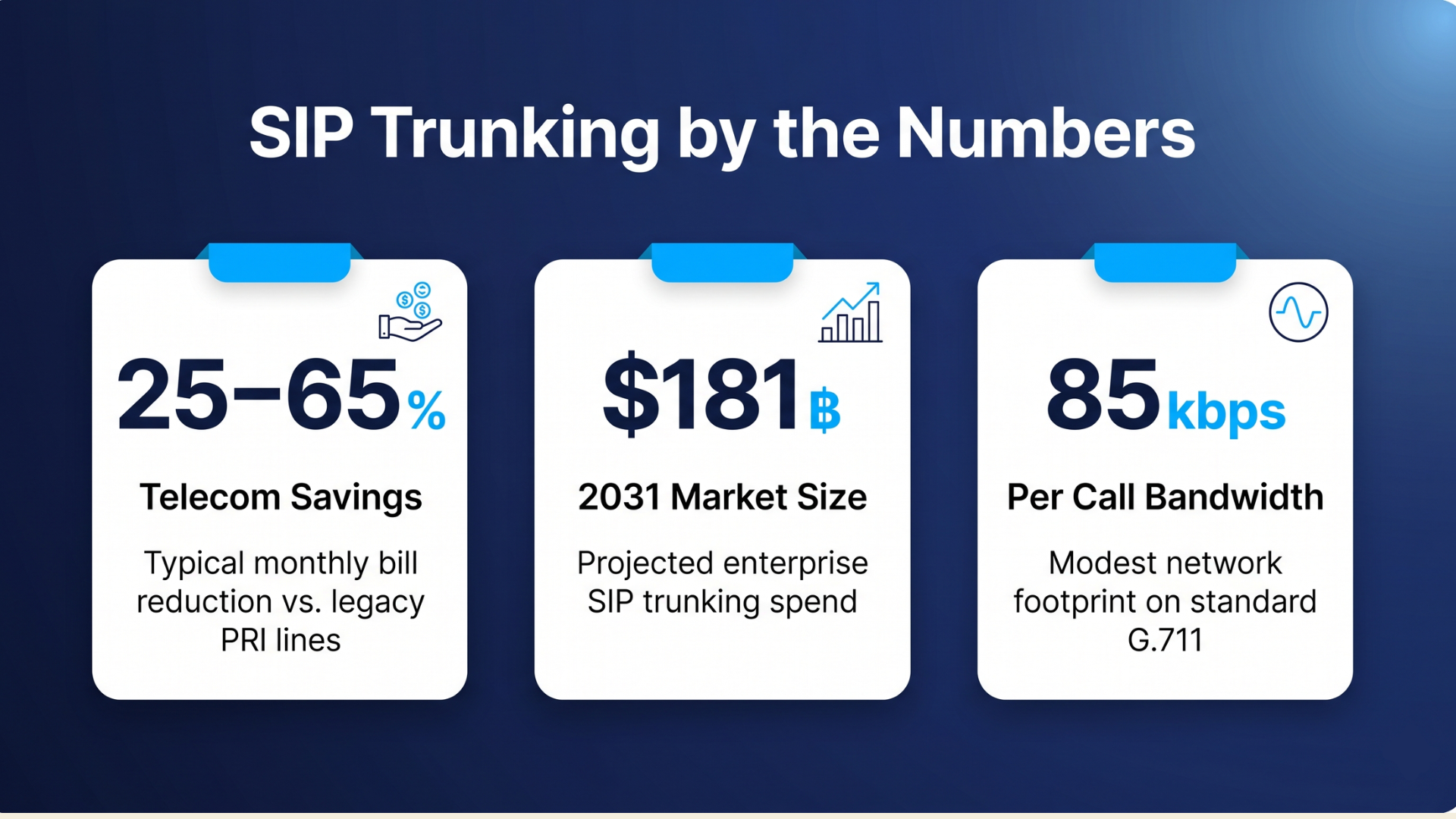
- The SIP trunking market is projected to grow from $73.14 billion in 2025 to $181.58 billion by 2031, reflecting rapid enterprise adoption.
- Businesses commonly report 25% to 65% savings on monthly telecom bills after switching from legacy PRI lines.
- Internet dependency, bandwidth planning, and security configuration are the primary disadvantages.
- The right SIP provider mitigates most disadvantages through Tier-1 connectivity, redundancy, and built-in fraud protection.
If your business relies on a stable broadband connection and wants predictable, scalable communications, SIP trunking almost always delivers a strong return.
As cloud-based infrastructure matures and copper lines disappear, SIP communications platforms have become the standard for modern business voice. According to Mordor Intelligence, the SIP trunking market is projected to grow at a 16.38% CAGR through 2031, reaching $181.58 billion. That momentum is fueled by clear cost reductions, feature-rich functionality, and the ongoing sunset of legacy telephone infrastructure.
If you’re evaluating a full-scale SIP trunking platform for your business, understanding the complete picture matters. This guide walks you through the advantages and disadvantages of SIP, side-by-side comparisons with traditional phone lines, and a practical framework to determine whether SIP trunking fits your operations.
What Are the Core Advantages of SIP Trunking?
SIP (Session Initiation Protocol) offers improvements beyond replacing traditional phone lines. The technology lets even small businesses leverage their communications network to boost efficiency, support distributed teams, and cut costs at the same time. For companies evaluating SIP pros and cons, the advantages cluster around cost, flexibility, and modern features.
How Much Money Does SIP Trunking Actually Save?
Cost savings remain the single strongest pull toward SIP adoption. Companies switching from legacy PRI lines typically reduce monthly telecom spend by 25% to 65%, with the highest savings going to organizations with multi-site footprints or high call volumes. Long-distance and inbound calling charges drop since SIP channels usually include unlimited calling to the contiguous U.S. and Canada.
SIP eliminates the capital expense of installing and maintaining physical telephone lines. There are no truck rolls, no copper repairs, and no hardware refresh cycles tied to your phone service. You can also explore practical ways VoIP saves money for additional context on how the math plays out for SMBs.
Why Is SIP More Flexible Than Traditional Phone Systems?
SIP trunking grows and shrinks with your company. Adding channels takes minutes through an online control panel, rather than days or weeks waiting on a carrier to install new lines. The same applies to phone numbers, which can be provisioned instantly across thousands of U.S. rate centers.
That flexibility extends to distributed teams. SIP delivers consistent communication to any device in any location, which is essential as hybrid work has become standard. Gallup’s latest research shows hybrid work has stabilized as the dominant model for remote-capable employees, so businesses need phone infrastructure that follows employees rather than anchoring them to a desk.
What Modern Features Come With SIP Trunking?
SIP unlocks a feature set that traditional phone systems can’t match. Standard capabilities include:
- Real-time call data records with downloadable reporting
- Bring-your-own-bandwidth flexibility across cable, DSL, fiber, or Metro Ethernet
- Nomadic e911 service with editable physical addresses
- Fault-tolerant routing with primary, secondary, and PSTN failover paths
- Integration with popular SIP-enabled PBX systems like 3CX, FreePBX, Cisco, and Asterisk
These features used to require enterprise-grade budgets. Today, they ship as standard with most quality SIP trunking services, making advanced communications accessible to small and mid-sized businesses.
What Are the Disadvantages of SIP Trunking?
While the disadvantages of SIP trunking are limited compared to alternatives, you should understand the trade-offs before making the switch. Most of these issues are manageable with the right provider and a bit of planning, but they’re worth examining honestly.
Does SIP Trunking Depend on Your Internet Connection?
Yes. Because SIP routes calls over your broadband connection, an internet outage means your primary phone system goes down with it. This requirement is the most cited disadvantage of SIP trunking, and it’s a real consideration.
That said, the impact is usually overstated. Quality providers offer PSTN failover routing that automatically redirects inbound calls to a backup number if your primary trunk becomes unreachable. You can also implement redundant internet connections from different providers, or use 4G or 5G cellular as a backup path. In contrast, if your copper phone lines went down without an alternative, the entire system would fail, and traditional lines take much longer to troubleshoot and repair.
What About Call Quality and Bandwidth Requirements?
SIP call fidelity depends on adequate bandwidth and a well-configured network. Latency, jitter, and packet loss can degrade audio quality if voice traffic competes with large file downloads or video streaming. The solution is straightforward: enable Quality of Service (QoS) prioritization on your router to give voice packets priority over other network traffic.
Bandwidth requirements are modest by modern standards. A typical G.711 call consumes roughly 85 kbps up and down, so even a small office connection can support dozens of concurrent calls without issue.
How Serious Are SIP Security Concerns?
Security has been a longstanding concern with internet-based communications, and it remains a worthy consideration. Toll fraud, eavesdropping, and SIP-targeted denial-of-service attacks are real threats that businesses need to plan for.
Advancements in SASE and SD-WAN infrastructure, combined with protocols like TLS encryption and Zero-Trust authentication, have strengthened VoIP and SIP security. Quality SIP providers also build in real-time international fraud detection that automatically terminates suspicious calls in progress and shuts down unauthorized international calling. In many ways, the security posture of advanced cloud-based infrastructure now exceeds that of on-premise systems that relied on physical isolation as their primary defense.

SIP Trunking vs. Traditional Phone Lines: How Do They Compare?
For a clear side-by-side view, the table below summarizes the most important differences between SIP trunking and legacy phone service. This comparison highlights why most businesses evaluating SIP trunking benefits ultimately conclude that the math favors the switch.
| Factor | SIP Trunking | Traditional Phone Lines (PRI) |
| Setup time | Minutes to hours | Days to weeks |
| Monthly cost per channel | Lower, predictable | Higher, often fixed bundles |
| Channel additions | Self-service, instant | New circuit install required |
| Long-distance calling | Typically included | Per-minute charges |
| Hardware investment | Minimal (existing PBX) | PRI circuits, cards, gateway |
| Remote workforce support | Native, device-agnostic | Limited or absent |
| Failover and redundancy | Built-in routing rules | Limited; physical line dependent |
| Feature set | Modern (CDRs, SMS, e911) | Basic voice only |
| Contract requirements | Often month-to-month | Multi-year typical |
The pattern is consistent across nearly every category that matters to a business buyer. Traditional phone lines retain a narrow advantage only in scenarios where internet connectivity is unreliable, and even then, hybrid configurations usually solve the problem. The clearest SIP trunking benefits come from the combination of cost, flexibility, and modern feature support, not any single category alone.
SIP vs. VoIP Pros and Cons: What’s the Real Difference?
The terms SIP and VoIP often get used interchangeably, but they describe different things. VoIP is the broad technology for sending voice over the internet. SIP is the specific protocol that sets up, manages, and ends those communication sessions. A SIP trunk connects your existing PBX to the phone network, while a hosted VoIP system replaces the PBX entirely with a cloud platform.
When you weigh SIP vs VoIP pros and cons, SIP trunking advantages include keeping your existing PBX investment, retaining control over routing and features, and lower per-channel costs. The SIP pros and cons trade-off is that you need in-house technical capability to manage your PBX. Hosted VoIP simplifies management but offers less customization and typically costs more per user. For businesses with existing IP-PBX hardware or those that want full control, the SIP vs VoIP pros and cons analysis usually favors SIP trunking.
Is SIP Trunking Right for Your Business?
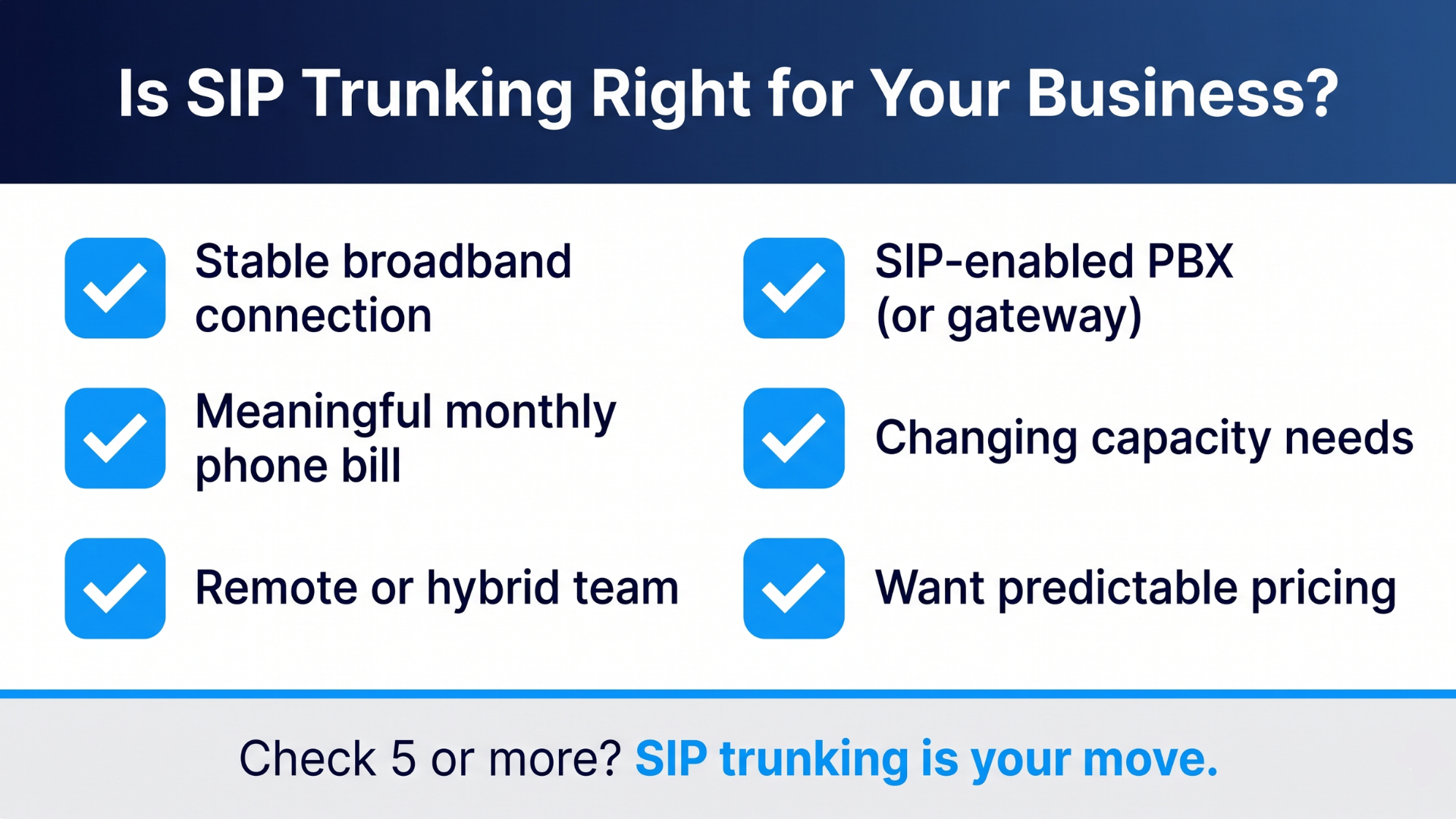
Use the following framework to evaluate fit. SIP trunking is usually the right move if most of these statements apply to your business.
- You have a stable broadband connection with sufficient upstream bandwidth
- Your existing PBX is SIP-enabled, or you’re willing to use a gateway for legacy systems
- Your current monthly phone bill is substantial enough that percentage-based savings would matter
- You expect to add or remove phone capacity at least once per year
- You have remote, hybrid, or multi-site employees who need consistent phone service
- You want predictable monthly pricing without surprise long-distance charges
If five or more of these statements describe your business, SIP trunking will almost certainly deliver clear ROI. If only one or two apply, the cost-benefit may be less compelling, but the trial-and-test approach available with most quality providers makes it low-risk to find out.
What Are the Advantages and Disadvantages of SIP Providers?
Beyond the general advantages and disadvantages of SIP, the quality of providers varies. Several factors separate the strong providers from the rest.
Look for explicit Tier-1 carrier relationships. Tier-1 providers have direct access to internet infrastructure, which cuts out third-party routing and mitigates most potential SIP disadvantages from the outset. Lesser providers often won’t disclose their upstream carriers, which is a meaningful signal in itself.
Evaluate the control panel before you sign. The best providers offer ultra-polished, intuitive self-service tools that handle number porting, channel management, billing, and call data records in one place. A good interface reduces the IT admin burden of running your phone system.
Don’t let self-service replace technical support, though. Dedicated phone-based and ticket support remains essential for the moments when you need real help, and the strongest providers offer both.
Frequently Asked Questions
What is the biggest disadvantage of SIP trunking? The most cited disadvantage of SIP trunking is dependency on your internet connection. If your broadband fails, your primary phone system can fail with it. This risk is manageable through PSTN failover routing, redundant internet connections, or cellular backup paths, all of which quality providers support.
How much can a small business save by switching to SIP trunking? Most small and mid-sized businesses save between 25% and 65% on monthly telecom costs after switching from PRI lines or traditional analog service. Savings depend on call volume, long-distance usage, and current contract structure, but the reduction is consistent and predictable.
Do I need to replace my existing PBX to use SIP trunking? Not necessarily. If your PBX is SIP-enabled, which most modern systems are, you can connect directly. For legacy analog PBXs, a multi-port analog telephone adapter (ATA) or SIP-to-T1 gateway bridges the gap without requiring a full PBX replacement.
Is SIP trunking secure enough for businesses handling sensitive data? Yes, when properly configured. Modern SIP trunks use TLS encryption, real-time fraud monitoring, and access controls that meet the security needs of most regulated industries. Choose a provider with built-in toll fraud protection and ensure your PBX, firewall, and router are configured following current security best practices.
Wrap Up Your SIP Evaluation With a No-Risk Trial
The advantages and disadvantages of SIP trunking come down to substantial cost savings, modern features, and flexibility on one side, with manageable trade-offs around internet dependency and security configuration on the other. For most businesses, the math clearly favors the switch, and the technology has matured to the point where the disadvantages are easily mitigated by choosing a quality provider.
SIP.US offers competitively priced SIP trunking with Tier-1 connectivity, an intuitive control panel, built-in fraud protection, and dedicated technical support. The no-obligation free trial includes 60 minutes of US48 and Canada calling, so you can test SIP in your real business operations before committing. Get started today to see the advantages of SIP trunking for yourself.

Mitch leads the Sales team at BCM One, overseeing revenue growth through cloud voice services across brands like SIPTRUNK, SIP.US, and Flowroute. With a focus on partner enablement and customer success, he helps businesses identify the right communication solutions within BCM One’s extensive portfolio. Mitch brings years of experience in channel sales and cloud-based telecom to every conversation.
Free SIP Trunk in 60 Seconds
Related Posts

What Is a DID Number? Direct Inward Dialing Explained
Unlock the potential of your communication system with our Beginner’s Guide to DID Numbers and SIP Trunks, offering cost-effective, scalable solutions for modern businesses and individuals.

What Is SIP? A Complete Guide to Session Initiation Protocol
Discover everything about SIP and how it revolutionizes communication. Learn what is SIP, its benefits, and how to implement it in your business for better connectivity.

What Is Internet Protocol? IP Definition and How It Works
Internet protocol is the addressing and routing system that gets every business call, email, and…