

Bulk SMS for Business: How It Works + SIP Integration Use Cases
Bulk SMS for business has become the highest-engagement communication channel available to SMBs, and pairing it with SIP trunking unlocks even greater cost efficiency and scale.
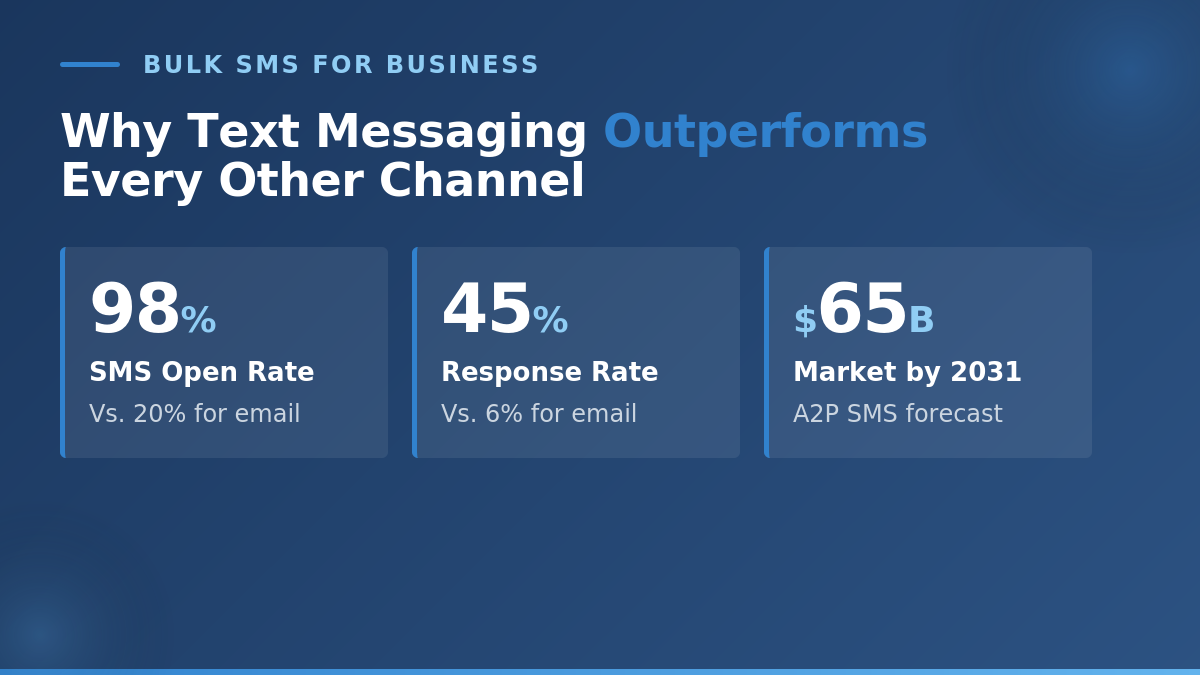
- The global A2P SMS market is projected to grow from $54.22 billion in 2026 to $65.05 billion by 2031, driven by transactional alerts, 2FA, and customer engagement.
- Text messages average a 98% open rate and 45% response rate, outpacing email’s benchmarks.
- Integrating SMS with SIP trunking consolidates voice and text on a single platform, reducing carrier overhead and simplifying compliance.
- 10DLC registration is now mandatory for any business sending application-to-person texts to U.S. mobile numbers from a standard long code.
If your customer outreach still relies on email alone, you’re leaving measurable revenue and engagement on the table.
Customer expectations have shifted toward instant, mobile-first communication, and businesses that fail to meet customers in the inbox they actually read are losing ground. According to Mordor Intelligence, application-to-person SMS remains firmly embedded in critical business workflows across financial services, healthcare, retail, and e-commerce, with cloud deployments and SME adoption driving steady expansion through 2031. For SMBs evaluating how to scale outbound communication without ballooning costs,bulk SMS solutions paired with VoIP infrastructure deliver an answer that traditional channels can’t match.
This guide explains what bulk SMS for business is, how it works on a technical level, how SIP trunking changes the equation, and where smart SMBs are deploying it today.
What Is Bulk SMS for Business?
Bulk SMS for business refers to sending the same text message to many recipients simultaneously, typically from an application or platform rather than a personal handset. The industry calls this application-to-person (A2P) messaging. It encompasses everything from order confirmations and shipping alerts to two-factor authentication codes and promotional campaigns.
The mechanics are simpler than they sound. Your business connects to a messaging gateway, uploads or pulls in a contact list, composes a message, and the gateway routes that message through wireless carriers to each recipient’s phone. The whole process can finish in seconds, even for tens of thousands of contacts.
How the Underlying Technology Works
A bulk messaging campaign moves through three layers: your business platform, the SMS gateway, and the mobile carriers. The gateway translates your message into a format carriers accept and selects the best route for delivery. For U.S. messaging, your originating number must be either a 10-digit long code (10DLC), a toll-free number, or a 5- to 6-digit short code. Each carries different throughput rates, regulatory requirements, and best-fit use cases.
You will also need a way to manage opt-ins and opt-outs at scale. Consent records, suppression lists, and audit trails are baseline requirements for any compliant program.
Why Bulk Messaging in Business Has Replaced Older Channels
Email open rates have declined as inbox fatigue grows. Phone calls go unanswered when the number is unfamiliar. Direct mail is slow and expensive. SMS sits in a different category entirely: messages average a 98% open rate, with a 45% response rate, according to the widely cited Gartner research. Most texts are read within minutes of delivery, which makes the channel uniquely suited to time-sensitive information. The economics of bulk messaging in business shift when speed-to-recipient becomes a measurable advantage rather than a nice-to-have.
Why Are SMS Business Solutions Growing So Fast?
Adoption of business texting has accelerated across nearly every industry vertical. According toFortune Business Insights, the enterprise A2P SMS market was valued at $55.79 billion in 2025 and is projected to reach $81.61 billion by 2034, reflecting how deeply embedded text messaging has become in customer engagement strategies. The driver behind that growth is that SMS produces measurable results.
Direct, Predictable Reach
You don’t need an app download, a data plan, or a smartphone for SMS to work. Any cellular device can receive a text. That universality matters when you need to reach a broad customer base without making assumptions about what platforms they use. It also means delivery is not at the mercy of changing social media algorithms or email spam filters.
Cost-Efficient at Scale
The per-message cost of bulk SMS is a fraction of a phone call or direct mail piece. When paired with a flexible communications backbone, the math gets even more favorable. Businesses can run promotional, transactional, and service messaging through the same infrastructure that handles their voice traffic, eliminating the need to maintain separate vendor relationships. This consolidation is one reason SMS business solutions have become a standard component of modern customer engagement stacks.
Higher Customer Satisfaction
Customers prefer texts for appointment reminders, order updates, and brief support exchanges. A short message that confirms a delivery window respects the customer’s time in a way that a phone call does not. That preference translates into better retention metrics for the businesses that meet it.
How Does SIP Trunk SMS Integration Work?
A SIP trunk replaces traditional phone lines with a virtual connection over your existing internet infrastructure. When that same trunk supports messaging, you gain a single, unified channel for both voice and text communication. Your business phone number becomes a complete customer engagement endpoint, not just a calling endpoint.

One Platform for Voice and Text
Combining SMS with SIP services means your team can send and receive texts from the same business numbers customers already call. You manage everything from one control panel, view call detail records and message history in one place, and bill through one vendor. The operational simplicity of SIP trunk SMS architecture is significant, especially for SMBs without dedicated telecom staff.
Lower Total Communications Cost
Routing voice and SMS through internet-based infrastructure cuts the per-channel cost compared to maintaining traditional phone lines plus a standalone SMS platform. You also avoid duplicating phone numbers across systems. The same DID that takes your inbound calls can send and receive customer texts, which simplifies caller ID consistency and customer recognition.
Easier Scaling and Compliance Management
When messaging volume grows, you can add capacity through your control panel without reprovisioning hardware. When a 10DLC campaign registration is required, you manage it within the same provider relationship. That continuity matters: every additional vendor in the chain adds friction during compliance audits and outage troubleshooting.
What Are the Top Use Cases for Bulk SMS for Business?
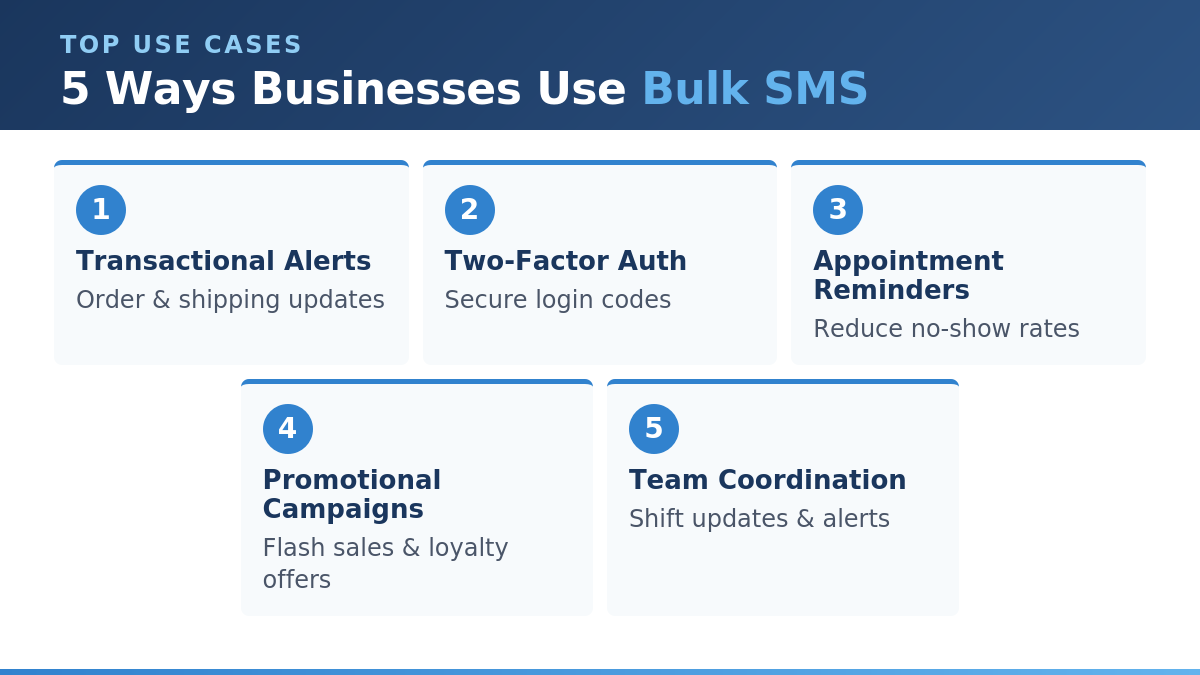
The strongest A2P programs tend to focus on a few high-value scenarios rather than broadcasting indiscriminately. Here are five proven applications where business texting integration consistently delivers return:
- Transactional alerts and notifications. Order confirmations, shipping updates, payment receipts, and account changes. Customers actively want these messages, which translates to near-universal open rates and minimal opt-outs.
- Two-factor authentication. SMS-delivered one-time passwords remain the most universally compatible authentication method, particularly for industries serving customers across a wide range of device generations.
- Appointment reminders. Healthcare, professional services, salons, and auto repair shops all see measurable reductions in no-show rates when reminders shift from phone calls to texts.
- Promotional campaigns. Flash sales, limited-time offers, and loyalty rewards perform well in SMS when carefully segmented and timed against customer purchase patterns.
- Internal team coordination. Field service technicians, drivers, and distributed teams use SMS for shift updates, dispatch coordination, and urgent alerts that need to bypass email entirely.
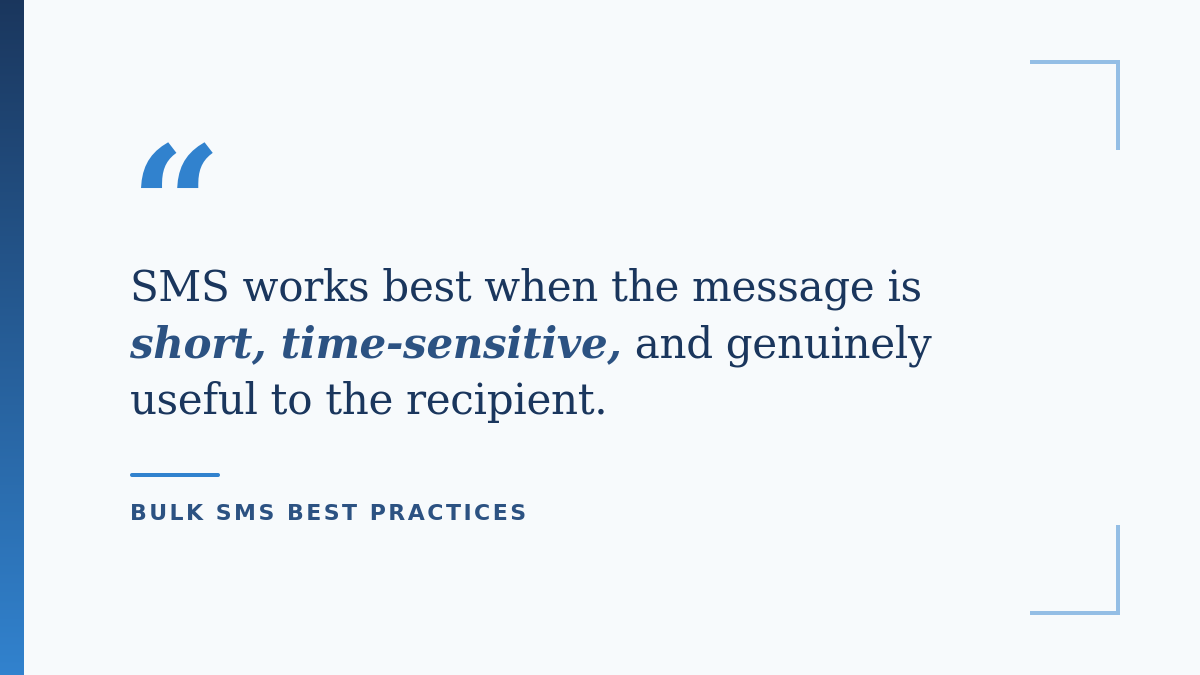
The unifying principle across all of these use cases is that SMS works best when the message is short, time-sensitive, and genuinely useful to the recipient.
How Do SMS Business Solutions Compare to Other Channels?
Most businesses don’t pick one channel and abandon the rest. The real question is where SMS fits within an existing communication mix. Email remains stronger for longer content, rich formatting, and nurture sequences. Phone calls still matter for complex conversations and high-trust interactions. Over-the-top messaging apps like WhatsApp work well in specific regions and verticals.
SMS occupies the immediacy slot. When you need to reach someone within minutes, when the message is short enough to fit a notification, or when the recipient may not be checking email, text wins. Smart operators layer SMS over their existing email and voice infrastructure rather than replacing them. The unified SIP-and-SMS approach is what makes that layering operationally simple.
For SMBs weighing whether to centralize communications, our breakdown of how a business SIP line consolidates voice and messaging provides a useful framework.
What Compliance Rules Apply to Business Texting Integration?
U.S. carriers now require 10DLC registration for any business sending A2P messages from a standard 10-digit number. That registration involves verifying your brand with The Campaign Registry and registering each specific use case as a campaign. Unregistered traffic is filtered, throttled, or blocked outright by major carriers.
Beyond 10DLC, the Telephone Consumer Protection Act (TCPA) governs how you obtain consent, what records you keep, and how you handle opt-out requests. Every successful business texting integration includes:
- Explicit opt-in from each recipient, with documented consent
- Clear identification of your business as the sender
- A simple opt-out mechanism (typically “Reply STOP”)
- Suppression list management that respects opt-outs immediately and permanently
These rules exist to protect consumers from spam, and they also protect legitimate senders by improving deliverability. Working with a provider that handles 10DLC submission as part of standard onboarding removes much of the friction. Pricing for messaging packages, 10DLC registration, and toll-free verification varies by volume, so it helps to map your projected message counts before selecting a plan.
For a fuller view of the infrastructure decisions that affect compliance, our comprehensive guide to SIP trunking walks through the broader architecture.
Get Started with Smarter Business Texting
Bulk SMS for business is a core component of how SMBs reach customers, confirm transactions, and coordinate teams. Pairing that capability with SIP trunking turns a standalone messaging channel into part of a unified communications platform, with predictable costs and a single point of management.
SIP.US delivers SMS-enabled DIDs, 10DLC support, and flexible business messaging packages alongside its SIP trunking service, all managed through one control panel. To see how integrated voice and text can simplify your operations, get started with your free trial today.
Frequently Asked Questions
What is the difference between bulk SMS and A2P messaging?
The terms are largely interchangeable. A2P (application-to-person) is the industry-standard term for messages sent from a software application to a person’s mobile device. Bulk SMS describes the same activity when it involves sending the same message to many recipients at once.
Do I need a separate platform for bulk SMS if I already use SIP trunking?
Not necessarily. SIP providers that offer SMS-enabled DIDs let you send and receive texts using the same numbers and infrastructure as your voice service. This consolidation reduces vendor overhead and simplifies billing.
What is 10DLC, and do I need to register?
10DLC stands for 10-digit long code. Any U.S. business sending A2P texts from a standard local number must register both their brand and their messaging campaigns with The Campaign Registry. Without registration, carriers will filter or block your messages.
How fast can I send bulk text messages?
Throughput depends on your number type and registration status. Registered 10DLC numbers generally support higher throughput than unregistered ones, short codes are reserved for very high-volume campaigns and require carrier approval, and toll-free numbers fall between the two. Your messaging provider can confirm the specific rates available on each option.
Can bulk SMS be used for two-way conversations?
Yes. Most business texting platforms support inbound and outbound messaging on the same number, which enables customer support exchanges, survey responses, and conversational commerce alongside outbound campaigns.

Mitch leads the Sales team at BCM One, overseeing revenue growth through cloud voice services across brands like SIPTRUNK, SIP.US, and Flowroute. With a focus on partner enablement and customer success, he helps businesses identify the right communication solutions within BCM One’s extensive portfolio. Mitch brings years of experience in channel sales and cloud-based telecom to every conversation.
Free SIP Trunk in 60 Seconds
Related Posts

What Is a DID Number? Direct Inward Dialing Explained
Unlock the potential of your communication system with our Beginner’s Guide to DID Numbers and SIP Trunks, offering cost-effective, scalable solutions for modern businesses and individuals.

What Is SIP? A Complete Guide to Session Initiation Protocol
Discover everything about SIP and how it revolutionizes communication. Learn what is SIP, its benefits, and how to implement it in your business for better connectivity.

What Is Internet Protocol? IP Definition and How It Works
Internet protocol is the addressing and routing system that gets every business call, email, and…