

5 Signs It’s Time to Switch to a SIP Trunk Provider
Your current phone system is costing you more than money. It’s costing you customers, productivity, and growth potential.
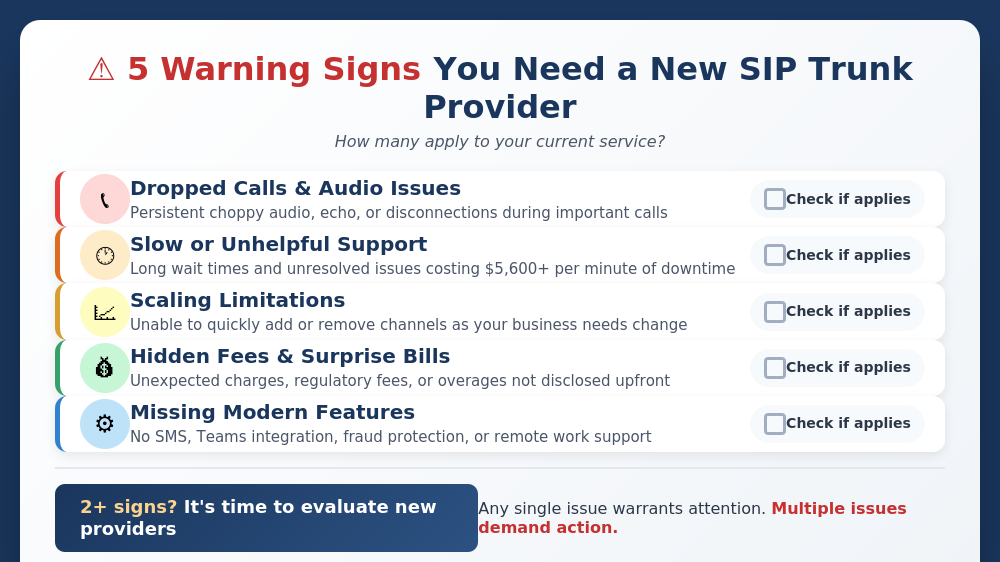
- Persistent dropped calls and audio quality issues signal infrastructure problems that your provider cannot resolve.
- Slow or unresponsive customer support creates unnecessary downtime during critical business hours.
- Inability to scale channels quickly means missed opportunities when your business expands.
- Hidden fees and unpredictable billing make accurate budgeting nearly impossible.
If two or more of these issues sound familiar, evaluating a new SIP trunk provider should move to the top of your priority list.
Every business owner knows that communication reliability directly impacts revenue. When customers can’t reach you or employees struggle with choppy calls, deals fall through and frustration mounts. The decision to modernize your phone system with a SIP trunk provider is one of the most impactful upgrades a small business can make, with organizations reporting cost reductions of 25–65% compared to traditional phone lines. Yet many businesses remain stuck with underperforming providers, tolerating problems that erode their competitive edge.
The SIP trunking market continues its expansion, reaching $73.14 billion in 2025 and projected to surge to $157 billion by 2030. However, the proliferation of providers means that quality varies. Understanding when your current service no longer meets your needs is essential for maintaining the reliable business VoIP communications your operations demand.
What Are the Warning Signs Your SIP Trunk Provider Is Failing You?
Before looking at specific indicators, consider the broader context. A SIP trunk provider should function as a silent partner in your success, delivering consistent service without requiring constant attention. When that relationship shifts and you find yourself regularly troubleshooting issues or fighting for support, something fundamental has broken.
The following five signs are the most common indicators that businesses experience before switching providers. Recognizing these patterns early allows you to proactively research alternatives rather than scrambling during a crisis.
Sign 1: Are Dropped Calls and Audio Issues Becoming Routine?
Voice quality problems are the most obvious sign that your current SIP trunk provider can’t deliver reliable service. While occasional technical hiccups occur with any technology, consistent issues point to deeper infrastructure problems.

Understanding What Causes VoIP Reliability Problems
Dropped calls during important conversations create immediate business impact. Clients form impressions based on every interaction, and technical difficulties project unprofessionalism regardless of fault. Common causes include insufficient bandwidth allocation by your provider, improperly configured network routing, and inadequate redundancy in their infrastructure.
Choppy audio, echo, and latency issues stem from similar root causes. When voice data packets arrive out of order or experience delays exceeding 150 milliseconds, conversations become difficult to follow. Quality providers invest heavily in Tier-1 network infrastructure and redundant systems specifically to prevent these problems.
When Technical Issues Signal Provider Limitations
Some VoIP reliability problems originate from your local network rather than your provider’s infrastructure. However, if you have addressed bandwidth concerns, enabled Quality of Service settings on your router, and still experience persistent issues, the problem likely resides upstream with your SIP trunk provider.
Consider keeping a log of call quality issues over a two-week period. Document the time, duration, and nature of each problem. This data proves valuable when evaluating whether issues are truly random or follow patterns suggesting systematic provider failures. Providers with robust systems offer real-time call data records that help diagnose problems quickly.
Sign 2: Is Customer Support Leaving You Stranded?
Technical problems become exponentially worse when support teams can’t promptly resolve them. Phone and network outages can cost businesses $5,600 for every minute systems remain offline. When your SIP trunk provider’s support team responds slowly, those costs accumulate rapidly. Evaluate your current provider’s support responsiveness honestly.

Measuring Support Quality Beyond Response Times
Initial response times tell only part of the story. A provider might answer your call quickly yet lack the technical expertise to diagnose complex issues. True support quality encompasses first-call resolution rates, access to knowledgeable technicians rather than script-reading agents, and availability during the hours your business actually operates.
Small businesses often feel deprioritized by large telecom companies. Enterprise clients receive dedicated account managers while smaller accounts route through general support queues with extended wait times. This tiered approach can leave growing businesses without adequate assistance during critical situations.
Red Flags in Provider Communication
Pay attention to how your provider communicates about ongoing issues and scheduled maintenance. Quality SIP trunk providers maintain transparent communication channels, providing advance notice of system updates and honest timelines during outages. Providers who minimize problems or deflect blame onto your equipment consistently demonstrate organizational cultures that deprioritize customer success.
The ability to reach technical support that understands SIP trunk configuration complexities separates adequate providers from exceptional ones. When evaluating alternatives, ask specifically about support team certifications and average resolution times for issues similar to those you have experienced.
Sign 3: Can Your Provider Scale When Your Business Grows?
Business communication needs fluctuate based on seasonality, growth initiatives, and market conditions. Your SIP trunk provider should accommodate these changes without friction.

The Hidden Costs of Inflexible Infrastructure
Traditional phone systems required physical line installations that took weeks and involved high costs. SIP trunking eliminates these constraints, yet some providers replicate the inflexibility through bureaucratic processes or technical limitations.
Warning signs include multi-day waits for additional channel provisioning, requirements for new contracts when scaling up, and the inability to scale down during slower periods. Modern SIP trunks for small businesses should allow instant adjustments through self-service portals rather than requiring support tickets for routine changes.
Evaluating True Scalability
Ask your current provider these questions: Can you add ten concurrent call channels today? What would that cost? Can you reduce those channels next month if needed? The answers reveal whether their infrastructure truly supports dynamic business needs or merely advertises scalability as a marketing term.
Businesses preparing to upgrade their phone system should prioritize providers offering control panels that enable real-time adjustments. The ability to manage channels, phone numbers, and routing configurations independently eliminates bottlenecks and reduces dependency on support teams for routine operations.
Sign 4: Are Hidden Fees Making Your Bills Unpredictable?
Cost transparency matters as much as the actual prices charged. Unexpected charges erode trust and complicate budgeting.
Common Billing Surprises to Watch For
Review your recent invoices carefully for charges beyond your expected monthly rate. Hidden fees often appear as regulatory recovery charges, number portability fees, early termination penalties, and per-minute overages on supposedly unlimited plans. While some regulatory fees are unavoidable, quality providers present them transparently during the sales process rather than burying them in fine print.
International calling is another area where billing surprises frequently occur. Providers may advertise competitive rates while applying surcharges that significantly increase actual costs. If your business regularly communicates with contacts outside the country, request a detailed rate schedule and compare it against your actual call patterns.
The Value of Predictable Pricing
The best business VoIP solutions offer straightforward pricing structures that align costs with usage. Per-channel monthly rates with unlimited domestic calling provide predictability that simplifies financial planning. Contract-free arrangements allow you to adjust services as needed without penalty, reflecting confidence in service quality rather than reliance on contractual lock-in.
When comparing providers, calculate total annual costs including all fees rather than focusing solely on advertised monthly rates. A seemingly cheaper provider may actually cost more once hidden charges accumulate over time.
Sign 5: Does Your Provider Support Modern Business Requirements?
Providers who fail to keep pace with technology leave their customers without access to capabilities that competitors leverage for advantage.
Essential Features for Today’s Businesses
Modern SIP trunk providers offer functionality beyond basic calling. Consider whether your current provider supports these essential capabilities:
- Business SMS: Text messaging has become a preferred communication channel for many customers. Providers should offer SMS capabilities integrated with your existing phone numbers.
- Microsoft Teams integration: Organizations using Microsoft 365 benefit from direct Teams connectivity that unifies collaboration and voice communications.
- Fraud protection: International toll fraud costs businesses millions annually. Real-time monitoring systems that detect suspicious calling patterns and automatically disable compromised accounts provide essential protection.
- Redundant infrastructure: Tier-1 network connections with geographic redundancy ensure continued operation even when individual network components fail.
- E911 compliance: Nomadic E911 capabilities allow remote workers to receive emergency services at their actual location rather than a central office address.
Assessing Future Readiness
Evaluate whether your provider actively develops new capabilities or merely maintains existing systems. Review their product announcements from the past year. Stagnant providers eventually become liabilities as their technology falls further behind market standards.
The shift toward hybrid work models has accelerated demand for advanced SIP trunking features that support distributed teams. Employees working from home need the same call quality and feature access as those in the office. Providers investing in modern infrastructure accommodate these requirements while legacy systems struggle to adapt.
What Should You Look for When Evaluating New Providers?
Once you have identified problems with your current service, selecting a replacement requires careful evaluation. Avoid repeating mistakes by thoroughly vetting potential providers.
Key Evaluation Criteria
The following factors deserve particular attention during your search:
Network infrastructure quality: Ask providers about their upstream carriers and redundancy configurations. Tier-1 network connections through multiple geographically distributed gateways indicate serious investment in reliability.
Self-service capabilities: Evaluate whether their control panel allows you to manage the functions most important to your business independently. Request a demonstration before committing.
Contract terms: Month-to-month arrangements demonstrate provider confidence in their service quality. Long-term contracts with hefty termination penalties protect the provider, not the customer.
Trial availability: Reputable providers offer risk-free trials that allow you to test service quality within your actual environment before committing.
Transparent pricing: Request a complete rate schedule, including all potential fees. Quality providers have nothing to hide.

Making the Transition Smooth
Switching to a new SIP trunk provider involves several practical considerations. Number porting allows you to retain existing business phone numbers, maintaining continuity for customers and marketing materials. The process typically takes one to two weeks, depending on your current provider’s cooperation.
Plan the transition to minimize disruption. Many businesses maintain parallel service briefly during migration, ensuring calls continue flowing even if technical issues arise during cutover. Providers experienced in SIP trunk migration can guide you through the process and help configure your PBX correctly.
Frequently Asked Questions
How long does it take to switch to a new SIP trunk provider?
The timeline varies depending on whether you need to port existing phone numbers. If you are starting fresh with new numbers, SIP trunks can be provisioned and operational within minutes. Number porting typically requires 5–14 business days, depending on your current carrier’s processes. Most businesses maintain overlapping services briefly to ensure a seamless transition.
Will switching providers disrupt my current phone service?
Proper planning minimizes disruption. Quality providers coordinate the cutover carefully, and number porting occurs at a scheduled time so you can prepare staff. Many businesses experience zero downtime when working with experienced providers who understand the technical requirements of migration.
Can I keep my existing phone numbers when switching?
Yes, number portability regulations allow you to transfer existing business phone numbers to a new provider. The process requires authorization from you and coordination between carriers. Your new provider should handle most of the paperwork and guide you through any steps requiring your direct involvement.
How do I know if problems are caused by my provider or my local network?
Start by testing with different devices and network connections. If problems persist across multiple phones and internet connections, the issue likely originates with your provider. Providers with robust diagnostic tools can help identify whether problems occur within their infrastructure or somewhere between their network and yours. Keeping detailed logs of issues helps during troubleshooting conversations.
Take Control of Your Business Communications
Poor phone service damages customer relationships, undermines professional credibility, and creates hidden costs through lost productivity. Recognizing when to switch PBX to SIP or change providers enables you to address these problems before they compound.
The signs outlined above represent patterns that precede most provider changes. Dropped calls erode customer confidence. Inadequate support extends downtime unnecessarily. Scaling limitations constrain growth. Hidden fees complicate planning. Outdated features handicap competitiveness. Any single issue warrants attention. Multiple issues demand action.
SIP.US provides the reliable, scalable, and transparently priced SIP trunking that small and medium businesses deserve. With instant provisioning, a powerful self-service control panel, no contracts, and a free trial including 60 minutes of calling, you can experience the difference quality service makes before committing. Get started today and discover why thousands of businesses trust SIP.US for their critical communications.

Mitch leads the Sales team at BCM One, overseeing revenue growth through cloud voice services across brands like SIPTRUNK, SIP.US, and Flowroute. With a focus on partner enablement and customer success, he helps businesses identify the right communication solutions within BCM One’s extensive portfolio. Mitch brings years of experience in channel sales and cloud-based telecom to every conversation.
Free SIP Trunk in 60 Seconds
Related Posts

What Is a DID Number? Direct Inward Dialing Explained
Unlock the potential of your communication system with our Beginner’s Guide to DID Numbers and SIP Trunks, offering cost-effective, scalable solutions for modern businesses and individuals.

What Is SIP? A Complete Guide to Session Initiation Protocol
Discover everything about SIP and how it revolutionizes communication. Learn what is SIP, its benefits, and how to implement it in your business for better connectivity.

What Is Internet Protocol? IP Definition and How It Works
Internet protocol is the addressing and routing system that gets every business call, email, and…