

The Ultimate SIP Provider Checklist for U.S. Businesses
Selecting the right SIP provider determines whether your business communications become a competitive advantage or a constant headache.
- The U.S. SIP trunking market is expanding, with businesses saving 25–65% compared to legacy phone lines.
- Compliance requirements, including STIR/SHAKEN, E911, and FCC registration, are non-negotiable for any legitimate provider.
- Network reliability, transparent pricing, and responsive support separate excellent providers from adequate ones.
- A thorough evaluation protects your investment and prevents costly migration mistakes down the road.
Take time to evaluate providers against the criteria in this checklist before signing any agreement.
Modernizing business communications has become essential as traditional phone infrastructure reaches end-of-life across the United States. The SIP trunking market continues to expand at impressive rates, withindustry research projecting growth from $73.14 billion in 2025 to $181.58 billion by 2031. American businesses are moving from expensive copper-based systems to flexible internet-based solutions.
For business owners and IT directors evaluating their options, the abundance of SIP provider USA choices creates both opportunity and complexity. Every provider claims superior service, competitive pricing, and enterprise-grade reliability. Distinguishing genuine capability from marketing claims requires a systematic evaluation that examines the factors most likely to affect your daily operations.
This checklist provides the framework you need to objectively evaluate potential SIP trunking providers. Whether you’re replacing aging PRI lines, expanding to new locations, or seeking better value from your telecom spend, these criteria will help you identify providers capable of meeting your requirements.
What Should You Prioritize When Evaluating a SIP Provider for USA Businesses?
Before examining individual features or comparing price quotes, clarify what matters most for your specific situation. A healthcare practice with HIPAA obligations faces different priorities than a retail operation with seasonal call volume spikes. A company with in-house IT expertise can handle more complex configurations than one relying entirely on provider support.
Start by documenting your current communication patterns. How many simultaneous calls does your business handle during peak periods? What percentage of calls are domestic versus those requiring specialized routing? Do you need integration with specific platforms like Microsoft Teams or existing CRM systems? Understanding these requirements prevents you from paying for capabilities you don’t need while ensuring critical features aren’t overlooked.
The most common mistake involves focusing exclusively on per-channel pricing while ignoring the total cost of ownership. A provider offering lower monthly rates but charging separately for E911, number porting, and regulatory compliance may cost more over time than one with higher base rates but inclusive pricing. Request detailed quotes that itemize all charges, then calculate annual costs based on your actual usage patterns.
How Do Compliance Requirements Affect Your SIP Provider Choice?
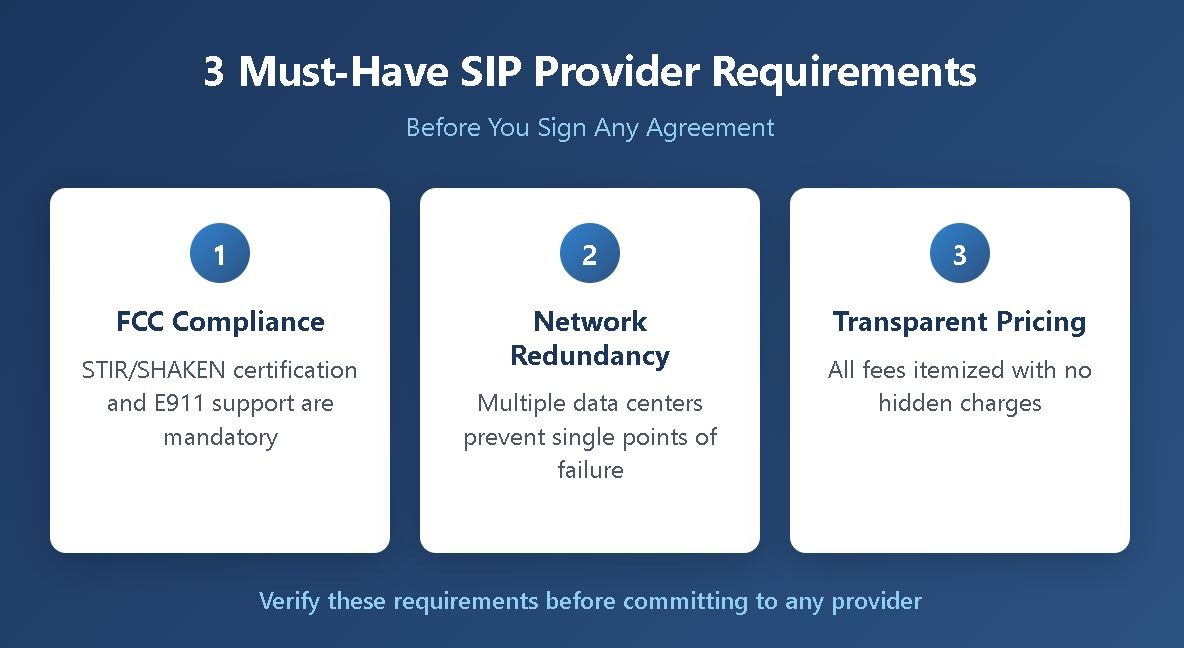
Regulatory compliance isn’t optional for VoIP for USA businesses. The Federal Communications Commission mandates specific SIP trunk compliance requirements that legitimate providers must meet, and partnering with a non-compliant service exposes your business to disruptions and potential liability.
STIR/SHAKEN compliance is the most significant recent regulatory change. This call authentication framework requires providers to verify caller identity and sign outbound calls with digital certificates. As of June 2025, enhanced FCC requirements require providers to maintain their own certificates rather than rely on third-party authentication services. Calls from non-compliant providers are increasingly being blocked or labeled as spam, directly affecting your ability to reach customers.
Emergency services compliance involves two distinct requirements. Kari’s Law mandates direct 911 dialing without requiring users to dial a prefix, while Ray Baum’s Act requires accurate location information transmission during emergency calls. The FCC provides specific guidance on E911 obligations for VoIP services. Your provider must support nomadic E911 that allows you to register accurate addresses for each location where calls might originate.
Beyond federal requirements, SIP providers serving U.S. businesses must register with the FCC using Form 499-A and maintain current registration status. This requirement applies regardless of provider size. Ask potential providers for documentation of their FCC registration and recent compliance certifications.
What Network Infrastructure Indicators Signal Reliability?
Network architecture determines call quality and service availability. Understanding the basic indicators helps you distinguish providers with robust infrastructure from those cutting corners to compete on price.
Tier-1 network relationships matter because they determine how your calls reach their destinations. Providers routing traffic through Tier-1 upstream carriers offer more direct paths to the public telephone network, reducing latency and improving voice quality. Ask providers about their carrier relationships and whether they maintain redundant connections through multiple upstream providers.
Geographic redundancy protects against localized outages. Quality providers operate SIP proxies in multiple data centers across different regions. If the primary server becomes unavailable, calls automatically route through secondary locations without user intervention. Single-point-of-failure architectures might offer lower prices but create unacceptable risk for businesses dependent on continuous phone availability.
Examine uptime guarantees carefully. Service Level Agreements (SLAs) should specify guaranteed uptime percentages and the remedies available when providers fail to meet commitments. A 99.99% uptime guarantee means different things depending on whether the provider offers service credits, bill adjustments, or no remedy at all for outages.
What Pricing Models Work Best for Different Business Types?
SIP trunk compliance with your budget requires understanding how different pricing structures align with your usage patterns. The three primary models serve distinct needs, and selecting the wrong approach wastes money or creates budget uncertainty.
Unlimited channel-based pricing charges a fixed monthly rate per concurrent call capacity. Businesses pay the same amount regardless of how many minutes they use, making this model ideal for organizations with consistent, moderate-to-high call volumes. When evaluating SIP trunking pricing, note that unlimited plans typically include domestic long-distance to the contiguous 48 states and Canada, eliminating separate per-minute charges for most business calls.
Metered pricing charges based on actual usage, typically ranging from fractions of a cent to a few cents per minute for domestic calls. This model benefits organizations with light or unpredictable calling patterns where paying for unused capacity wastes money. However, costs can spike unexpectedly during busy periods, complicating budget management.
Hybrid models offer flexibility by combining elements of both approaches. Some providers allow businesses to purchase base channel capacity at unlimited rates while paying per-minute for usage beyond that threshold. This setup provides predictability for typical operations while accommodating occasional spikes without requiring permanent capacity increases.
Beyond the base pricing model, examine ancillary charges that affect total cost. Setup fees, number porting costs, E911 charges, regulatory recovery fees, and charges for features like call recording or advanced analytics all contribute to monthly expenses. Transparent providers itemize these charges clearly rather than burying them in complex terms of service.
Top Criteria for Evaluating a SIP Provider USA
When comparing providers, evaluate each against these essential criteria:
- Technical compatibility: Verify support for your existing phone system or planned equipment. Quality providers maintain compatibility with major PBX platforms, including Asterisk, FreePBX, 3CX, and enterprise systems from Cisco, Avaya, and others. They should provide configuration documentation and technical support for your specific setup.
- Security infrastructure: Essential protections include TLS encryption for signaling traffic, SRTP for voice content, and advanced fraud detection systems that monitor for suspicious calling patterns. International toll fraud costs businesses billions annually, making automated protection a requirement rather than a luxury.
- Scalability: Your provider should accommodate growth without requiring contract renegotiation or infrastructure changes. Adding channels or phone numbers should happen instantly via a self-service portal, not through support tickets that require days of processing.
- Support responsiveness: When phone systems fail, business stops. Evaluate support availability, response time commitments, and the technical depth of support staff. Providers offering only email support or limited hours may prove inadequate during critical outages.
- Feature depth: Beyond basic calling, consider requirements for fax, SMS, call recording, detailed analytics, and integrations with business software. Understanding what SIP technology enables helps you identify which features matter for your operations.
- Industry-specific certifications: Depending on your sector, SIP trunk compliance includes frameworks like HIPAA for healthcare organizations, SOC 2 for businesses handling sensitive data, and PCI DSS for companies processing payment information. Ask providers for documentation of relevant certifications and audit reports. Providers serving regulated industries should demonstrate familiarity with your specific compliance obligations and offer features like encrypted call recording and secure data retention that support your audit requirements.
Your Complete SIP Provider Checklist
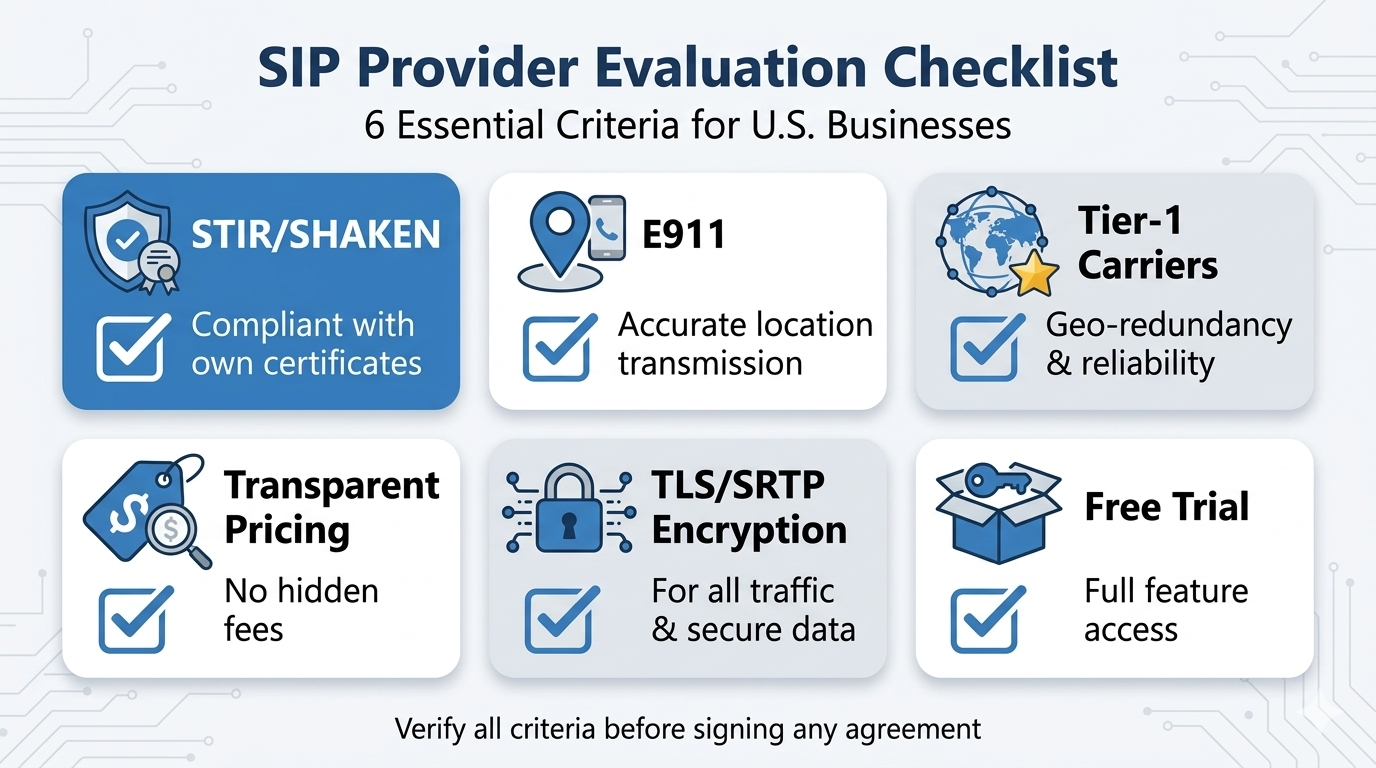
Use this SIP provider checklist during your evaluation. A provider unable to satisfy these requirements warrants additional scrutiny or elimination from consideration.
Compliance and Registration
- FCC Form 499-A registration is current and verifiable
- STIR/SHAKEN compliance with provider-owned certificates
- E911 support with accurate location transmission
- Robocall mitigation plan filed with the FCC database
Network and Reliability
- Tier-1 carrier relationships for voice routing
- Geographic redundancy with multiple data centers
- Documented uptime SLA with specific remedies
- Automatic failover capabilities for business continuity
Pricing and Contracts
- Clear itemization of all charges, including regulatory fees
- Flexible contract terms without excessive termination penalties
- Transparent international rates if needed
- No hidden fees for standard features like caller ID
Security and Fraud Protection
- TLS/SRTP encryption for all traffic
- Real-time fraud detection and automatic blocking
- Configurable spending limits and destination restrictions
- Regular security audits and compliance certifications
Technical Capabilities
- Compatibility with your PBX system is documented
- Number porting support with reasonable timelines
- Adequate codec options, including G.711 and G.729
- API access for custom integrations if needed
Support and Service
- Technical support available during your business hours
- Multiple contact methods, including phone and ticket systems
- Dedicated onboarding assistance for new customers
- Self-service portal for routine management tasks
Trial and Validation
- Free trial period with meaningful usage allowance
- Access to the full feature set during evaluation
- Technical support available during trial
- No credit card required for initial testing
Frequently Asked Questions
How many SIP channels does a typical U.S. business need? Channel requirements depend on your maximum concurrent calls, not total employees. A general guideline suggests one channel for every three to four phone-using employees in standard office environments. Sales teams, customer service departments, and other call-intensive operations require higher ratios. Most providers allow easy channel adjustments, so starting conservatively and scaling based on actual usage often proves practical.
What happens if my SIP provider experiences an outage? Properly configured SIP provider services include failover capabilities that route calls through backup systems or forward to alternative numbers during outages. Ask potential providers about their failover architecture and whether PSTN backup routing is available. Businesses with critical communication needs should configure secondary trunk assignments and regularly test failover procedures.
How long does porting phone numbers to a new SIP provider take? Number porting timelines vary based on the type of numbers and cooperation from your current provider. Local numbers typically port within 7–14 business days after submitting proper documentation. Providers should communicate realistic timelines upfront and handle the porting process on your behalf.
Are there compliance differences for SIP providers serving specific industries? Yes. Healthcare organizations must ensure HIPAA compliance for protected health information transmitted over voice systems. Financial services may face additional recording and retention requirements under regulations like MiFID II or Dodd-Frank.
Make an Informed Decision for Your Business Communications
Choosing a SIP provider USA businesses can rely on requires more than comparing advertised prices. The evaluation criteria covered in this checklist address the factors most likely to affect your experience: compliance standing, network reliability, pricing transparency, security capabilities, and support quality.
Take advantage of free trial periods to validate provider claims with hands-on testing. Configure your actual phone system, make calls to real destinations, and evaluate call quality under your network conditions. Test support responsiveness by submitting questions during the trial. These practical validations reveal more about provider quality than any marketing material.
SIP.US delivers the reliability, transparent pricing, and self-service control that American businesses need from their communication provider. With no contracts, instant provisioning, and a 60-minute free trial, you can validate our service before committing. Get started today and experience the difference a dedicated SIP trunking provider makes.

Mitch leads the Sales team at BCM One, overseeing revenue growth through cloud voice services across brands like SIPTRUNK, SIP.US, and Flowroute. With a focus on partner enablement and customer success, he helps businesses identify the right communication solutions within BCM One’s extensive portfolio. Mitch brings years of experience in channel sales and cloud-based telecom to every conversation.
Free SIP Trunk in 60 Seconds
Related Posts

What Is a DID Number? Direct Inward Dialing Explained
Unlock the potential of your communication system with our Beginner’s Guide to DID Numbers and SIP Trunks, offering cost-effective, scalable solutions for modern businesses and individuals.

What Is SIP? A Complete Guide to Session Initiation Protocol
Discover everything about SIP and how it revolutionizes communication. Learn what is SIP, its benefits, and how to implement it in your business for better connectivity.

What Is Internet Protocol? IP Definition and How It Works
Internet protocol is the addressing and routing system that gets every business call, email, and…