
What is a VoIP Number? How It Works + Business Use Cases
VoIP numbers deliver enterprise-grade calling features at a fraction of traditional phone costs, making them essential for modern businesses.
- The global VoIP market was valued at over $176 billion in 2025 and continues to grow as businesses abandon legacy phone systems.
- Companies switching to VoIP report cost savings up to 60% on communication expenses.
- Business VoIP numbers support remote work, integrate with CRM platforms, and scale instantly without hardware investments.
For small and mid-sized businesses seeking reliable, flexible phone service, a VoIP number is the most practical path forward.
Adopting new communication technology can determine whether a business thrives or struggles to keep pace with competitors. VoIP numbers have become the standard for organizations seeking flexibility, cost control, and professional-grade calling features. The global VoIP market reached $176.16 billion in 2025 and is projected to grow to nearly $389 billion by 2034, reflecting how quickly businesses are moving away from traditional phone infrastructure.
This shift is driven by lower costs, easier management, and the ability to support employees working from anywhere. Whether you run a growing startup, manage a call center, or oversee IT for a mid-sized company, understanding what a VoIP number is and how it works will help you make informed decisions about your communication infrastructure.
What Is a VoIP Number?
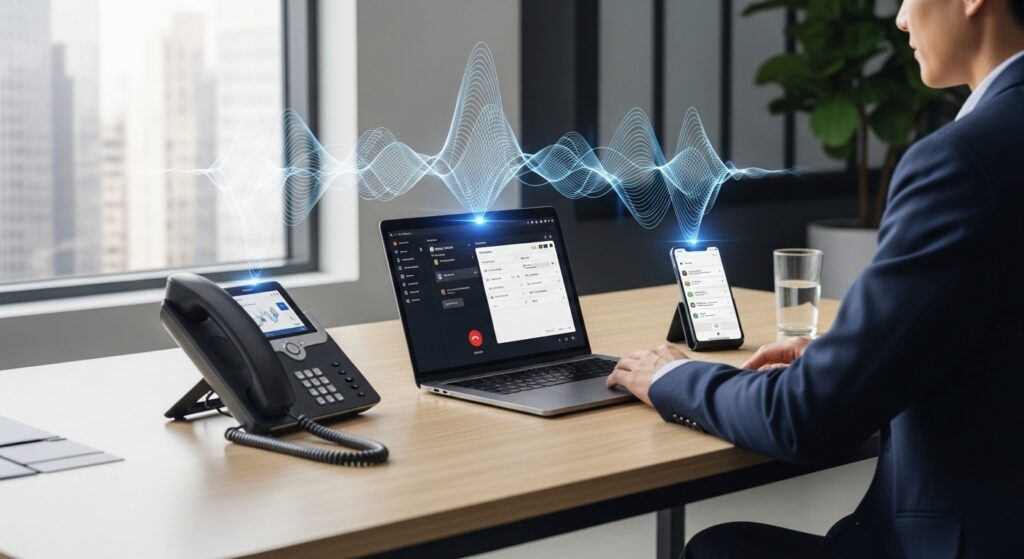
A VoIP number, short for Voice over Internet Protocol number, is a telephone number that transmits calls over the internet rather than through traditional copper phone lines. When someone dials your VoIP phone number, the call travels as digital data packets across your broadband connection instead of routing through the legacy public switched telephone network.

The technology behind VoIP numbers converts your voice into compressed digital signals that travel efficiently across internet connections. When the data reaches its destination, the system reassembles those packets into clear audio. This process happens instantaneously, making VoIP calls indistinguishable from traditional calls in terms of user experience.
Unlike landline numbers tied to physical addresses, a VoIP phone number is assigned to your business rather than to a specific location. You can answer business calls from your office desk phone, your laptop at home, or your smartphone while traveling. The number stays the same regardless of where you are or what device you use.
VoIP numbers look identical to regular phone numbers. Callers can’t tell whether they’re reaching a VoIP line or a traditional landline. Businesses maintain a professional image while benefiting from the flexibility and cost advantages that internet-based calling provides.
How Does a VoIP Number Work?
Understanding the technical process behind VoIP numbers helps explain why they have become so popular for business communications. The system relies on several coordinated steps that happen in milliseconds.
Voice Capture and Conversion
When you speak into a VoIP-enabled device, the microphone captures your voice as an analog audio signal. The system immediately converts this signal into digital data using audio codecs. The G.711 codec, commonly used for VoIP, delivers high-quality audio while consuming approximately 85 kbps of bandwidth per call.
Packet Transmission
Once digitized, your voice data gets broken into small packets, each containing a tiny portion of the conversation along with routing information. These packets travel across your internet connection through the most efficient available paths. Unlike traditional phone systems that maintain a dedicated circuit for each call, VoIP uses your existing bandwidth dynamically.
Reassembly and Delivery
At the receiving end, the packets are reassembled in the correct order and converted back into audio that the listener hears through their phone, headset, or speaker. Quality of Service (QoS) settings on your network can prioritize voice traffic to ensure clear calls even when other internet activities are happening simultaneously.

The entire process is managed by protocols like SIP (Session Initiation Protocol), which handles call setup, maintenance, and termination. SIP and VoIP work together to deliver the full calling experience that businesses depend on.
What Are the Different Types of VoIP Numbers?
Business VoIP numbers come in several varieties, each serving different purposes. Choosing the right type depends on your customer base, branding goals, and operational needs.
Local VoIP Numbers
Local numbers include area codes associated with specific geographic regions. A business in Chicago might use a 312 area code, while a company in Los Angeles could select a 213 prefix. The advantage of local VoIP numbers is that they build trust with customers who prefer doing business with companies that appear to be nearby. You can obtain local numbers for regions where you want to establish a presence, even if your physical office is elsewhere.
Toll-Free VoIP Numbers
Toll-free numbers (800, 888, 877, 866, 855, 844, 833 prefixes) allow customers to call your business without incurring long-distance charges. These numbers project a professional, established image and are valuable for customer service departments, sales teams, and any business that wants to remove barriers to customer contact. Toll-free VoIP numbers typically carry slightly higher monthly costs than local numbers.
Fixed vs. Non-Fixed VoIP Numbers
Fixed VoIP numbers are associated with a physical address and provide location verification. They work well for businesses that need E911 services tied to a specific location. Non-fixed VoIP numbers are not tied to any physical address, offering maximum flexibility for businesses with remote teams or employees who travel frequently. The trade-off is that some services may view non-fixed numbers with more scrutiny due to their use in certain fraud scenarios.
Vanity Numbers
Vanity numbers use memorable letter combinations that spell words related to your business, such as 1-800-FLOWERS. These numbers are excellent for marketing because customers remember them easily. Obtaining vanity numbers often requires working with specialized providers or porting existing numbers to your VoIP service.
What Are the Benefits of a Business VoIP Number?
Organizations that switch from traditional phone systems to VoIP consistently report multiple advantages that impact both their bottom line and daily operations.
Significant Cost Reduction
The financial case for VoIP numbers is compelling. Businesses switching to VoIP can save up to 60% on their communication expenses. These savings come from eliminating physical phone line rental fees, reducing long-distance charges, and consolidating voice and data onto a single network. A small business paying $50 per month per traditional phone line might pay $20 to $30 per VoIP channel for unlimited calling, with no long-distance fees for domestic calls.
Scalability Without Infrastructure Changes
Traditional phone systems require physical line installations when adding capacity. VoIP numbers eliminate this constraint. Need to add five new employees next month? Simply provision five additional extensions through your online control panel. Scaling down works the same way, making VoIP ideal for seasonal businesses or companies experiencing rapid growth.
Remote Work Enablement
The shift toward hybrid and remote work has made location-independent communication essential. VoIP systems support distributed teams by allowing employees to access their business phone numbers from any internet-connected device. A sales representative working from home uses the same business number and has access to the same features as colleagues in the office. Over 50% of remote-capable employees work in hybrid arrangements, making this flexibility a business necessity.
Advanced Features Included
VoIP phone numbers come with capabilities that traditional systems charge extra for or cannot provide at all. Standard features typically include call forwarding, voicemail-to-email transcription, auto-attendants, call recording, and detailed analytics. Many providers also offer CRM integration, which automatically displays customer information when calls come in.
Professional Image for Small Businesses
A virtual phone number within the USA allows even one-person operations to present a professional image. Auto-attendants greet callers with customized messages, call routing directs inquiries to the right department, and toll-free numbers suggest an established business presence. These features help small businesses compete with larger organizations.
Are There Disadvantages to VoIP Numbers?
While VoIP numbers offer substantial benefits, understanding their limitations helps you prepare for and mitigate potential challenges.
Internet Dependency
VoIP calls require a stable internet connection. If your broadband goes down, your phone service goes with it. However, modern VoIP providers address this concern through automatic failover features that route calls to mobile phones or backup numbers when primary connections fail. Business continuity solutions built into quality VoIP platforms minimize this risk.
Emergency Services Considerations
Traditional landlines automatically transmit location information to 911 dispatchers. VoIP numbers require separate E911 registration, where you manually enter your address into the system. If your team works from multiple locations, each location needs its own E911 registration. Reputable VoIP providers include nomadic E911 services that allow you to update your registered address whenever you move.
Call Quality Depends on Bandwidth
Poor internet connections can result in choppy audio, delays, or dropped calls. Businesses with inconsistent internet service may experience quality issues. The solution involves ensuring adequate bandwidth (approximately 85 kbps per concurrent call for standard quality) and configuring QoS settings to prioritize voice traffic on your network.
Learning Curve for Staff
Switching from familiar phone systems to VoIP requires some adjustment. Employees need to learn new interfaces, features, and potentially new hardware. Most staff adapt quickly, but planning for a brief training period helps ensure smooth adoption.
How Can You Get a VoIP Number for Your Business?
Obtaining a business VoIP number involves straightforward steps. The process typically takes less than an hour from start to making your first call.

Step 1: Assess Your Communication Needs
Before selecting a provider, evaluate your requirements. Consider how many concurrent calls your business handles during peak times, whether you need toll-free or local numbers, what features matter most (call recording, CRM integration, mobile apps), and whether you have existing phone numbers to port.
Step 2: Choose a VoIP Provider
Select a provider based on reliability, feature set, pricing transparency, and customer support. Look for providers offering free trials so you can test call quality and features before committing. Ensure the provider supports the PBX system you use or offers compatible hosted solutions.
Step 3: Verify Your Internet Connection
Test your internet connection to confirm it can handle your expected call volume. A basic speed test helps, but also consider whether your connection remains stable during peak usage hours. Most business internet connections easily support VoIP, but verification prevents surprises.
Step 4: Select Your Phone Numbers
Decide which types of numbers you need. You can buy VoIP numbers in specific area codes to establish local presence, obtain toll-free numbers for customer service, or port existing numbers to maintain continuity with customers who already know how to reach you.
Step 5: Configure Your System
Set up your account through the provider’s control panel. This step includes configuring user extensions, setting up voicemail, creating call routing rules, and establishing any auto-attendant menus. Most providers offer configuration guides and support to help with initial setup.
Step 6: Test Before Going Live
Make test calls to verify audio quality, ensure routing works correctly, and confirm that features function as expected. Testing with calls to mobile phones, landlines, and other VoIP numbers helps identify any issues before they affect customers.
What Are Common Business Use Cases for VoIP Numbers?
VoIP phone numbers serve organizations across industries, with specific applications depending on business needs.
Small Business Operations
Small businesses gain the most dramatic improvements when switching to VoIP. A five-person accounting firm can present the same professional phone presence as a large corporate office, with auto-attendants, departmental routing, and individual voicemail boxes. The cost savings allow small businesses to invest in growth rather than communication infrastructure.
Remote and Hybrid Teams
Companies with distributed workforces rely on VoIP to keep everyone connected. Team members access the same business phone system regardless of location, using desktop apps, mobile applications, or physical IP phones. Call transfers between remote and in-office staff work seamlessly, and customers never know whether they are reaching someone in headquarters or a home office.
Customer Service Departments
Call centers and customer service teams benefit from VoIP features designed for high-volume call handling. Intelligent routing directs calls to available agents, call recording supports quality assurance, and integration with ticketing systems provides agents with customer context before they answer. VoIP systems for small businesses include many of these same capabilities at accessible price points.
Multi-Location Businesses
Organizations with multiple offices use VoIP to unify communications across locations. A single phone system serves all sites, with extension dialing connecting employees regardless of physical location. Centralized management through web-based control panels simplifies administration and ensures consistent call handling across the organization.
Professional Services Firms
Law firms, consulting agencies, and financial advisors use VoIP to maintain client accessibility while protecting personal phone numbers. Professionals can receive business calls on their mobile devices without revealing personal contact information, and call recording provides documentation when needed.
Top Features to Look For in a Business VoIP Number
When evaluating VoIP providers, certain features deliver the most value for business users:
- Mobile Applications: Allow employees to make and receive business calls from smartphones while displaying the company number, essential for remote work and traveling staff
- Voicemail-to-Email: Transcribes voicemail messages and delivers them to email, enabling quick review and response without dialing into a voicemail system
- Auto-Attendant: Greets callers professionally and routes them to appropriate departments or individuals based on their selections
- Call Analytics: Provides data on call volume, peak times, call duration, and other metrics that inform staffing and operational decisions
- CRM Integration: Connects your phone system to customer relationship management software, displaying customer information during calls and logging call activity
- Call Recording: Captures conversations for training, quality assurance, and compliance documentation
- Failover Routing: Automatically redirects calls to backup numbers when primary connections fail, maintaining business continuity
- Number Portability: Allows you to keep existing phone numbers when switching providers, maintaining continuity for customers
Frequently Asked Questions
Can I keep my existing phone number when switching to VoIP?
Yes. Number portability allows you to transfer your current phone numbers to a VoIP provider. The process typically takes one to two weeks, during which your service continues uninterrupted. Your provider will guide you through submitting a port request and any documentation required by your current carrier.
How much bandwidth do VoIP calls require?
Each concurrent VoIP call requires approximately 85 kbps of upload and download bandwidth when using the G.711 codec. Compressed codecs like G.729 use less bandwidth at a slight reduction in audio quality. A standard business internet connection easily supports multiple simultaneous calls.
What equipment do I need to use a VoIP number?
At a minimum, you need a broadband internet connection and a device to make calls. This can be a traditional IP desk phone, a computer running softphone software, or a smartphone with your provider’s mobile app. Many businesses use a combination of all three options to provide flexibility for different work situations.
Is VoIP reliable enough for business use?
Modern VoIP systems achieve reliability comparable to or exceeding traditional phone service when properly implemented. Quality providers maintain redundant infrastructure with automatic failover capabilities. Reliability depends on your internet connection quality and your provider’s infrastructure investment.
How does E911 work with VoIP numbers?
VoIP providers offer E911 services that transmit your registered address to emergency dispatchers when you dial 911. You must manually register the physical address where you will use the VoIP number. If you work from multiple locations, update your E911 registration whenever you move to ensure emergency services can locate you accurately.
Take Control of Your Business Communications
VoIP numbers have transformed from a cost-cutting alternative into the foundation of modern business communication. The combination of lower costs, advanced features, and support for flexible work arrangements makes VoIP the logical choice for organizations of all sizes. The technology continues to evolve, with AI-powered features like real-time transcription and intelligent call routing becoming standard offerings.
SIP.US provides reliable SIP trunking services built around your operational needs. With fast setup, a powerful self-service control panel, and predictable pricing, we make it easy to implement professional-grade VoIP capabilities. Get started today with a free trial to experience the difference that modern communication infrastructure can make for your business.

Mitch leads the Sales team at BCM One, overseeing revenue growth through cloud voice services across brands like SIPTRUNK, SIP.US, and Flowroute. With a focus on partner enablement and customer success, he helps businesses identify the right communication solutions within BCM One’s extensive portfolio. Mitch brings years of experience in channel sales and cloud-based telecom to every conversation.
Free SIP Trunk in 60 Seconds
Related Posts

What Is a DID Number? Direct Inward Dialing Explained
Unlock the potential of your communication system with our Beginner’s Guide to DID Numbers and SIP Trunks, offering cost-effective, scalable solutions for modern businesses and individuals.

What Is SIP? A Complete Guide to Session Initiation Protocol
Discover everything about SIP and how it revolutionizes communication. Learn what is SIP, its benefits, and how to implement it in your business for better connectivity.

What Is Internet Protocol? IP Definition and How It Works
Internet protocol is the addressing and routing system that gets every business call, email, and…