

SIP Trunking vs VoIP: What’s the Difference and Which Should You Choose?
SIP trunking and VoIP are related technologies that serve different purposes in business communications.
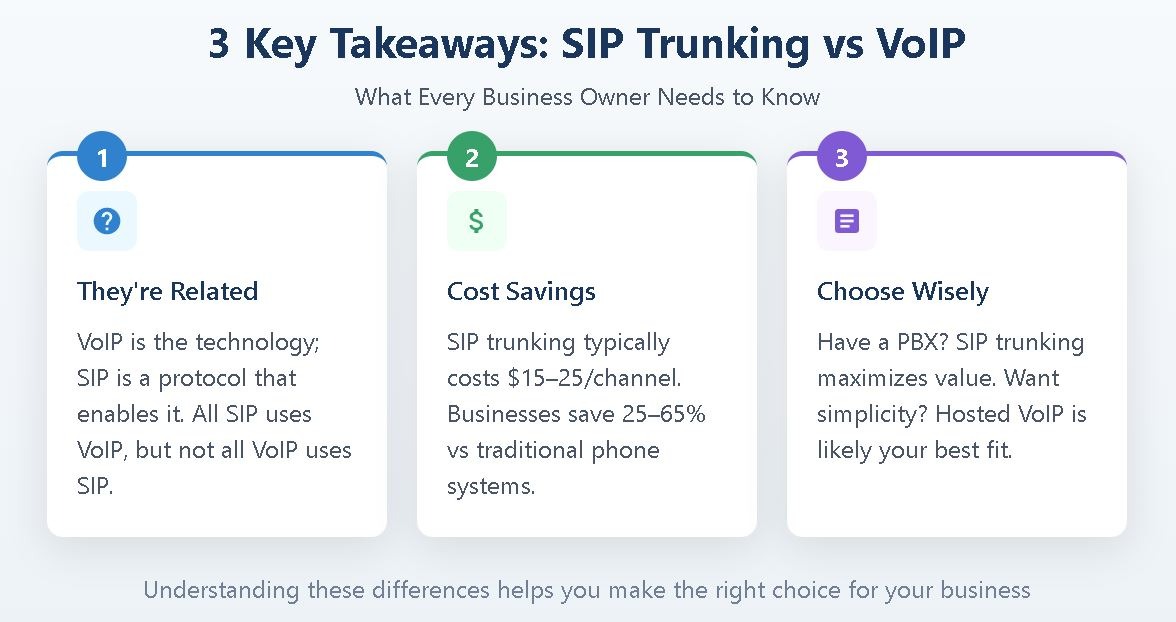
- VoIP (Voice over Internet Protocol) is the technology that enables voice calls over the internet instead of traditional phone lines.
- SIP trunking is a specific method that connects your existing phone system to the public telephone network using the SIP protocol.
- Businesses switching to SIP trunking report cost savings between 25% and 65% compared to traditional phone systems.
- The difference between VoIP and SIP comes down to scope: VoIP handles voice transmission while SIP manages the entire communication session.
If you already have a PBX system and want maximum control with multimedia capabilities, SIP trunking is likely your best choice. If you prefer a simpler, fully managed solution, hosted VoIP may be the better fit.
Business owners researching phone system upgrades often encounter the terms “SIP trunking” vs “VoIP” used interchangeably. While these technologies work together, understanding the difference between VoIP and SIP helps you make smarter decisions about your communication infrastructure. The SIP trunking market reached $85.07 billion in 2026 and continues growing at over 16% annually, reflecting how businesses are embracing internet-based communications for their flexibility and cost advantages.
This guide breaks down exactly what separates these technologies, compares their costs and capabilities, and helps you determine which approach makes sense for your business.
What Is VoIP and How Does It Work?
VoIP is the technology that converts your voice into digital data packets and transmits them over the internet rather than through traditional copper phone lines.
When you speak into a VoIP-enabled device, the technology captures your voice, compresses it into small data packets, and sends those packets across your internet connection. On the receiving end, the packets are reassembled and converted back into audio. This entire process happens in milliseconds, making conversations feel natural and immediate.
Hosted VoIP Explained
Hosted VoIP places all the infrastructure and management responsibility with a third-party provider. Your business simply connects devices to the internet and starts making calls. The provider handles servers, software updates, security patches, and system maintenance.
This approach works well for businesses that want predictable monthly costs without significant upfront investment. Small businesses with limited IT resources often appreciate that they can be operational within hours rather than weeks. The tradeoff is less customization and ongoing subscription fees that continue indefinitely.
On-Premise VoIP Systems
On-premise VoIP requires purchasing and maintaining your own equipment, including routers, servers, and PBX hardware. Your team manages all aspects of the phone system, from configuration to troubleshooting.
Larger organizations with dedicated IT staff often prefer this model because it provides complete control over their communication environment. Initial costs run higher, but long-term expenses may be lower for businesses with predictable, high-volume calling needs. Data stays entirely within your network, which appeals to businesses with strict security or compliance requirements.

How Is SIP Explained in Simple Terms?
SIP stands for Session Initiation Protocol. It’s the rulebook that governs how multimedia communication sessions start, proceed, and end. While VoIP specifically handles voice transmission, SIP manages the entire communication process, including signaling between devices, establishing connections, and coordinating different types of media.
SIP explained metaphorically is a sophisticated traffic controller for your communications. When you initiate a call, SIP sends an “invite” message to the recipient’s device. This message contains all the technical details needed to establish the connection, such as which audio formats to use and where to send the data. Once both parties agree on these parameters, the actual communication begins.
What makes SIP valuable for businesses is its versatility. The same protocol that handles your voice calls can also manage video conferences, instant messaging, and presence information showing whether colleagues are available. This unified approach simplifies communication infrastructure and reduces the complexity of managing multiple separate systems.
Why Does SIP Trunking Matter?
SIP trunking connects your business phone system to the public telephone network using the internet instead of physical phone lines. A SIP trunk acts as a virtual phone line that can carry multiple simultaneous calls through a single internet connection.
Traditional phone systems required dedicated copper lines for each concurrent call. A business needing capacity for ten simultaneous calls would need ten separate phone lines, each with its own monthly cost. SIP trunking eliminates this constraint by channeling all calls through your existing internet connection, with each “channel” representing capacity for one concurrent call.
How SIP Trunking Channels Work
Each SIP channel supports one incoming or outgoing call at a time. If your business typically has five employees on phone calls simultaneously, you need five channels. The beauty of this approach is instant scalability. Adding channels takes minutes rather than waiting for a technician to install new lines.
SIP trunks connect directly to your IP-PBX (Internet Protocol Private Branch Exchange), which manages call routing within your organization. This integration allows businesses to maintain their existing investments while modernizing their connection to the outside world. Companies using legacy PBX equipment can often add a SIP gateway device to enable SIP connectivity without replacing their entire phone infrastructure.
How Does the Difference Between VoIP and SIP Impact Your Business?
Understanding the VoIP vs SIP distinction helps clarify what each technology contributes to your communications:
VoIP is the capability that enables voice transmission over internet connections. SIP trunking is a method of delivering that capability while connecting your phone system to external networks.
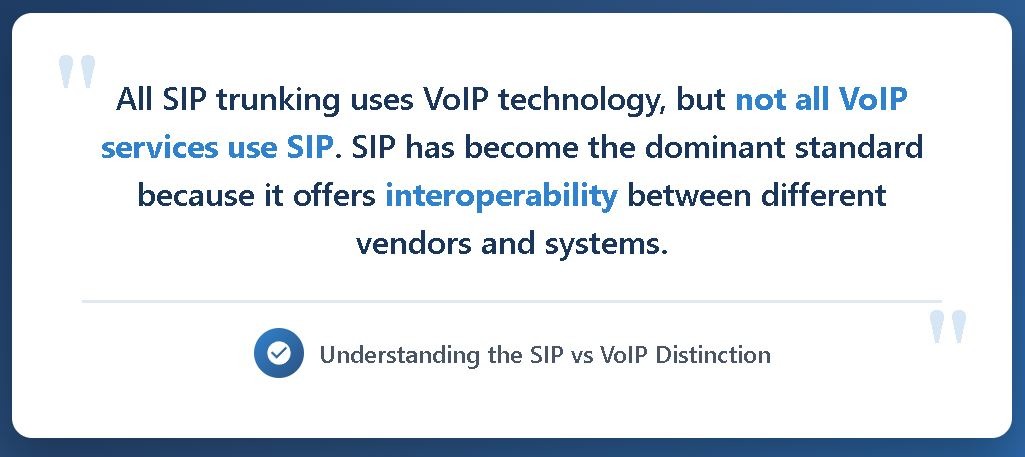
All SIP trunking uses VoIP technology, but not all VoIP services use SIP. Some VoIP providers use proprietary protocols that accomplish similar goals through different means. SIP has become the dominant standard because it offers interoperability between different vendors and systems.
SIP Trunking vs VoIP: Complete Feature Comparison
| Feature | SIP Trunking | Hosted VoIP |
| Infrastructure | Uses existing PBX system | Provider manages all hardware |
| Setup complexity | Moderate (requires PBX) | Low (plug and play) |
| Upfront costs | Lower if PBX exists | Minimal to none |
| Monthly costs | $15–25 per channel | $20–35 per user |
| Scalability | Add/remove channels instantly | Add/remove users easily |
| Control level | High (you manage PBX) | Low (provider manages) |
| Customization | Extensive | Limited |
| Multimedia support | Voice, video, messaging | Primarily voice |
| Best for | Businesses with existing PBX | Businesses wanting simplicity |
This comparison reveals why choosing between SIP trunking and hosted VoIP often depends on your existing infrastructure and operational preferences rather than one option being universally superior.
What Does SIP Trunking vs VoIP Cost?
Cost comparisons between SIP trunking and VoIP require understanding the pricing models each technology uses.
SIP Trunking Pricing Models
Unlimited channel pricing charges a flat monthly rate per channel regardless of usage. Rates typically range from $15 to $25 per channel monthly, including unlimited calling to the United States and Canada. Businesses with consistent, high call volumes benefit most from this predictable expense structure.
Metered pricing charges based on actual minutes used, typically $0.005 to $0.02 per minute for domestic calls. This model suits businesses with variable or seasonal calling patterns where paying per minute costs less than maintaining unused channel capacity.
Per-DID pricing adds costs for each phone number (Direct Inward Dial) your business uses, usually $1 to $3 monthly per number. Enhanced features like E911 services add $1.50 to $3 per number.
Hosted VoIP Pricing Models
Hosted VoIP typically charges per user rather than per channel. Monthly costs range from $20 to $35 per user for basic plans, with advanced features pushing prices toward $50 or higher per user. These fees generally include the phone system software, maintenance, and a bundle of features.
Real-World Cost Example
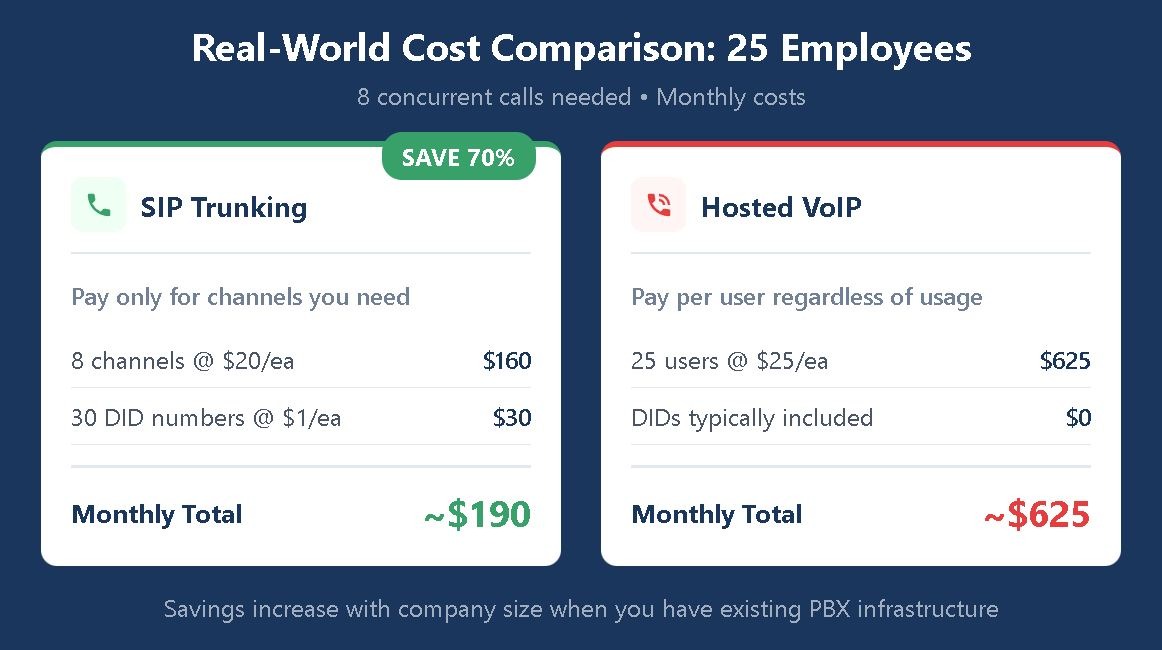
Consider a business with 25 employees where 8 people are typically on calls simultaneously:
SIP Trunking scenario:
- 8 unlimited channels at $20 each: $160/month
- 30 DID numbers at $1 each: $30/month
- Total: approximately $190/month
Hosted VoIP scenario:
- 25 users at $25 each: $625/month
- Total: approximately $625/month
This example illustrates why businesses with existing PBX systems often find SIP trunking more economical. The cost advantage grows with company size and decreases if you need to purchase PBX equipment.
What Are the Key Benefits of SIP Trunking Over Traditional Phone Lines?
Organizations switching from traditional phone services to SIP trunking consistently report several advantages that justify the transition.
Significant cost reduction stands out as the primary driver. Traditional PRI (Primary Rate Interface) lines cost $400 to $600 monthly for 23 channels. SIP trunking delivers equivalent capacity for roughly $250 to $350 monthly while eliminating long-distance charges that traditional services assess separately.
Instant scalability addresses one of the biggest frustrations with legacy phone systems. Adding capacity no longer means scheduling installation appointments and waiting days or weeks. Businesses can add channels within minutes through online portals and remove them just as quickly when demand decreases.
Geographic flexibility enables businesses to obtain local phone numbers in any area code without physical presence. A company headquartered in one city can establish local numbers in markets across the country, making it easier for customers to reach them without long-distance concerns.
Business continuity improvements come from SIP trunking’s ability to route calls to backup locations or mobile devices when primary systems fail. Traditional phone lines tied to physical locations become useless during power outages or disasters. SIP calls can automatically failover to keep your business accessible.
Unified communications integration allows SIP to handle voice, video, messaging, and presence through a single protocol. This consolidation simplifies management and enables features that weren’t possible with separate systems for each communication type.
5 Questions to Determine Whether SIP Trunking vs VoIP Fits Your Business
Answering these questions helps clarify which technology aligns with your situation:
- Do you already have a PBX system? If yes, SIP trunking lets you leverage that investment. If not, hosted VoIP avoids the need to purchase one.
- How important is customization? SIP trunking with an on-premise PBX offers extensive control. Hosted VoIP provides standardized features that work for most businesses but limit unique configurations.
- What’s your IT capacity? Managing a PBX requires technical expertise. Hosted VoIP shifts that responsibility to your provider, which benefits businesses without a dedicated IT staff.
- Do you need multimedia capabilities? SIP trunking inherently supports video, messaging, and other media types. Basic VoIP services may only handle voice calls.
- How predictable is your call volume? Steady, high-volume calling favors unlimited SIP trunking plans. Variable volumes might benefit from metered VoIP options.
What Security Considerations Apply to SIP Trunking vs VoIP?
Both technologies transmit communications over the internet, introducing security considerations that traditional phone lines didn’t present.
SIP trunking security starts with your network infrastructure. Session Border Controllers (SBCs) serve as specialized firewalls designed for SIP traffic. These devices inspect packets, authenticate users, and prevent common attacks like toll fraud, where hackers hijack your phone system to make expensive international calls.
Encryption protects call content from eavesdropping. Transport Layer Security (TLS) encrypts signaling information, while Secure Real-time Transport Protocol (SRTP) encrypts the actual voice data. Quality providers offer both encryption methods as standard features rather than premium add-ons.
Hosted VoIP providers manage security on your behalf, which can be either an advantage or a concern depending on your perspective. Reputable providers invest heavily in security infrastructure and maintain compliance certifications. However, you’re trusting them with your communication data and depending on their practices to meet your standards.
Toll fraud protection deserves particular attention. Sophisticated providers monitor calling patterns in real time, automatically detecting and blocking suspicious activity. This protection prevents situations where compromised systems generate thousands of dollars in fraudulent international calls before anyone notices.
How Do SIP Phones Differ From Standard VoIP Phones?
The terms “SIP phone” and “VoIP phone” are often used interchangeably, but technical differences exist.
VoIP phones transmit voice over internet connections using various protocols. A VoIP phone might use SIP, proprietary protocols, or other standards depending on its design and the system it connects to.
SIP phones specifically use the Session Initiation Protocol and can typically work with any SIP-compliant system. This interoperability means you’re not locked into a single vendor’s ecosystem. A SIP phone purchased today can work with different providers in the future without replacing hardware.
SIP-enabled devices extend beyond traditional desk phones. Softphones turn computers and smartphones into fully functional business phones. Conference room systems, intercoms, and specialized devices like emergency notification systems can all participate in your SIP communication environment.
Frequently Asked Questions
Can I use SIP trunking without a PBX?
SIP trunking traditionally requires a PBX to route calls within your organization. However, some providers offer cloud-based PBX functionality that eliminates the need for on-premise equipment while still using SIP trunking for external connectivity. This hybrid approach combines SIP trunking benefits with hosted PBX convenience.
Is SIP trunking more reliable than traditional phone lines?
SIP trunking reliability depends heavily on your internet connection and provider infrastructure. Quality providers maintain redundant connections and multiple data centers to prevent outages. Many businesses find SIP trunking more reliable because calls can automatically route to backup locations when problems occur, something traditional phone lines can’t do.
What bandwidth do I need for SIP trunking?
Each concurrent call requires approximately 85–100 Kbps of bandwidth when using the standard G.711 codec. The G.729 codec reduces this requirement to about 30 Kbps per call but may slightly affect audio quality. A business expecting ten simultaneous calls should ensure at least 1 Mbps of dedicated bandwidth for voice traffic, though most modern internet connections easily exceed this requirement.
Can I keep my existing phone numbers when switching to SIP?
Yes. Number portability allows businesses to transfer existing phone numbers to a SIP trunking provider. The porting process typically takes 5 to 15 business days, depending on the current carrier and number type. Toll-free numbers generally port faster than local numbers.
What happens to my phone service if the internet goes down?
Quality SIP trunking providers offer failover options that automatically redirect calls to backup numbers, cell phones, or secondary locations during internet outages. Configuring these failover routes in advance ensures your business remains reachable even when primary systems are unavailable.
Make the Right Choice for Your Business Communications
The SIP trunking vs VoIP decision ultimately depends on your existing infrastructure, technical capabilities, and business priorities. Both technologies deliver clear advantages over traditional phone systems through cost savings, flexibility, and advanced features.
Businesses with established PBX systems typically benefit most from SIP trunking’s cost efficiency and control. Organizations prioritizing simplicity over customization often find hosted VoIP’s managed approach more appealing. Many businesses use both, implementing SIP trunking for primary locations while using hosted VoIP for remote workers or smaller offices.
SIP.US provides straightforward SIP trunking solutions designed for businesses ready to modernize their communications. With instant provisioning, transparent pricing, and no long-term contracts, you can test whether SIP trunking fits your needs without major commitments. Get started with a free trial that includes 60 minutes of calling to experience the difference quality SIP service makes.

Mitch leads the Sales team at BCM One, overseeing revenue growth through cloud voice services across brands like SIPTRUNK, SIP.US, and Flowroute. With a focus on partner enablement and customer success, he helps businesses identify the right communication solutions within BCM One’s extensive portfolio. Mitch brings years of experience in channel sales and cloud-based telecom to every conversation.
Free SIP Trunk in 60 Seconds
Related Posts

Voice over IP Services Explained: Everything You Need to Know
Learn everything about voice over IP VoIP services: benefits, drawbacks, setup, and top features. Modernize communications efficiently!

SIP Trunking Pricing Explained: What You’re Really Paying For
Your business phone bill doesn’t have to be a mystery. SIP trunking pricing typically ranges…

The 5 Best PBX Systems for Your Business in 2026
The business PBX market has transformed, with AI-powered features and cloud deployment becoming standard rather…