

What is VoIP? A Complete Guide to Voice Over IP for Business
Voice over Internet Protocol (VoIP) is a technology that transmits phone calls as digital data over an internet connection instead of traditional copper telephone lines.
- VoIP converts your voice into digital data packets, routes them across an IP network, and reassembles them at the receiving end for clear, real-time conversation.
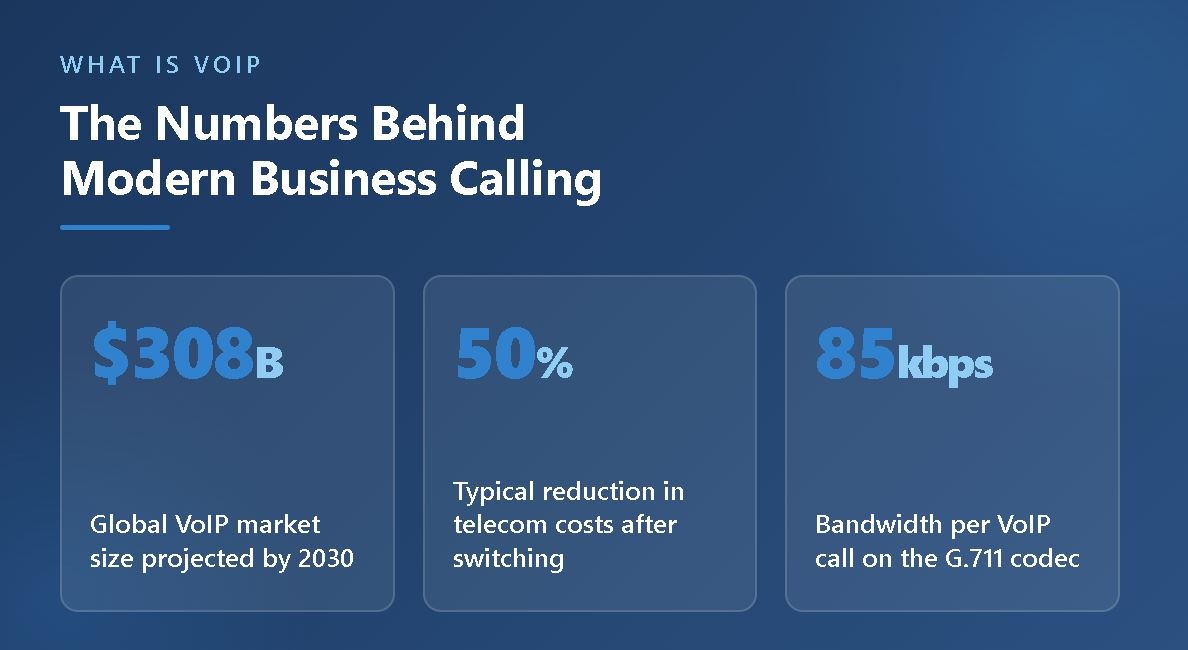
- Businesses switching from legacy phone services can reduce telecommunications costs by up to 50%, with many eliminating long-distance fees entirely.
- A VoIP phone system supports remote work, scales on demand, and adds features like call routing, voicemail-to-email, and video conferencing without new hardware.
- The global VoIP market is projected to grow to $308.41 billion by 2030, reflecting how thoroughly internet-based calling has replaced legacy telephony.
If your business still depends on PRIs or copper lines, evaluating a VoIP phone system is one of the best moves you can make this year.
Modern businesses need communication that travels with their teams, integrates with their software, and costs a fraction of what legacy phone service charges. That requirement is exactly why people are asking, “What is VoIP?” The technology delivers on all three. Adoption has accelerated as cloud-first infrastructure becomes the default for organizations of every size. According to Mordor Intelligence, the VoIP services market is projected to grow from $172.49 billion in 2025 to $308.41 billion by 2030, driven by hybrid work, cloud PBX adoption, and the steady retirement of copper-based telephone networks.
This guide explains what VoIP is, how it works, the components that make up a business VoIP phone system, real-world scenarios where it outperforms traditional service, and what to look for when choosing a provider.
What Is VoIP, and How Does It Work?
The VoIP meaning is straightforward: Voice over Internet Protocol is a method of placing and receiving phone calls using an internet connection rather than the Public Switched Telephone Network (PSTN). When you speak into a VoIP-enabled device, your voice is captured, compressed into small digital packets, and transmitted across an IP network. At the destination, those packets are reassembled into audio so the person on the other end hears your voice in real time.
The voice over IP definition has not changed much technically since the protocol matured in the early 2000s, but the surrounding infrastructure has. Faster broadband, better codecs, and carrier-grade redundancy mean today’s VoIP phone service delivers audio quality that meets or exceeds traditional landlines.
The Core Building Blocks of a VoIP System
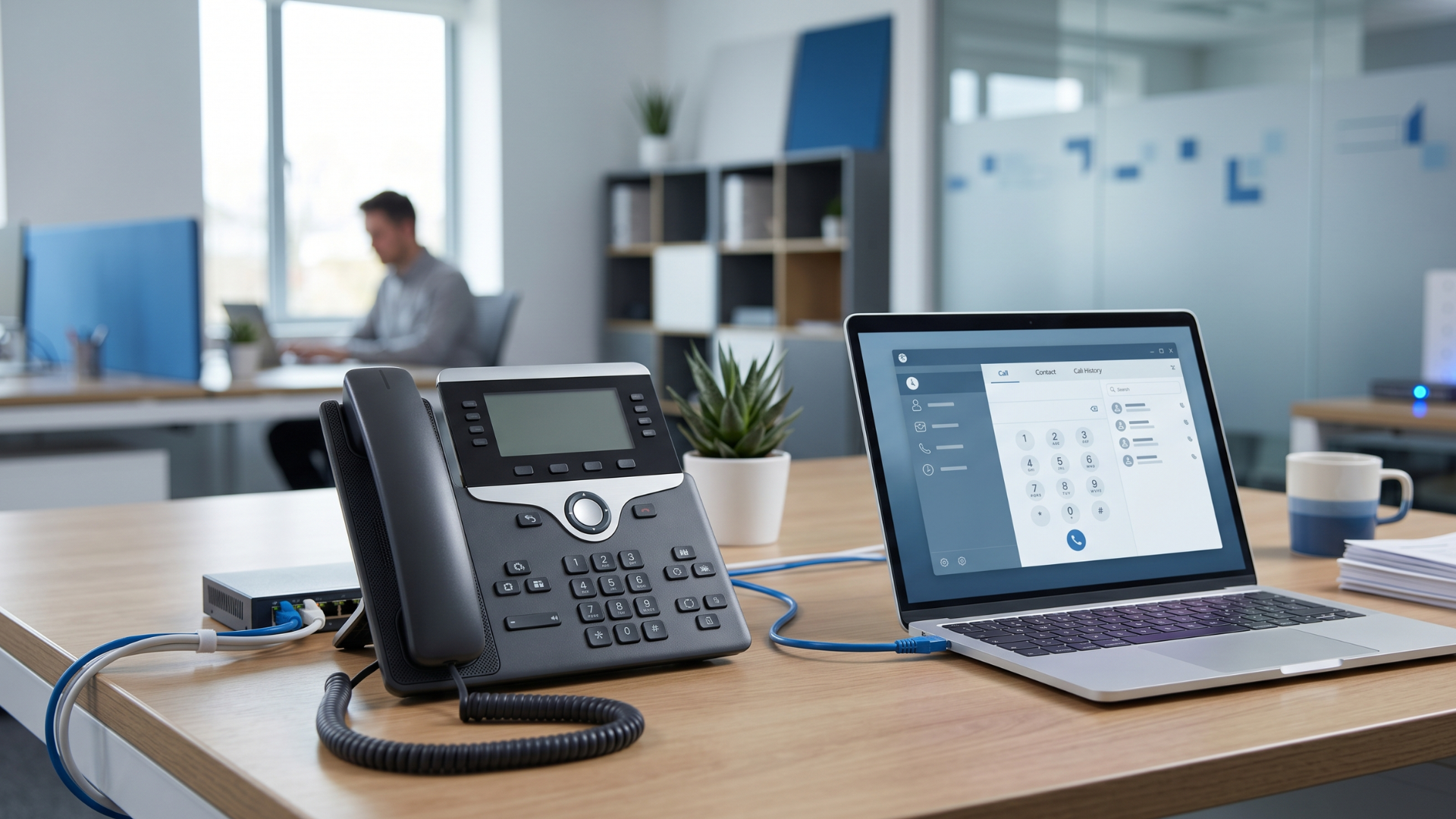
A functioning VoIP phone system relies on several components working together. The endpoint device is what the user interacts with, which might be an IP desk phone, a softphone application on a laptop, or a mobile app. Behind that endpoint sits an IP-PBX or hosted PBX that manages call routing, extensions, voicemail, and advanced features. Connecting the PBX to the outside world is a SIP trunk, the virtual circuit that carries voice traffic between your phone system and the public telephone network. Each component is software-defined, which is why VoIP scales so much faster than hardware-bound legacy systems.
You can read a deeper breakdown of how SIP cal ling works and the role it plays in modern business communications.
How VoIP Differs from Traditional Phone Service
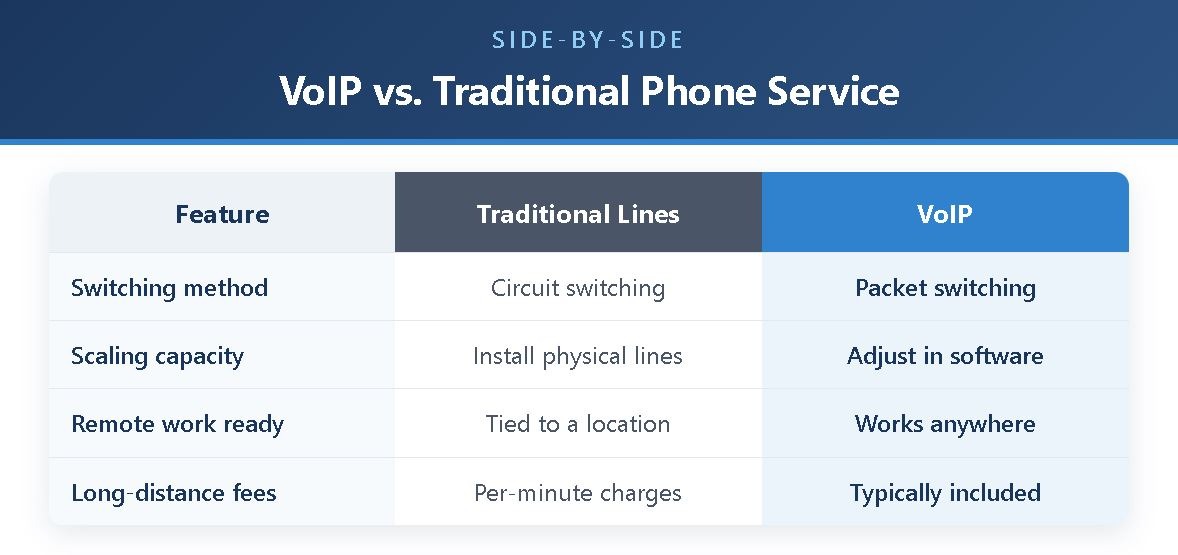
Traditional telephone service uses circuit switching, which dedicates a physical pathway between two callers for the duration of a call. VoIP uses packet switching, which sends voice data along the most efficient path at that moment. The result is lower overhead, no per-minute charges for most domestic calls, and the ability to add capacity by adjusting a software setting rather than installing physical lines. Calls also become device-agnostic, so the same business number can ring a desk phone, a laptop softphone, and a mobile app simultaneously.
Why Are Businesses Adopting VoIP Phone Systems?
A 2024 survey found that 87% of startups use VoIP or are planning to adopt the technology. That share is climbing as hybrid work becomes permanent and copper networks are phased out across the United States. The reasons fall into three broad categories: cost, flexibility, and feature depth.
Cost Reductions That Are Worth It
Businesses switching from PRIs or analog lines to a VoIP phone system see meaningful savings on monthly telecom expenses. The savings come from eliminating dedicated copper lines, removing the maintenance burden on expensive on-premise PBX hardware, predictable per-channel pricing, and abolishing separate long-distance carriers. For a 25-person company, the multi-year savings often run into the tens of thousands of dollars without any reduction in call quality or features.
Flexibility Built for Modern Workforces
Because VoIP runs on your existing internet connection, your phone system is no longer tied to a building. Employees working from home, satellite offices, or the road can all place and receive calls using the same business number. Scaling up for a hiring push or scaling down after a seasonal peak takes minutes through an online portal, not weeks of vendor coordination. This flexibility is one of the main reasons business VoIP has displaced legacy systems so rapidly, especially among small and mid-sized companies that can’t afford months of downtime during a phone system change.
Advanced Features Without Extra Hardware
A modern VoIP phone system comes with features that would have required dedicated appliances on a legacy PBX. Call forwarding, auto-attendants, voicemail-to-email, call recording, real-time analytics, video conferencing, and CRM integrations are typically included or available as add-ons. You can review the full feature set on a business VoIP platform to see how it compares to your current phone bill line by line.
What Is SIP Trunking, and How Does It Fit Into VoIP?
VoIP is the broader technology that enables voice communication over the internet, while SIP trunking is the specific delivery method that connects your phone system to the public telephone network. If you have an IP-PBX (or a legacy PBX paired with a SIP gateway), SIP trunking is how that PBX reaches the outside world without copper lines.
Why Most Business VoIP Setups Use SIP Trunking
Session Initiation Protocol gives businesses precise control over voice, video, and messaging sessions. Unlike fully hosted VoIP services that bundle everything together, SIP trunking lets you keep your existing PBX investment, choose your own internet provider, and add or remove channels as call volume changes. This control matters for organizations that want predictable per-channel pricing and the freedom to scale capacity without renegotiating with a managed service provider. For a closer look at the distinction, see this guide to the differences between SIP trunking and VoIP.
Compatibility with Existing PBX Infrastructure
One of the strongest practical advantages of SIP trunking is that it works with both modern and legacy hardware. Businesses running Asterisk, FreePBX, 3CX, Cisco, Avaya, or any other SIP-enabled IP-PBX can connect a SIP trunk in minutes. Organizations still using analog phones can deploy an analog telephone adapter (ATA) to bridge the gap. The result is a path to modernize voice communications without scrapping the equipment that already works.
What Is VoIP Used for in Real-World Business Use Cases?
Understanding what VoIP does on paper is one thing. Seeing where it actually moves the needle is what makes the decision concrete. Below are common scenarios where a VoIP phone system delivers measurable improvements over traditional service.
- Distributed support teams. A SaaS company with agents in five time zones routes inbound calls to whichever team is on shift, using a single business number and softphone apps on agent laptops. No physical PBX, no copper, no per-seat hardware cost.
- Multi-location retail or healthcare. A regional clinic group with 12 offices unifies all locations under one VoIP phone system, transfers calls between sites instantly, and pulls call analytics into a single dashboard.
- Seasonal businesses. A landscaping or tax preparation firm doubles its SIP channels for peak season and scales back down the next quarter, paying only for the capacity it actually uses.
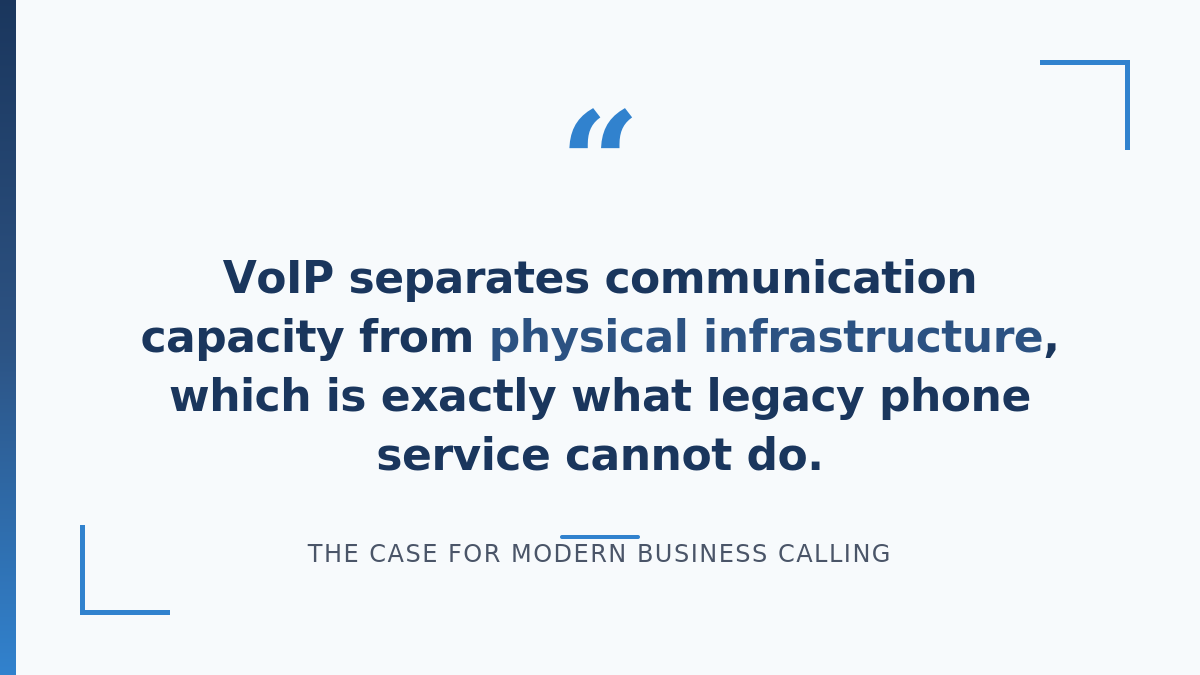
The common thread is that VoIP separates communication capacity from physical infrastructure, whereas legacy phone service cannot.
Replacing Aging PRI Lines
Many mid-sized businesses still operate on PRIs that were installed a decade or more ago. As carriers retire copper and PRI infrastructure, the choice becomes either upgrading to newer (and more expensive) legacy circuits or migrating to SIP trunking. The migration path usually delivers significant savings while preserving the existing PBX investment.
Supporting Remote and Hybrid Teams
Hybrid work has made geography irrelevant to communications. With a VoIP phone system, the same business extension follows an employee from the office to a home setup to a hotel room. Calls, voicemail, and messages stay in one place regardless of which device the employee is using. For companies that have committed to flexible work, VoIP is essential.
Connecting Microsoft Teams and Other Collaboration Platforms
Many businesses already use Microsoft Teams for messaging and meetings but still pay separately for traditional phone service. SIP trunking allows you to connect a VoIP phone system directly to Teams (or other unified communications platforms), giving employees enterprise voice within the tools they already use. The result is fewer vendors, one bill, and a consolidated communication stack.
How Do You Choose the Right VoIP Provider?
Selecting a provider is as much about operational fit as it is about price. Once you understand what VoIP is and how SIP trunking enables it, the evaluation criteria become much clearer. A good place to start is this decision guide for cloud SIP providers, which walks through the tradeoffs in detail.
Network Reliability and Redundancy
Look for providers that operate on Tier-1 upstream carriers with multiple geographic gateways. Redundant SIP proxies and automatic failover routing are essential for businesses that cannot tolerate dropped calls or outages. Ask specifically about uptime, failover behavior during network disruptions, and how the provider handles inbound DID routing if a primary PBX goes offline.
Transparent, Predictable Pricing
VoIP pricing should be straightforward. Per-channel unlimited plans with no setup fees, no contracts, and the ability to add or remove capacity in your control panel give you the most flexibility. Beware of providers that obscure costs with bundled features you don’t need or contracts that lock you in for years. Reviewing transparent SIP trunking pricing is a good benchmark for what to expect.
Self-Service Management and Support
The best providers give you a real-time control panel for managing trunks, DIDs, call routing, and billing. You should be able to add a phone number, change failover settings, or pull call detail records without filing a support ticket. At the same time, responsive technical support should be available when you need help with PBX configuration or troubleshooting.
Compatibility with Your Existing Setup
Confirm the provider supports your current PBX or SIP-compliant device, whether that’s 3CX, FreePBX, Asterisk, Cisco, Avaya, or another platform. For legacy analog systems, verify the provider supports ATAs. A good VoIP provider should make integration straightforward rather than forcing you into a proprietary ecosystem.
What Are the Most Common Questions About VoIP?
Is VoIP reliable enough for a business phone system?
Yes, when paired with a stable broadband connection and a reputable provider. Modern VoIP phone systems use redundant carriers and intelligent failover routing to maintain service even during network disruptions. Call quality typically matches or exceeds traditional landlines.
What internet speed do you need for VoIP?
Each concurrent VoIP call using the G.711 codec consumes roughly 85 kbps of upstream and downstream bandwidth. A standard broadband connection supports dozens of simultaneous calls without strain. Enabling Quality of Service (QoS) on your router prioritizes voice traffic during periods of heavy data usage.
Can you keep your existing phone numbers when switching to VoIP?
Yes. Number porting allows businesses to move existing phone numbers from a previous carrier to a new VoIP provider, typically with no disruption to service. Most providers handle the porting paperwork on your behalf.
Does VoIP work with old analog phones?
It can. An analog telephone adapter (ATA) converts SIP signals to analog, allowing legacy phones or even older PBX systems to connect to a modern VoIP phone system. This is a practical option for businesses that want to modernize without replacing every device.
How quickly can you set up VoIP?
Most providers offer near-instant provisioning. Once you sign up and configure your PBX or device, you can typically place calls within minutes. Some providers offer free trials so you can validate quality and compatibility before committing.
Ready to Move Your Communications to VoIP?
The modern answer to “What is VoIP?” is that it’s the default standard for business phone systems because it delivers lower costs, better flexibility, and richer features than any legacy alternative. Whether your priority is supporting hybrid teams, replacing aging PRIs, or connecting Microsoft Teams to the public phone network, a properly configured VoIP phone system gives you the foundation to do it.
SIP.US provides business-grade SIP trunking with transparent per-channel pricing, no contracts, instant provisioning, and full compatibility with the major IP-PBX platforms. The self-service control panel lets you manage trunks, numbers, and call routing without waiting for support tickets. Start your free trial and see how quickly your business communications can move to the cloud.

Mitch leads the Sales team at BCM One, overseeing revenue growth through cloud voice services across brands like SIPTRUNK, SIP.US, and Flowroute. With a focus on partner enablement and customer success, he helps businesses identify the right communication solutions within BCM One’s extensive portfolio. Mitch brings years of experience in channel sales and cloud-based telecom to every conversation.
Free SIP Trunk in 60 Seconds
Related Posts

What Is a DID Number? Direct Inward Dialing Explained
Unlock the potential of your communication system with our Beginner’s Guide to DID Numbers and SIP Trunks, offering cost-effective, scalable solutions for modern businesses and individuals.
What Is SIP? A Complete Guide to Session Initiation Protocol
Discover everything about SIP and how it revolutionizes communication. Learn what is SIP, its benefits, and how to implement it in your business for better connectivity.

What Is Internet Protocol? IP Definition and How It Works
Internet protocol is the addressing and routing system that gets every business call, email, and…