
Which Business VoIP Phone Systems Are Best?
The right business VoIP phone system depends on how much control, scalability, and cost savings your company needs, not on which provider tops a generic ranking.
- Business VoIP phone systems route calls over your internet connection, replacing copper lines and rigid PRIs with flexible, software-defined infrastructure.
- Deployment model matters more than brand: hosted cloud PBX, SIP trunking with your own PBX, and all-in-one UCaaS platforms each suit different needs.
- AI features like real-time transcription, smart call routing, and automated call summaries are becoming standard buyer expectations.
- Reliability, scalability, security, integrations, and transparent pricing should drive your decision more than long feature lists alone.
Map your current infrastructure and growth plans first, then choose the deployment model that gives you the most control for the lowest predictable cost.
Voice over Internet Protocol has become the default for company communications, and business VoIP phone systems now anchor how organizations of every size connect with customers and teams. These systems send calls over a broadband connection instead of legacy copper lines, which lowers costs and unlocks features traditional landlines can’t match. Demand reflects that shift. The global VoIP market is projected to reach $388.97 billion by 2034 at a 10.4% compound annual growth rate.
If you’re weighing an upgrade, the goal isn’t to find a single “best” provider. It’s to match the right system to how your business actually operates. Below, you’ll find how these systems work, how today’s options compare, what to evaluate, and where AI fits in.
What Are Business VoIP Phone Systems?
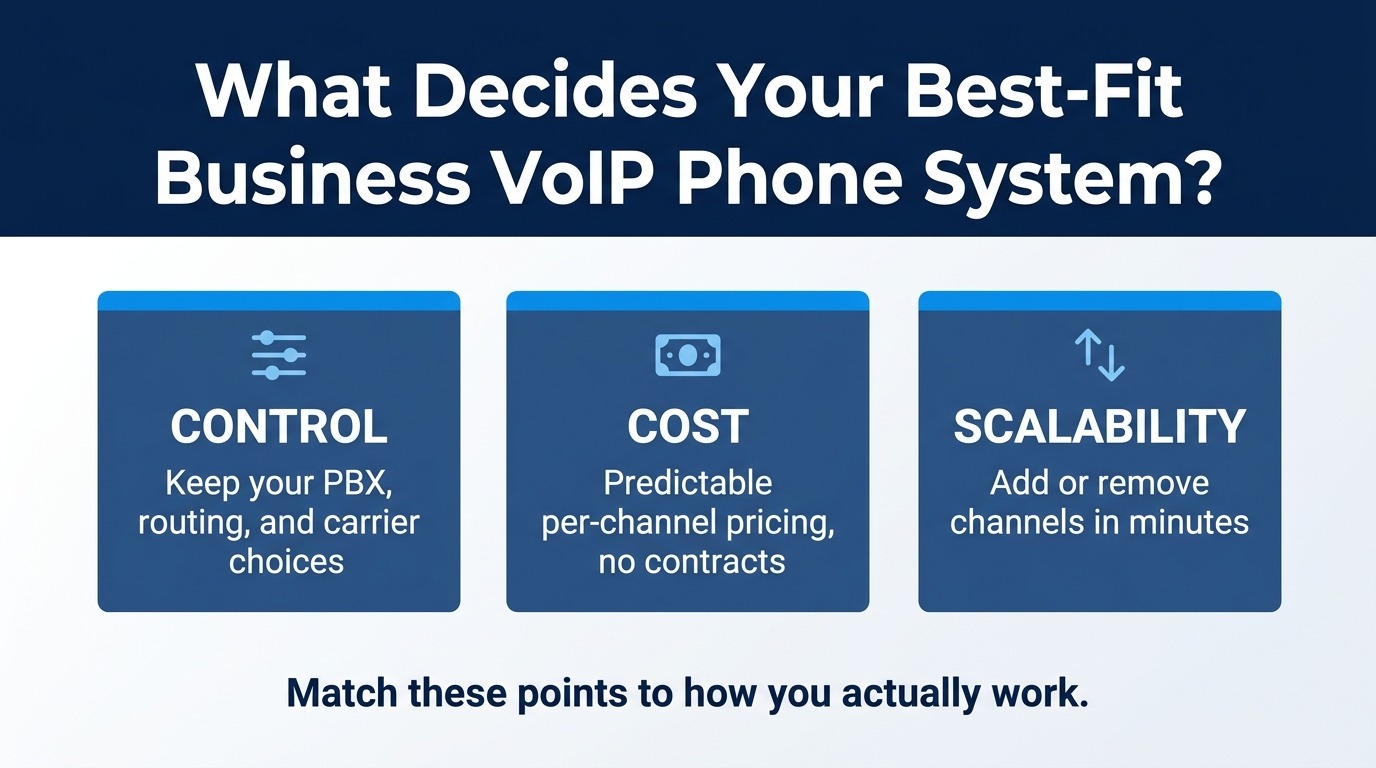
A modern business VoIP phone system delivers calls to employees through your IP data network rather than the public switched telephone network. It typically combines an endpoint (a desk phone, a softphone app, or a mobile app), a PBX or hosted platform that manages routing and features, and a connection to the outside phone network. Because each piece is software-defined, these systems scale and adapt far faster than hardware-bound landlines.
How Do VoIP Phone Systems Work?
When you speak into a VoIP-enabled device, the system converts your voice into digital packets, sends them across the internet, and reassembles them as audio at the other end. The Federal Communications Commission defines VoIP as technology that lets you place calls using a broadband connection instead of a regular phone line. That single change, moving voice onto the data network, enables remote work, instant scaling, and advanced call management. For a deeper technical breakdown, our guide to the difference between SIP and VoIP explains how the underlying protocol fits in.
Why Are Businesses Replacing Traditional Phone Lines?
Carriers are actively retiring copper infrastructure, and many companies now face a forced upgrade as legacy lines reach end of life. Beyond that pressure, internet-based calling simply costs less and does more, which is why business VoIP phone systems have become the practical default. A side-by-side look at VoIP vs traditional phone systems shows the gap across cost, scalability, and features. Traditional lines hold a narrow edge only where internet connectivity is unreliable, and even that advantage shrinks as broadband expands.
How Do Today’s Business VoIP Providers Compare?
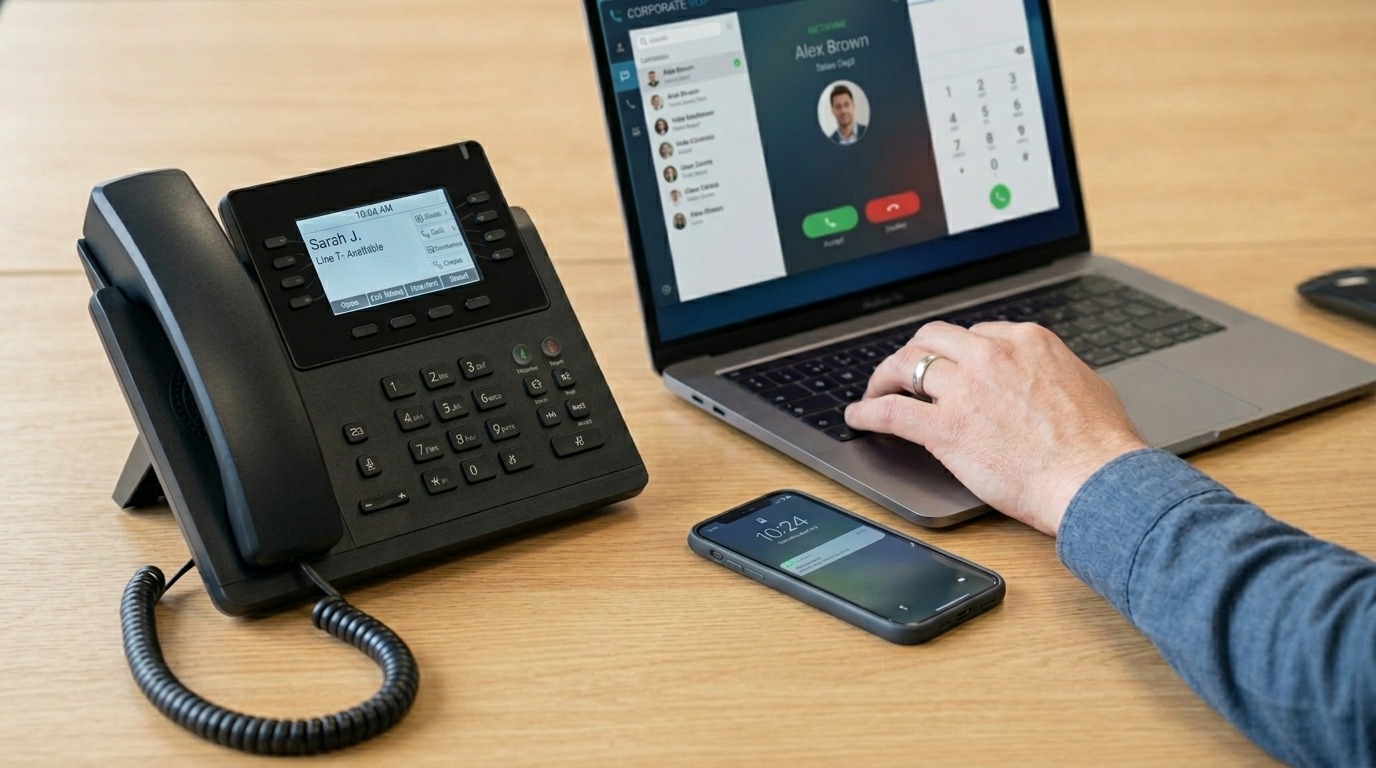
The most useful comparison is between deployment models rather than brand names. The model you choose shapes your costs, control, and day-to-day management more than any single feature does. Most business VoIP providers fall into one of three approaches, and the right fit depends on whether you already own PBX hardware and how much you want to manage yourself.
Hosted Cloud PBX vs. SIP Trunking: Which Model Fits?
A hosted cloud PBX replaces your phone system entirely with a provider-managed platform. You get simplicity and minimal maintenance, but less control and a higher per-user cost as you grow. SIP trunking takes a different path. It connects your existing PBX to the phone network over the internet, so you keep your hardware, your routing rules, and lower per-channel pricing. Our overview of how SIP trunking works walks through the setup and where it delivers the strongest savings.
What About All-in-One UCaaS Platforms?
Unified Communications as a Service (UCaaS) bundles voice, video, messaging, and collaboration into one subscription. These platforms appeal to teams that want everything in a single app and don’t mind paying a per-seat premium for the convenience. The trade-off is flexibility, since bundled suites can tie you to one provider’s ecosystem and pricing. Businesses that already run a capable PBX, or that want to control their own bandwidth and carrier choices, often find SIP trunking delivers the same modern features at a lower, more predictable cost than bundled business phone systems.
What Should You Look for in Small Business Phone Systems?
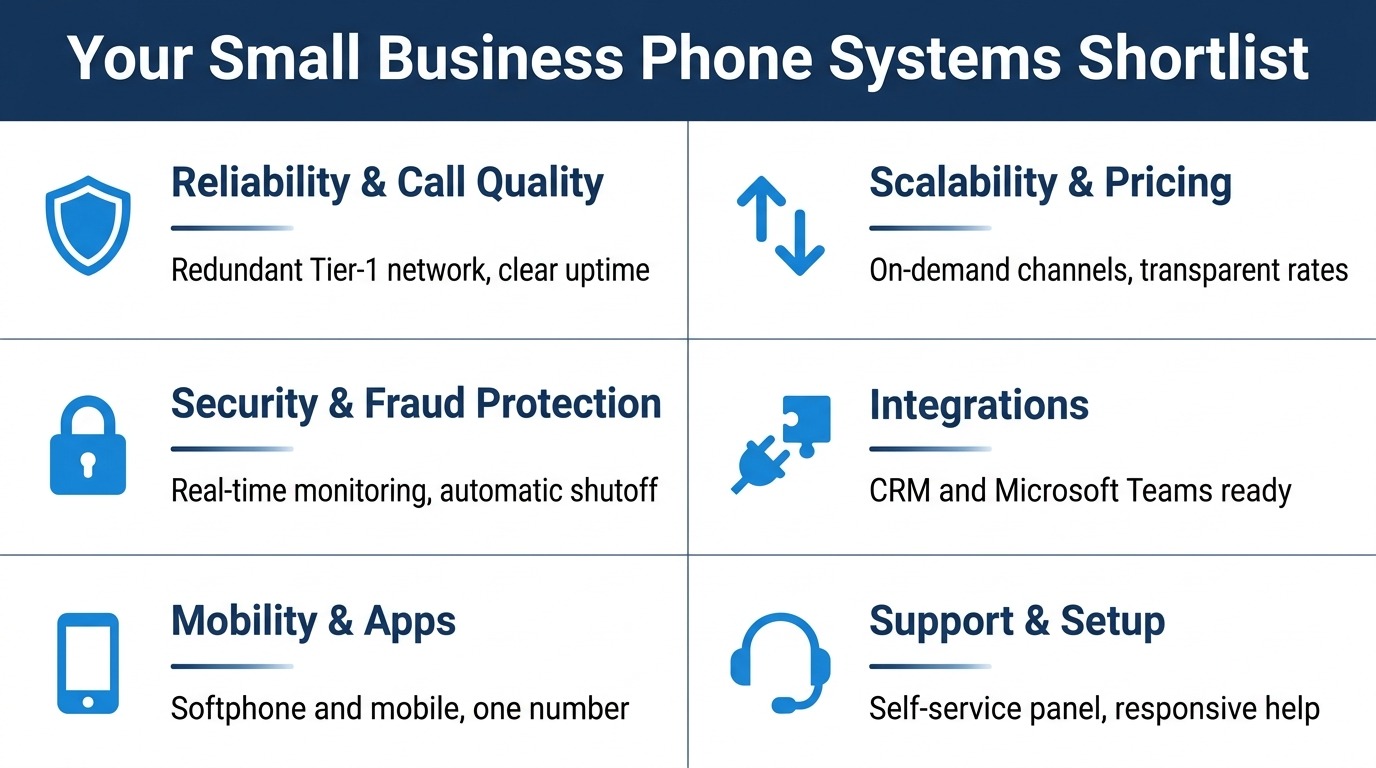
Once you’ve settled on a deployment model, the provider you choose still matters. The strongest small business phone systems share a consistent set of qualities, and evaluating them in an apples-to-apples way keeps you from overpaying for features you won’t use. Use these criteria as your shortlist when comparing options:
- Reliability and call quality. Look for a redundant, Tier-1 network and clear uptime commitments so dropped calls and outages don’t interrupt your business.
- Scalability and pricing. You should be able to add or remove channels and numbers on demand, with transparent per-channel rates and no long-term contracts.
- Security and fraud protection. Real-time fraud monitoring, call authentication, and automatic shutoff of suspicious activity protect you even if an on-premise system is compromised.
- Integrations. Confirm the system connects with the tools you already use, from your CRM to platforms like Microsoft Teams.
- Mobility and apps. Softphone and mobile apps let your team work from anywhere using the same business number and features.
- Support and setup. A self-service control panel speeds up everyday changes, while responsive support helps when you need a hand.
For a closer look at the buyer’s perspective, our guide on what to look for in small business phone systems expands on each of these points.
How Is AI Changing Business Communications?
Artificial intelligence has become one of the biggest differentiators among VoIP solutions, turning the phone system from a simple utility into a source of insight. The call center AI market alone is forecast to grow from around $2 billion in 2024 to more than $7 billion by 2030, a 23.8% annual growth rate that signals how quickly these features are spreading. For small teams, AI can now deliver capabilities that once required dedicated staff.
Which AI Features Matter Most for Small Businesses?
The most practical AI features handle work your team would otherwise do manually. Real-time transcription and automated call summaries free your people from note-taking, while sentiment analysis flags conversations that need a manager’s attention. Intelligent call routing sends each caller to the right person faster, which reduces wait times and missed opportunities. Together, these tools help a small business deliver the kind of responsiveness customers expect from much larger companies.
How Should You Prepare Your Phone System for AI?
You don’t need to overhaul everything at once. Start by choosing a flexible foundation, since modern VoIP solutions and SIP trunking platforms can layer AI-driven features on top of your existing setup. Make sure your provider supports the integrations and bandwidth those tools require, and favor systems that let you adopt new capabilities without ripping out your infrastructure. That way, you can move on your own timeline rather than a vendor’s.
Is VoIP the Right Choice for Your Small Business?
For most small businesses, the answer comes down to network readiness and goals. If you have reliable broadband with enough upload bandwidth and a router that can prioritize voice traffic, a business VoIP phone system is almost always the smarter, more economical choice. The bigger question is which scenarios make the value obvious.
Consider a few common situations where the switch pays off quickly:
- Distributed or hybrid teams that need one business number to follow employees across home offices and locations.
- Growing companies that want to add lines in minutes instead of scheduling technician visits.
- Seasonal operations that scale channels up for peak demand and back down afterward, paying only for what they use.
If any of these sound familiar, the case for upgrading is strong. Companies supporting remote and hybrid teams, in particular, gain flexibility that legacy business phone systems can’t provide.
Frequently Asked Questions
Are business VoIP phone systems reliable enough for a growing business?
Yes. With a quality broadband connection and a provider that runs a redundant, Tier-1 network, business VoIP phone systems match or exceed the reliability of traditional landlines. Enabling Quality of Service (QoS) on your router to prioritize voice traffic is the most important step for consistent call quality.
How much can a small business save by switching to VoIP?
Savings vary by usage and your current setup, but most companies reduce telecom costs by eliminating per-line landline charges, long-distance fees, and on-site hardware maintenance. Predictable per-channel pricing also makes budgeting far easier than variable phone bills.
Do I need new equipment for a business VoIP phone system?
Often not. If your PBX is SIP-enabled (look for an Ethernet or data port), you can usually connect it directly. Older analog systems can still join the network through an analog telephone adapter (ATA) until you’re ready to upgrade.
What’s the difference between SIP trunking and a hosted phone system?
SIP trunking connects your existing PBX to the phone network over the internet, letting you keep your hardware and control. A hosted system replaces the PBX entirely with a provider-managed cloud platform, trading some control for simplicity. The right choice depends on whether you want to keep your current infrastructure.
Can business VoIP phone systems support remote and hybrid teams?
Yes. Softphone and mobile apps let employees place and receive calls on the same business number from any location with internet access, which makes these systems a strong fit for distributed and hybrid workforces.
Make the Switch to Smarter Business Communications
Choosing among business VoIP phone systems gets simpler when you focus on control, scalability, and predictable cost rather than chasing the longest feature list. Map your infrastructure, weigh the deployment models, and pick the provider that fits how you actually work. For a flexible, on-demand option that keeps your existing PBX and scales channels in minutes, SIP.US offers business-class SIP trunking with transparent pricing and no contracts. Start your free trial today and see how quickly you can modernize your communications.

Mitch leads the Sales team at BCM One, overseeing revenue growth through cloud voice services across brands like SIPTRUNK, SIP.US, and Flowroute. With a focus on partner enablement and customer success, he helps businesses identify the right communication solutions within BCM One’s extensive portfolio. Mitch brings years of experience in channel sales and cloud-based telecom to every conversation.
Free SIP Trunk in 60 Seconds
Related Posts

PBX vs SIP Trunking: Which Is Right for Your Business?
PBX vs SIP trunking isn’t an either/or choice for most companies. It’s a question of…

SIP Trunking Providers: What’s the Difference?
Choosing among SIP trunking providers comes down to network ownership, contract terms, reliability guarantees, and…

SIP vs VoIP: What’s the Difference and Which is Right for Your Business?
The fastest way to choose between SIP and VoIP is to stop treating them as…