

What to Look for in Top SIP Trunking Providers
SIP trunking delivers cost savings of 25–65% over traditional phone systems, but selecting the wrong provider can result in poor call quality, security vulnerabilities, and hidden expenses that erode those benefits.
- The SIP trunking market is projected to grow from $73 billion in 2025 to nearly $182 billion by 2031, making your provider choice a vital decision.
- About 65% of North American businesses have already adopted SIP trunking, with small and medium-sized companies driving the fastest growth.
- Key differentiators among top providers include Tier-1 network reliability, transparent pricing, robust fraud protection, and seamless PBX compatibility.
Prioritize providers offering unlimited domestic calling, real-time monitoring, and month-to-month flexibility to maximize value while minimizing risk.
Top SIP trunking providers deliver enterprise-grade business telecommunications services that transform how companies manage voice, video, and messaging. The technology replaces physical phone lines with virtual connections over existing internet infrastructure, enabling organizations to scale instantly without hardware investments. The SIP trunking market is experiencing a compound annual growth rate exceeding 16%, driven by unified communications adoption and accelerating PSTN decommissioning mandates across major carriers.
Understanding what separates exceptional providers from adequate ones requires examining the technical capabilities, security infrastructure, and business practices that directly impact daily operations.
This guide breaks down the essential criteria for evaluating SIP trunking providers in 2026, including the features that matter most, how to conduct a meaningful SIP trunking comparison, and the questions that reveal which vendors genuinely prioritize customer success.
What Makes the Top SIP Trunking Providers Stand Out in 2026?
The SIP trunking market has matured, with dozens of providers competing for business across various segments. Some emphasize cost efficiency with pay-as-you-go models, while others highlight security layers, enterprise scalability, or specialized integrations. Understanding what distinguishes top SIP trunking providers from the rest helps decision-makers avoid pitfalls and identify partners aligned with their specific requirements.
Modern business VoIP providers must deliver more than basic connectivity. They serve as critical infrastructure partners whose technology choices, network investments, and support capabilities directly affect customer experience, employee productivity, and operational resilience. The best SIP providers in 2026 combine technical excellence with business-friendly practices that reduce complexity and total cost of ownership.
Why Does Network Quality Matter So Much?
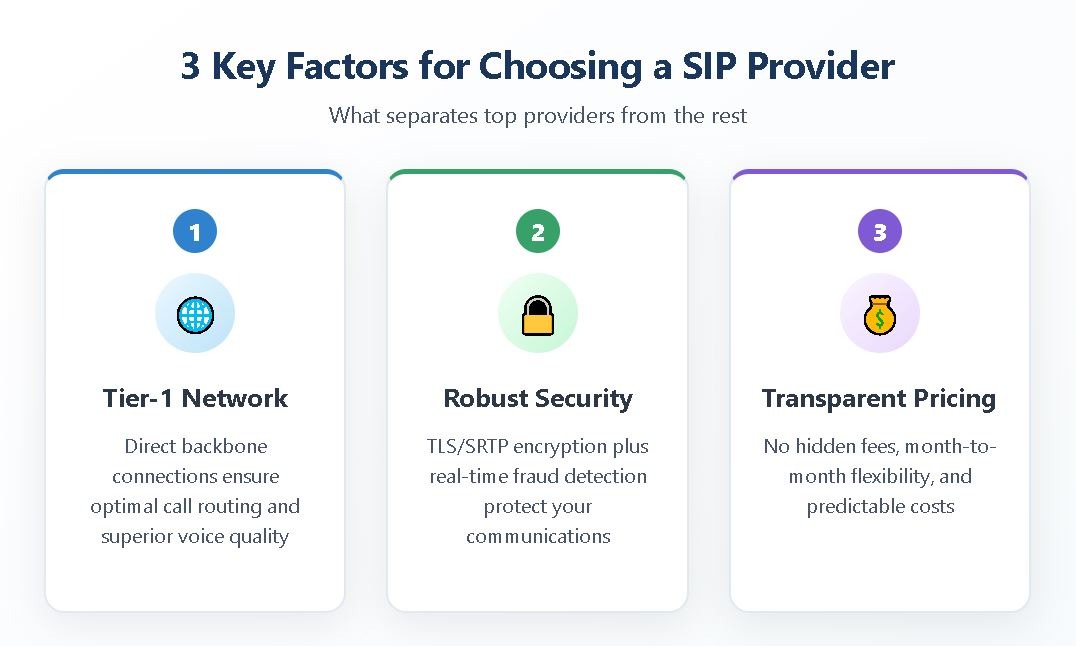
Tier-1 carrier relationships form the foundation of reliable SIP trunking service. Providers connecting directly to the internet’s backbone infrastructure ensure optimal call routing, minimal latency, and superior voice quality compared to those using tier-2 or tier-3 networks. While lower-tier providers may offer slightly reduced pricing, the resulting call quality issues damage professional relationships and create hidden costs through lost opportunities.
Redundant network architecture across multiple geographic regions provides essential protection against localized outages. Quality providers maintain diverse carrier connections with automatic failover capabilities that reroute calls seamlessly when primary paths experience disruption. This redundancy transforms SIP trunking from a cost-saving measure into a genuine business continuity solution capable of maintaining operations through circumstances that would disable traditional phone systems.

How Has Security Become a Differentiator?
Cybersecurity considerations have elevated SIP trunk security features. Transport Layer Security (TLS) and Secure Real-time Transport Protocol (SRTP) have become baseline requirements rather than premium add-ons. TLS encrypts signaling traffic protecting call setup information, while SRTP secures the actual voice content, together creating end-to-end protection against eavesdropping and manipulation.
International toll fraud is one of the most pressing threats to business telecom systems. Top SIP trunking providers implement real-time fraud detection that continuously monitors calling patterns, automatically identifying suspicious activity and taking protective action before unauthorized charges accumulate. These systems analyze destination patterns, call duration anomalies, and unusual volumes to detect compromised accounts within minutes.
What Essential Features Should SIP Trunking Providers Offer?
Evaluating business VoIP providers requires looking beyond marketing claims to examine the specific capabilities that affect daily operations. The features that matter most depend on your organization’s size, industry, and communication patterns, but certain fundamentals apply universally.
How Important Is Unlimited Calling?
Unlimited SIP trunking allows companies to make all necessary calls within one predictable price. This model should include unlimited outbound and inbound calling within your primary geographic region, typically the continental United States and Canada. Review terms carefully to confirm coverage areas and verify that both directions of calling receive unlimited treatment.
Some providers attempt to sneak restrictions into “unlimited” plans through fair-use clauses or hidden caps that trigger overage charges. Reputable providers state their terms clearly and honor them consistently. The predictability of truly unlimited calling simplifies budgeting and eliminates the anxiety of watching minutes accumulate during busy periods.
What Uptime Guarantees Should You Expect?
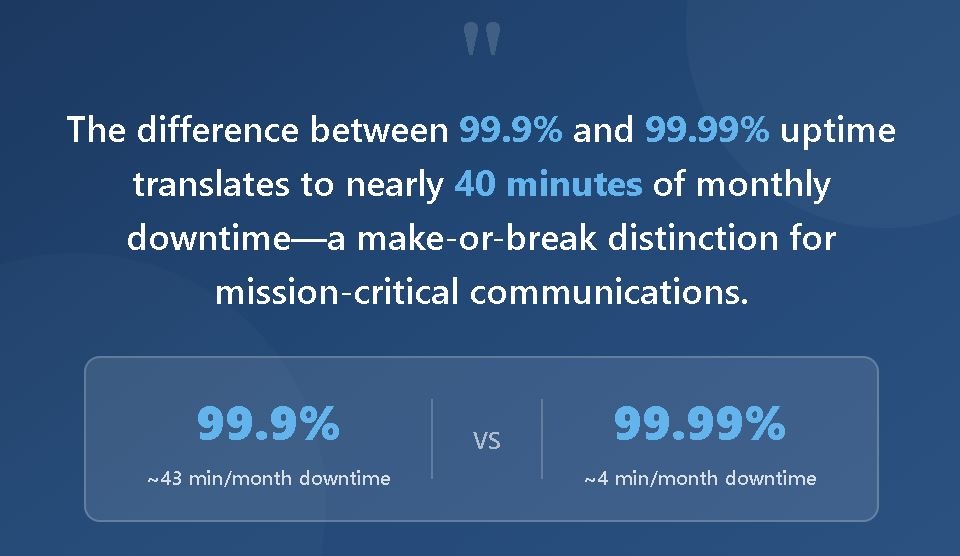
Service level agreements (SLAs) formalize reliability commitments and establish accountability when problems occur. Industry-leading providers guarantee 99.99% uptime or higher, backed by service credits when they fall short. The difference between 99.9% and 99.99% uptime translates to nearly 40 minutes in monthly downtime, a make-or-break distinction for mission-critical business communications.
Achieving exceptional uptime requires deliberate infrastructure investments. Fault-tolerant DID routing allows inbound calls to automatically reach secondary systems when primary paths fail. Geographically distributed gateways eliminate single points of failure that could disable service for entire regions. The ability to configure PSTN backup numbers ensures calls reach you even when internet connectivity fails completely.
Why Does Transparent Pricing Matter?
Hidden fees are one of the most common complaints about business VoIP providers. Setup charges, number porting fees, regulatory compliance surcharges, and per-feature add-ons can inflate what appeared to be an attractive base rate. Top SIP trunking providers structure transparent pricing that makes the total cost predictable from the start.
Month-to-month billing without contractual lock-ins provides flexibility to adjust services as needs change. Businesses with seasonal fluctuations can scale capacity up during peak periods and reduce it during slower months without penalties. This flexibility proves especially valuable for growing organizations uncertain about their future requirements.
How Critical Is PBX Compatibility?
Your SIP trunk should integrate with your existing communication infrastructure. Quality providers support a wide range of SIP-compliant devices and software, including popular IP-PBX systems like 3CX, Asterisk, FreePBX, Cisco, and Avaya. They also accommodate legacy systems through analog telephone adapters that bridge traditional equipment with modern SIP connectivity.
Detailed configuration documentation and responsive technical support simplify implementation for organizations without dedicated telecom expertise. Some providers offer remote configuration assistance at no additional charge, helping customers establish connections properly from the start rather than troubleshooting problems after deployment.
How Do You Compare SIP Trunking Providers Effectively?
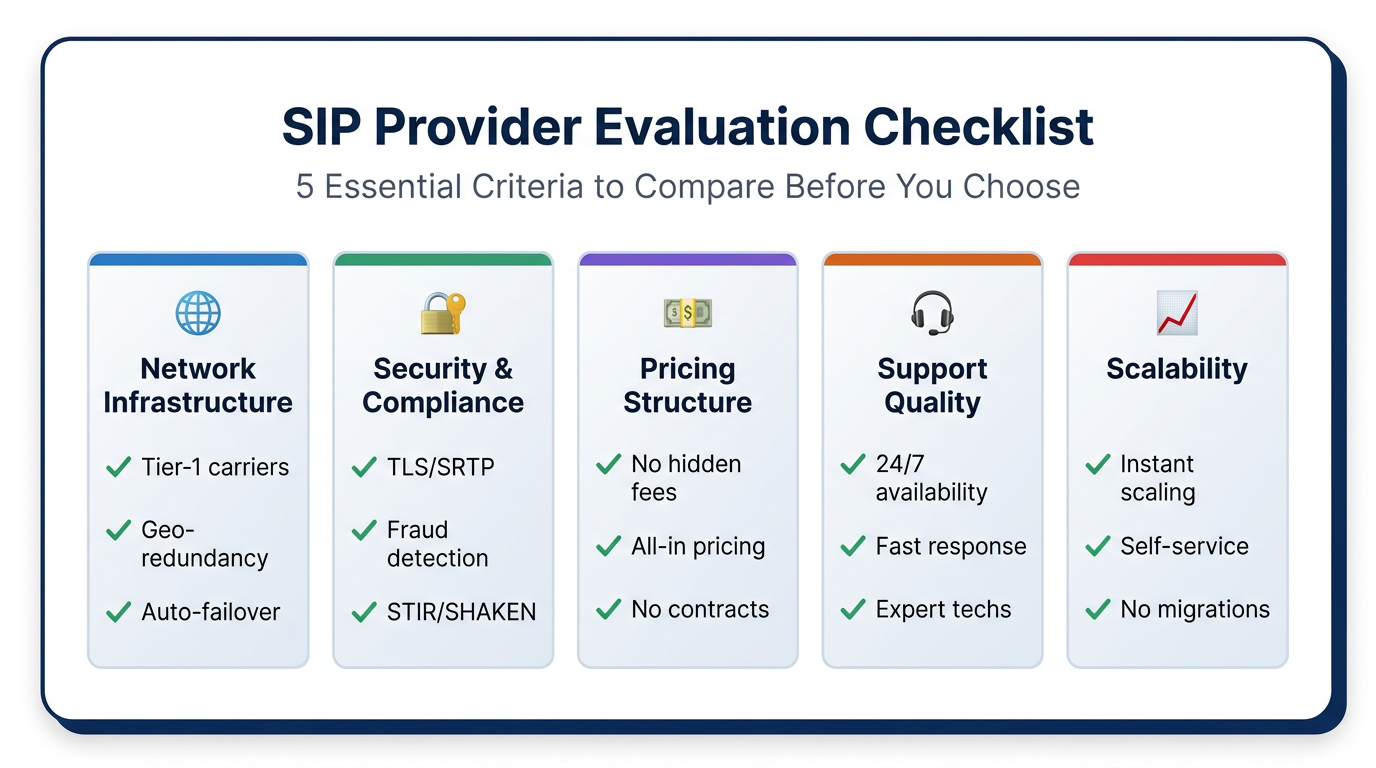
A structured SIP trunking comparison reveals differences that matter for your situation. The following framework covers the primary evaluation criteria that distinguish providers across key dimensions.
Provider Evaluation Criteria: What Should You Prioritize?
Network Infrastructure: Verify Tier-1 carrier relationships, geographic redundancy, and documented uptime history. Ask specifically about failover mechanisms and disaster recovery capabilities. Request details about session border controller implementation that enhances security and call routing efficiency.
Security and Compliance: Confirm TLS/SRTP encryption implementation, fraud detection capabilities, and relevant industry certifications. Healthcare organizations require HIPAA compliance, while businesses handling payment data need PCI-DSS compatible solutions. FCC STIR/SHAKEN compliance has become mandatory for call authentication.
Pricing Structure: Compare the total cost including all fees rather than advertised per-channel rates alone. Factor in DID telephone numbers, E911 services, porting costs, and any premium feature charges. Calculate costs based on your actual usage patterns to identify the most economical option.
Support Quality: Evaluate response times, support channel availability, and technical expertise. Providers offering 24/7 support with documented escalation procedures demonstrate a commitment to customer success. Knowledge bases, configuration guides, and community forums indicate ongoing investment in customer enablement.
Scalability: Confirm the ability to instantly add or remove channels through self-service portals. Understand any capacity limits and the process for expanding beyond them. Growing businesses need partners capable of supporting their trajectory without disruptive migrations.
2026 SIP Trunking Comparison: Key Differentiators
When conducting your SIP trunking comparison, focus on these distinguishing characteristics:
- Unlimited calling scope: Geographic coverage varies. Confirm whether unlimited plans include only local calling, extend to nationwide coverage, or encompass both U.S. and Canadian destinations.
- Channel pricing models: Metered plans charging per minute work for low-volume users, while unlimited channel pricing benefits organizations with consistent call activity. Block pricing offers middle-ground options.
- Free trial availability: Risk-free testing periods allow evaluation of call quality, feature functionality, and compatibility before financial commitment.
- Contract requirements: Month-to-month flexibility versus annual commitments with potential discounts. Consider the tradeoff between savings and lock-in.
- Feature bundling: Some providers include call recording, analytics, and advanced routing at no extra charge; others itemize each capability separately.
What Questions Should You Ask Before Choosing Your SIP Provider?
The following questions help reveal which providers genuinely meet your requirements versus those offering impressive marketing with inadequate substance.
- What carrier relationships power your network, and where are your gateways located? The answer reveals infrastructure quality and geographic coverage. Providers should answer confidently and specifically.
- How does your fraud protection work, and what happens when suspicious activity is detected? Sophisticated answers demonstrate genuine capability. Vague responses suggest limited protection.
- Can I try your service before committing? Reputable providers confident in their quality offer meaningful trial periods that demonstrate real-world performance.
- What happens to my service if my primary internet connection fails? Business continuity features like PSTN failover routing distinguish comprehensive solutions from basic connectivity.
- How quickly can I add or remove capacity? Instant self-service changes versus manual processes requiring support tickets indicate operational sophistication.
- What compliance certifications do you maintain? SOC 2, HIPAA, PCI-DSS, and other certifications demonstrate security commitment relevant to regulated industries.
- How do you handle number porting, and what timeline should I expect? Smooth porting processes minimize transition disruption. Experienced providers manage this routinely.
Frequently Asked Questions
What is the difference between SIP trunking and traditional phone lines?
Traditional phone systems use physical copper lines connecting to the Public Switched Telephone Network (PSTN), requiring dedicated infrastructure for each line. SIP trunking transmits voice as data packets over your existing internet connection, eliminating physical line requirements and enabling virtual channels that scale instantly. This architectural difference enables the cost savings and flexibility that drive SIP trunking adoption across businesses of all sizes.
How many SIP channels does my business need?
A general guideline suggests one channel for every three to four employees, though call-intensive businesses may require higher ratios. Each channel supports one concurrent call, whether inbound or outbound. Start by analyzing your current simultaneous call peaks, then add modest headroom for growth. Quality providers allow easy capacity adjustments, so initial estimates need not be perfect.
Is SIP trunking secure enough for sensitive business communications?
Modern SIP trunking with proper encryption implementation provides enterprise-grade security suitable for sensitive communications. TLS secures signaling while SRTP protects voice content, together preventing interception and manipulation. Top SIP trunking providers offering additional protections (session border controllers, IP address restrictions, and real-time fraud monitoring) deliver security levels that meet requirements for regulated industries.
Can I keep my existing phone numbers when switching providers?
Yes, number portability allows businesses to retain existing phone numbers when transitioning to new SIP trunking providers. The porting process typically takes one to four weeks, depending on your current carrier and number quantity. Quality providers manage this process proactively, minimizing disruption and ensuring continuity throughout the transition.
Transform Your Communications with the Right SIP Partner
Selecting the right SIP trunking provider is a strategic investment in your organization’s communication infrastructure. The best providers combine reliable Tier-1 networks, comprehensive security, transparent pricing, and genuine support for customer success. These fundamentals matter far more than marginal price differences that dissolve once hidden fees and quality issues surface.SIP.US delivers the reliability, features, and straightforward pricing that growing businesses need. With instant provisioning, comprehensive fraud protection, and flexible month-to-month plans, our platform provides enterprise-grade capabilities without complexity. We built our service around the principle that business communications should be simple, reliable, and affordable. Experience the difference quality SIP trunking makes by starting your free trial today.

Mitch leads the Sales team at BCM One, overseeing revenue growth through cloud voice services across brands like SIPTRUNK, SIP.US, and Flowroute. With a focus on partner enablement and customer success, he helps businesses identify the right communication solutions within BCM One’s extensive portfolio. Mitch brings years of experience in channel sales and cloud-based telecom to every conversation.
Free SIP Trunk in 60 Seconds
Related Posts

What Is a DID Number? Direct Inward Dialing Explained
Unlock the potential of your communication system with our Beginner’s Guide to DID Numbers and SIP Trunks, offering cost-effective, scalable solutions for modern businesses and individuals.

What Is SIP? A Complete Guide to Session Initiation Protocol
Discover everything about SIP and how it revolutionizes communication. Learn what is SIP, its benefits, and how to implement it in your business for better connectivity.

What Is Internet Protocol? IP Definition and How It Works
Internet protocol is the addressing and routing system that gets every business call, email, and…