

What Is a DID Number? Direct Inward Dialing Explained
A DID number is the difference between a caller reaching the right person immediately and a caller working through a menu to get there.
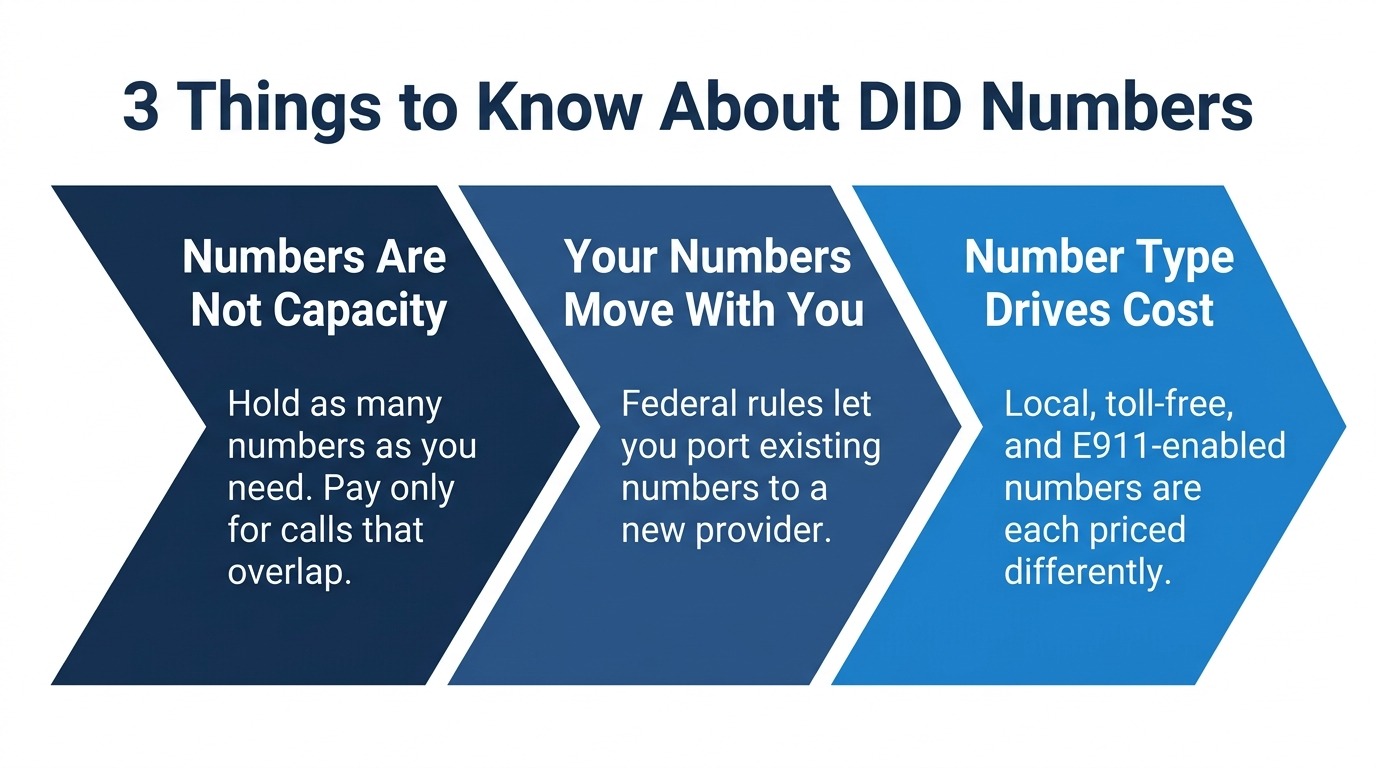
- Direct inward dialing assigns a real, dialable phone number to a specific person, team, or destination without a separate physical line for each one.
- Numbers and calling capacity are billed separately. You can hold dozens of numbers while paying for only the simultaneous calls you actually place.
- Federal rules protect the numbers you own. Simple ports must complete in one business day, so switching providers doesn’t mean reprinting your business cards.
- Number type drives cost. Local, toll-free, and E911-enabled numbers each carry different recurring and one-time charges.
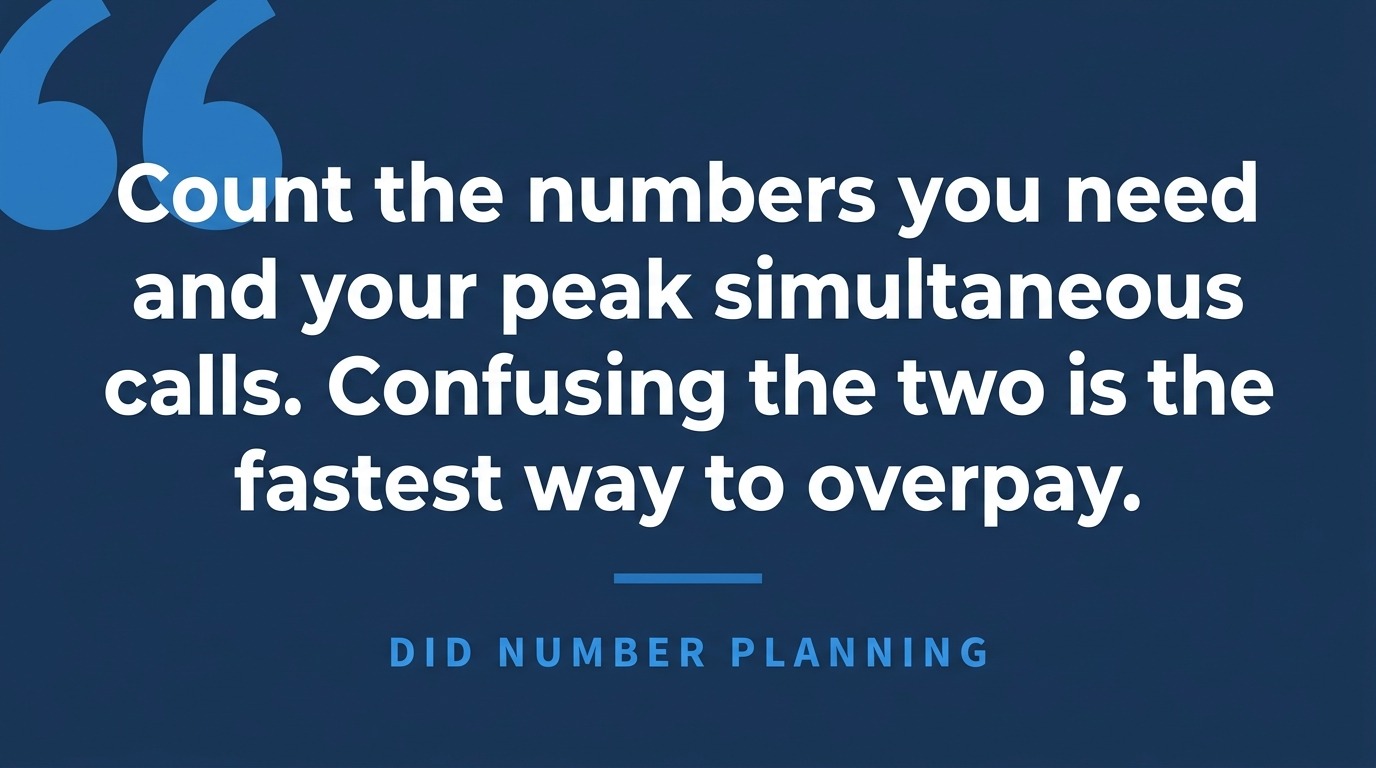
Before requesting quotes, count the numbers you need and your peak simultaneous calls. Those are two different figures, and confusing them is the fastest way to overpay.
Most businesses inherit their phone numbers rather than planning them. A main line gets published, direct lines get handed out over the years, and nobody revisits it until someone asks why sales shares a number with billing. That’s when a DID number becomes a business decision.
Internet-based voice made those decisions cheaper to act on. In the FCC’s latest count of wireline business voice connections, roughly 84% of the 53 million business lines in service are interconnected VoIP rather than legacy switched access. A SIP trunk provider supplies that connection, and direct inward dialing determines what callers dial to reach you.
What Is a DID Number?
A DID number is a standard 10-digit telephone number that routes inbound calls to a specific destination inside your phone system rather than to a general reception point. Direct inward dialing is the service behind it: your provider assigns the numbers, delivers the dialed digits to your PBX, and your PBX decides where each call goes.
How Does Direct Inward Dialing Work?
When someone dials one of your numbers, the call crosses the public telephone network to your provider, who passes it to your phone system along with the digits dialed. Your PBX matches those digits against a routing table you configure. If the number maps to extension 214, then extension 214 rings.
What doesn’t happen matters just as much. No dedicated circuit sits idle behind each number, and no operator transfers the call. One connection carries traffic for every number you own, which is why reassigning a departing employee’s direct line takes minutes.
How Is a DID Number Different From an Extension?
An extension is internal. It works for colleagues dialing each other inside your phone system, but an outside caller can’t dial three digits from a mobile phone and reach anyone. A DID number is external and publishable, which is the entire point.
In practice, the two are paired. You assign a number to an extension, the extension keeps handling internal dialing, and the number handles everything arriving from outside. Employees who only take internal calls need an extension alone, which keeps your number count smaller.
What Types of DID Numbers Can Businesses Order?
Local numbers carry an area code tied to a specific rate center and cover most direct lines. They signal regional presence, and callers in that area are generally more willing to answer them than an unfamiliar out-of-state number.
Toll-free numbers reverse the economics, since the caller pays nothing and the business absorbs the inbound cost. Somos, the FCC-appointed registry administrator, reports more than 48 million toll-free numbers in use. Enhanced numbers add a registered street address so 911 calls reach the correct dispatch center, which means most numbers tied to a physical desk should be enhanced.
How Does DID Work on a SIP Trunk?
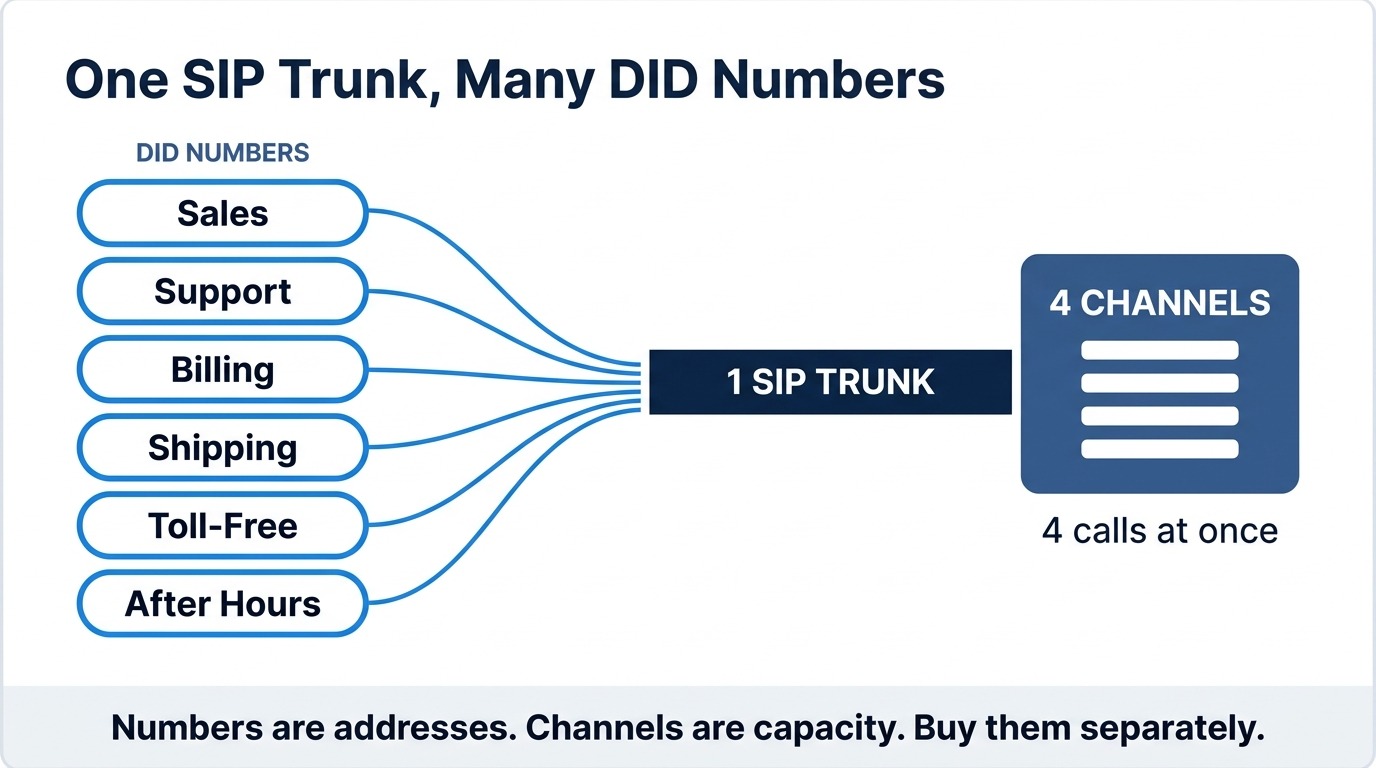
A SIP trunk is the connection between your phone system and the public telephone network. Channels are the capacity on that connection, each carrying one call at a time. A DID number is an address, not capacity.
The two are purchased separately and scale independently. A 12-person accounting firm might hold 15 numbers so that every partner has a direct line while paying for four channels because it never runs more than four calls at once. Getting this calculation right is the largest single lever on your monthly cost, worth settling before you compare quotes on business phone numbers with SIP trunking.
How Do Numbers Map to Trunks, Extensions, and Devices?
Each number points at a trunk, and your PBX takes it from there. Inside the PBX, you decide whether the number rings a handset, a ring group, an auto attendant, a queue, or a voicemail box.
Nothing limits a number to one destination. A support line can ring the daytime queue during business hours and an after-hours voicemail box outside of them, all from the same DID number on a SIP trunk you already have. Outbound behavior is configured separately, so a salesperson’s calls can display their direct line instead of the main office number.
What Happens When a Call Can’t Be Delivered?
A well-designed number plan includes a fallback path. Each number can be given a primary trunk destination, a secondary trunk, and a forwarding number on the traditional phone network, so an outage doesn’t send callers to a dead line.
Endpoints are no longer all in one building either. A single number can ring a desk phone, a laptop softphone, and a mobile app at once, and failover routing for distributed teams is a configuration exercise, not a purchase.
How Do You Get DID Numbers? Provisioning and Porting
There are two ways to acquire numbers: order new ones or bring the ones you already have. Most businesses do both, and the processes run on very different timelines.
What Does Ordering a New Number Involve?
New numbers come from your provider’s inventory, organized by rate center. You search the area code and locality you want, select from what’s available, and the number is typically active within minutes. There’s no field visit and no circuit to install.
Availability is the one constraint worth planning around. Popular area codes get thin, and a rate center may have nothing left the day you look. Providers can usually backorder numbers, though that takes several business days.
How Does Porting an Existing Number Work?
Porting moves a number you already own from your current carrier to a new one, and your right to do it is protected by federal rule. Your current provider can’t refuse to release a number over an unpaid balance, and simple ports must be processed in one business day.
Business ports are rarely “simple” in the regulatory sense, since they usually involve multiple lines. Plan for a week or more, and expect to supply a recent bill, your account number, and a letter of authorization matching your service record. Never cancel service with your existing carrier first because cancellation releases the number back to inventory.

What Causes a Port Request to Be Rejected?
Mismatched account information is the leading cause. If the request reads “Northside Dental LLC” and the carrier’s record says “Northside Dental Associates,” it bounces back and the clock restarts.
Geography is the other blocker, since numbers are tied to rate centers. A number can follow you to a new provider but generally not to a new region.
7 Ways Businesses Put DID Numbers to Work
Beyond giving individuals direct lines, DID numbers solve problems that would otherwise need separate systems:
- Department routing. Publish separate numbers for sales, support, and billing so callers skip the menu.
- Marketing attribution. Assign a unique number to each campaign, then use call detail records to see which channels generate calls.
- Multi-location presence. Hold local numbers in every market you serve, even when calls route to one central team.
- After-hours coverage. Point a number at a different destination outside business hours.
- Vendor and partner lines. Give key accounts a dedicated number that bypasses the general queue.
- Fax and messaging. Dedicate numbers to inbound fax or business texting so they don’t compete with voice.
- Seasonal capacity. Add numbers for a promotion, then release them when it ends.
Each of these use cases is a routing change rather than a hardware purchase, which makes them practical for small teams.
What Determines DID Pricing?
Number costs are usually the smallest line on a voice bill and the least clearly quoted. Separating recurring charges from one-time fees makes proposals comparable.
What Are the Recurring Per-Number Charges?
Local numbers carry a modest flat monthly fee each. Toll-free numbers cost more per month and typically add a per-minute inbound charge, since the business pays for the caller’s connection. E911-enabled numbers carry a small additional monthly fee.
None of these costs varies with call volume on local numbers, which keeps budgeting straightforward. Total your numbers by type, apply the monthly rate for each, and you have your recurring cost. You can see how those stack against capacity on the SIP channel and phone number pricing page.
What One-Time and Regulatory Charges Apply?
Expect a small per-number setup fee on new orders and a one-time porting fee per number transferred, often discounted above 10 numbers. Federal Universal Service Fund and Telecommunications Relay Service charges apply on top as a percentage of telecommunications charges.
The savings driving most migrations come from the channel side rather than the number side. Mordor Intelligence puts the reduction at 25% to 65% over legacy PRI lines, largely because a PRI forces you to buy 23 channels whether you use three or twenty. A closer look at what SIP trunking really costs shows how the pieces combine.
How Many Numbers and Channels Do You Actually Need?
Count numbers first, since that’s a list you can write down: every direct line, department, location, and campaign. Numbers are inexpensive, so err toward having enough.
Channels are the harder figure because they depend on simultaneous usage rather than headcount. A common starting point is one channel for every three or four employees, adjusted upward for phone-heavy operations. Working through how many channels you need prevents both overbuying and busy signals.
Frequently Asked Questions
Is a DID number the same as a SIP phone number?
In practice, yes. A SIP phone number delivered over a SIP trunk functions as a DID number: a dialable number routing to a destination you control. The terms describe the same thing from different angles, one pointing at the delivery method and the other at the routing behavior.
How many DID numbers can one SIP trunk support?
There’s no practical limit tied to the trunk itself. Numbers and channels are billed separately, so one trunk can carry hundreds of numbers while your channel count is sized to peak simultaneous calls. Adding a DID number on a SIP trunk doesn’t require adding a channel.
Can I keep my business phone numbers when I switch providers?
Yes, in almost all cases. Federal portability rules let you move numbers to a new provider as long as you stay in the same geographic area, and your current carrier can’t block the transfer over an outstanding balance. Keep the existing service active until the port completes.
Should a small business use local or toll-free numbers?
Most benefit from a mix. Local numbers work well for direct lines and for markets where regional presence matters, since callers tend to answer numbers they recognize. Toll-free numbers suit a published main line, a support desk, or any number printed on materials reaching customers outside your area.
Build Your Number Plan Before You Buy
Direct inward dialing isn’t a premium add-on to evaluate on its own. It’s the layer that determines whether your phone system reflects how your business is actually organized, and it costs little to get right. Map out who needs to be directly reachable, decide where local and toll-free numbers each make sense, confirm which must be E911-enabled, then size your channels.
SIP.US supports all of it from one self-service control panel, with instant number provisioning, nomadic e911, and no contract required. Start your free trial and build a number plan that matches how your business actually works.

Mitch leads the Sales team at BCM One, overseeing revenue growth through cloud voice services across brands like SIPTRUNK, SIP.US, and Flowroute. With a focus on partner enablement and customer success, he helps businesses identify the right communication solutions within BCM One’s extensive portfolio. Mitch brings years of experience in channel sales and cloud-based telecom to every conversation.
Free SIP Trunk in 60 Seconds
Related Posts

What Is SIP? A Complete Guide to Session Initiation Protocol
Discover everything about SIP and how it revolutionizes communication. Learn what is SIP, its benefits, and how to implement it in your business for better connectivity.

What Is Internet Protocol? IP Definition and How It Works
Internet protocol is the addressing and routing system that gets every business call, email, and…
Analog Telephone Adapter: How to Choose an ATA for SIP
A single inexpensive device can keep your existing analog phones, faxes, and paging equipment working…