

How to Compare SIP Trunk Providers: Features, Pricing, and Support
The right SIP trunk provider can reduce communication costs while delivering enterprise-grade reliability, but choosing poorly leads to dropped calls, hidden fees, and inadequate support.
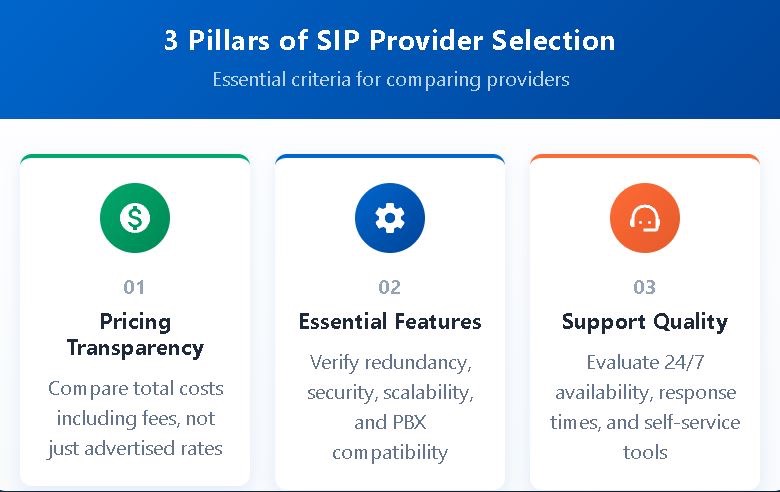
- Pricing transparency matters more than advertised rates because setup fees, regulatory charges, and per-minute overages can double your actual costs.
- Essential SIP trunk features include redundant networks, fraud protection, scalable channels, and PBX compatibility that matches your existing infrastructure.
- Contract flexibility determines long-term value since month-to-month terms without cancellation penalties protect your business as needs evolve.
- Support quality directly impacts uptime, making 24/7 availability and self-service tools critical for businesses that depend on reliable communications.
Evaluate providers using a weighted decision matrix that prioritizes your business requirements rather than selecting based on the lowest advertised price alone.
Selecting a SIP trunking provider is one of the most consequential technology decisions a business can make. With the SIP trunking market projected to grow from $13.85 billion in 2024 to over $33 billion by 2032, the number of providers vying for your business continues to expand. This growth creates opportunities but also challenges for IT directors and business owners who must compare SIP trunk providers across dozens of variables.
Poor provider selection results in communication disruptions that frustrate customers, hidden costs that blow through budgets, and technical limitations that prevent business growth. Meanwhile, the best SIP provider for your organization will deliver measurable cost savings, enhanced call quality, and the flexibility to scale communications as your business evolves.
This guide provides a structured framework for evaluating SIP trunk providers across the criteria that matter most: pricing transparency, essential features, contract terms, and support quality. Whether you’re migrating from traditional phone lines or switching from an underperforming provider, understanding how to systematically compare SIP trunk providers ensures you make decisions based on substance rather than marketing claims.
How Do I Compare SIP Trunk Providers on Pricing Models?
Understanding SIP trunk pricing requires examining the different billing structures providers use and how each model aligns with various business needs. The right pricing model depends on your call volume patterns, budget preferences, and growth projections.
Per-Channel Unlimited Pricing
The most common pricing structure for businesses with predictable, moderate-to-high call volumes is per-channel unlimited pricing. Under this model, you pay a fixed monthly fee for each SIP channel, which provides one concurrent call path. Typical rates range from $15 to $30 per channel monthly, with most providers including unlimited domestic calling within that fee.
This model provides budget predictability since your monthly costs remain consistent regardless of call duration or frequency. Businesses with steady call volumes benefit from knowing exactly what their communication expenses will be each month. Companies switching to SIP trunking can save between 25% and 65% on telecommunication fees compared to traditional systems. When evaluating SIP trunk pricing across providers, examine whether the unlimited calling applies only to domestic destinations or includes Canada and other regions your business frequently contacts.
Metered and Pay-As-You-Go Options
Metered pricing charges per minute of usage, typically ranging from $0.01 to $0.03 for domestic calls. This model suits businesses with low or highly variable call volumes, such as seasonal operations or companies where most communication happens through email and chat rather than voice.
Pay-as-you-go structures eliminate monthly commitments, making them attractive for businesses with unpredictable communication needs. However, per-minute charges accumulate quickly for organizations with substantial call activity. Calculate your average monthly minutes and compare total projected costs against unlimited plans before selecting metered pricing.
Hidden Costs to Identify
The advertised per-channel or per-minute rate rarely represents your total cost. Regulatory fees, including Federal Universal Service Fund charges and Telecommunications Relay Service contributions, add percentage-based surcharges to your bill. E911 service fees, required for emergency calling compliance, typically add $1–3 per number monthly.
Setup fees, number porting charges, and minimum commitment requirements further impact the total cost of ownership. Some providers waive setup fees for new accounts, while others charge substantial one-time amounts. Request a complete fee schedule before signing any agreement, and compare the all-in costs rather than headline rates when you compare SIP trunk providers.
Which SIP Trunk Features Are Essential for Business Communications?
The features included with your SIP trunking service determine what capabilities your business gains and how reliably they perform under real-world conditions. Evaluating SIP trunk features requires understanding both the technical requirements and the business outcomes you need to achieve.
Network Reliability and Redundancy
Network architecture directly determines call quality and uptime. Providers using Tier-1 carrier networks and geographically distributed infrastructure deliver superior reliability compared to those operating on single-location systems. Look for providers that maintain multiple points of presence and automatic failover capabilities that reroute calls when primary connections experience issues.
Uptime guarantees expressed as percentages reveal provider confidence in their infrastructure. A 99.99% uptime commitment translates to roughly 52 minutes of annual downtime, while 99.9% allows for over 8 hours. Review service level agreements carefully and understand what remedies you receive if the provider fails to meet committed uptime levels.
Understanding how PBX and SIP technology work together helps you evaluate whether a provider’s network architecture supports your existing phone system.
Security and Fraud Protection
SIP trunking exposes voice communications to internet-based threats, making security features essential. Effective fraud protection systems monitor call patterns in real time, automatically terminating suspicious international calls and alerting administrators when unusual activity occurs. Without these protections, compromised systems can generate thousands of dollars in fraudulent charges overnight.
Encryption capabilities protect call content from interception. TLS encryption for signaling and SRTP for media ensure that both call setup information and actual voice data remain secure. STIR/SHAKEN compliance authenticates caller identity, helping prevent spoofing attacks that damage business reputation and customer trust.

Scalability and Flexibility
Business communication needs fluctuate with growth, seasonal demand, and market conditions. The best SIP provider allows you to add or remove channels instantly through self-service portals rather than requiring support tickets or contract amendments. This flexibility prevents you from paying for unused capacity during slow periods while ensuring adequate resources during peak demand.
Evaluate how quickly new channels become active after provisioning. Instant activation enables rapid response to changing needs, while providers requiring 24–48 hour provisioning delays create operational constraints. Similarly, assess whether scaling down carries penalties or waiting periods that lock you into capacity you no longer need.
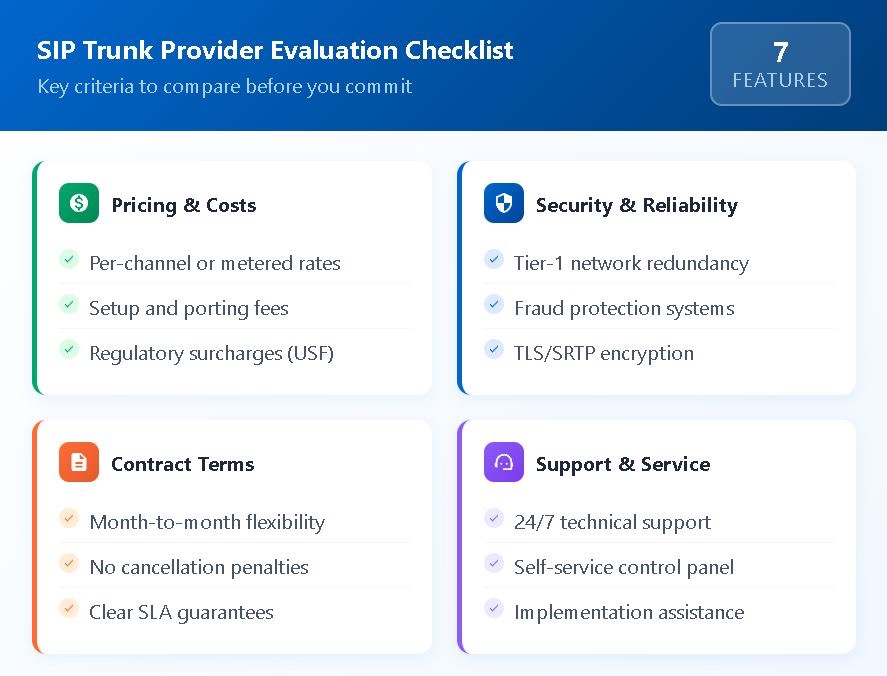
Seven Critical Features to Evaluate
When assessing any SIP trunk provider, evaluate these capabilities that directly impact your daily operations:
- PBX Compatibility: Confirm support for your specific phone system, whether Asterisk, FreePBX, 3CX, Cisco, or other platforms. Providers should offer configuration guides and technical assistance for connecting your equipment.
- Codec Support: G.711 delivers superior audio quality while consuming approximately 85kbps of bandwidth per call. G.729 reduces bandwidth requirements to around 30kbps, which is beneficial when internet capacity is limited. Verify your provider supports both options.
- DID Coverage: Direct inward dialing number availability varies by geographic region. Assess whether the provider maintains inventory in the rate centers where your business needs local presence.
- E911 Compliance: Nomadic E911 service allows you to register specific addresses for each number, ensuring emergency responders receive accurate location information regardless of where calls originate.
- Call Detail Records: Real-time access to comprehensive call data enables usage monitoring, troubleshooting, and compliance documentation. Evaluate the reporting interface and data export capabilities.
- Failover Routing: The ability to route calls to backup destinations when primary systems are unavailable protects business continuity. Look for providers offering multiple failover tiers, including secondary SIP trunks and PSTN forwarding.
- Control Panel Quality: Self-service management tools determine how efficiently you can modify services, provision numbers, and resolve issues without contacting support.
How Should You Evaluate Contract Terms and Commitments?
Contract structure impacts both your financial flexibility and operational risk. A VoIP providers comparison requires examining the fine print that determines what happens when your needs change or you decide to switch providers.
Month-to-Month Versus Annual Agreements
Month-to-month service provides maximum flexibility, allowing you to cancel or modify service without penalty as business conditions evolve. This arrangement protects against being locked into a provider that underperforms or a service level that no longer matches your needs. While some providers offer discounted rates for annual commitments, calculate whether those savings outweigh the value of flexibility.
Annual contracts often include early termination fees that can exceed several months of service charges. If considering an annual commitment, understand exactly what triggers termination penalties and whether any circumstances allow penalty-free cancellation. Providers confident in their service quality typically offer month-to-month options without pressuring customers into long-term commitments.
Setup Fees and Porting Costs
Setup fees for new accounts range from zero to several hundred dollars, depending on the provider and complexity of implementation. Number porting, which transfers your existing phone numbers to the new provider, typically costs $10-50 per number, though volume discounts often apply for larger ports.
Porting timelines also merit consideration. Simple ports complete within days, while complex ports involving multiple carriers or large number blocks can take weeks. Understand the expected timeline and whether the provider offers temporary forwarding arrangements to maintain communication during transitions.
Service Level Agreements
Formal SLAs define provider commitments regarding uptime, call quality, and issue resolution. Review what metrics the provider commits to maintaining, how those metrics are measured, and what credits or remedies you receive when commitments are not met. Vague language about “best efforts” provides less protection than specific, measurable guarantees.
Providers serious about service quality back their SLAs with meaningful credits that compensate for disruptions. When you compare SIP trunk providers, look at both the committed metrics and the compensation structure that applies when they fail to deliver.
What Support Levels Should You Expect from SIP Trunk Providers?
Support quality becomes apparent only when problems occur, making it essential to evaluate provider support capabilities before those situations arise. For businesses dependent on voice communications, inadequate support translates directly into lost revenue and damaged customer relationships.
Availability and Response Times
24/7 support matters for organizations operating outside standard business hours or serving customers across time zones. Evaluate whether round-the-clock support includes access to qualified technical staff or merely answering services that escalate issues during business hours.
Response time commitments indicate how quickly providers address reported issues. Tiered support structures typically promise faster responses for critical issues affecting all calls versus minor concerns affecting individual features. Understand how severity levels are defined and whether your assessment of issue criticality matches the provider’s classification.
Support Channels and Self-Service Tools
Multiple support channels provide flexibility in how you engage with provider assistance. Phone support enables real-time troubleshooting for urgent issues, while email and ticket systems create documentation trails for complex problems. Live chat offers middle-ground responsiveness for moderate concerns.
Comprehensive knowledge bases and self-service portals reduce support dependency for routine tasks and common issues. Providers investing in documentation and management tools demonstrate commitment to customer success beyond reactive problem-solving. Evaluate the quality and completeness of available resources by reviewing documentation for your specific VoIP phone system configuration.
Implementation Assistance
Initial setup assistance varies from basic documentation to hands-on configuration support. Providers willing to access your systems remotely and configure connections directly reduce risk and accelerate time to value. This assistance proves valuable when connecting legacy equipment or implementing complex routing requirements.
Evaluate whether implementation support incurs additional charges or is included with the service. Some providers include professional services for initial setup while charging for ongoing configuration changes, while others bundle comprehensive support throughout the relationship.
How Can You Build a Decision Matrix for Provider Selection?
Systematic evaluation prevents emotional or marketing-influenced decisions by forcing objective comparison across consistent criteria. A weighted decision matrix transforms subjective impressions into quantifiable scores that support defensible recommendations.
Defining Evaluation Criteria
Begin by identifying the factors most important to your situation. While pricing matters to every organization, its relative weight compared to reliability, features, or support varies based on priorities. A healthcare organization bound by compliance requirements weighs security features differently than a retail business prioritizing cost minimization.
Standard categories include pricing and total cost of ownership, feature completeness, network reliability, security capabilities, contract flexibility, and support quality. Within each category, define specific measurable elements. For pricing, this might include per-channel costs, regulatory fees, and porting charges. For reliability, consider uptime guarantees, redundancy architecture, and failover capabilities.
Assigning Weights and Scores
Assign percentage weights to each category reflecting your priorities, ensuring weights total 100%. An organization where communication disruptions cause significant revenue loss might weigh reliability at 30%, while a budget-constrained startup might weigh pricing at 40%. Honest assessment of priorities prevents misalignment between evaluation criteria and actual business needs.
Score each provider on each criterion using a consistent scale, typically 1–5 or 1–10. Gather scoring inputs from multiple stakeholders who will interact with the service. Technical staff evaluate feature capabilities and compatibility, while financial stakeholders assess pricing transparency and contract terms.
Conducting Proof-of-Concept Testing
Shortlisted providers should demonstrate actual performance through trial implementations. Most reputable providers offer free trials that allow you to test call quality, evaluate management interfaces, and assess support responsiveness before committing. Use trial periods to place calls under realistic conditions, not just optimal testing scenarios.
Document trial results, noting any issues encountered and how quickly and effectively provider support resolved them. Performance during trials indicates what you can expect from ongoing service, making thorough testing essential to informed decisions.
What Questions Should You Ask Before Signing with Any Provider?
Direct questions reveal information that marketing materials obscure. Request detailed breakdowns of all charges that will appear on your bill, including regulatory fees and surcharges not included in advertised rates. Ask about rate change policies and how much notice you receive before pricing adjustments take effect. Understand what circumstances allow the provider to modify your agreement unilaterally.
Inquire about network architecture, including where points of presence are located and what redundancy exists. Ask how many customers experienced outages in the past year and what the average resolution time was. Request references from customers with similar technical environments and communication patterns.
Clarify support escalation procedures for urgent issues, including who has the authority to make decisions and commit resources outside normal processes. Understand what proactive monitoring the provider performs and how you are notified when issues are detected. These conversations reveal provider culture and commitment to customer success.
Frequently Asked Questions
How many SIP channels does my business need?
Calculate concurrent call requirements by analyzing your maximum simultaneous calls during peak periods. Review existing phone system reports showing trunk utilization, or estimate based on employee count and call intensity. Most businesses need one channel for every 3–5 employees who make regular phone calls, though call-center operations require higher ratios. Providers with flexible scaling allow you to adjust channel counts as you refine your understanding of actual needs.
Can I keep my existing phone numbers when switching providers?
Yes, number portability regulations allow you to transfer most existing phone numbers to a new SIP trunk provider. The porting process typically takes 5–15 business days, depending on complexity and the releasing carrier’s responsiveness. Verify that your new provider supports porting from your current carrier and covers the geographic rate centers where your numbers originate. Some specialty numbers, such as certain toll-free or vanity numbers, may require additional steps.
What internet bandwidth do SIP trunks require?
Each concurrent call consumes approximately 85kbps when using the G.711 codec or around 30kbps with G.729. Multiply your expected concurrent call count by the codec bandwidth to determine minimum requirements, then add capacity for other business applications. Quality of Service configuration that prioritizes voice traffic prevents bandwidth competition from degrading call quality during periods of heavy network use.
How do I test call quality before committing to a provider?
Take advantage of free trial periods to place calls under realistic conditions. Test calls to various destinations, including mobile phones, landlines, and other VoIP systems. Evaluate call quality at different times of day and during periods when your internet connection handles other traffic. Note any audio issues, including echo, delay, or choppy audio, and assess how responsive provider support is when you report concerns.
Take the Next Step Toward Better Business Communications
Choosing the right SIP trunk provider requires balancing pricing, features, contracts, and support. By applying the evaluation framework outlined here, you can cut through marketing noise and identify providers that genuinely match your business requirements. The time invested in comparison pays dividends through years of reliable, cost-effective communications.
SIP.US delivers the transparency, flexibility, and reliability that businesses need from their communication infrastructure. With straightforward pricing, enterprise-grade features, and responsive support, SIP.US helps organizations achieve their communication goals without hidden costs or long-term lock-in. Get started today to experience how the right provider transforms your business communications.

Mitch leads the Sales team at BCM One, overseeing revenue growth through cloud voice services across brands like SIPTRUNK, SIP.US, and Flowroute. With a focus on partner enablement and customer success, he helps businesses identify the right communication solutions within BCM One’s extensive portfolio. Mitch brings years of experience in channel sales and cloud-based telecom to every conversation.
Free SIP Trunk in 60 Seconds
Related Posts

What Is a DID Number? Direct Inward Dialing Explained
Unlock the potential of your communication system with our Beginner’s Guide to DID Numbers and SIP Trunks, offering cost-effective, scalable solutions for modern businesses and individuals.

What Is SIP? A Complete Guide to Session Initiation Protocol
Discover everything about SIP and how it revolutionizes communication. Learn what is SIP, its benefits, and how to implement it in your business for better connectivity.

What Is Internet Protocol? IP Definition and How It Works
Internet protocol is the addressing and routing system that gets every business call, email, and…