

SIP Trunk Cost Savings: A Buyer’s Guide to Pricing and ROI
Most businesses still running legacy voice circuits are overpaying every month, and the math to prove it takes about 15 minutes.
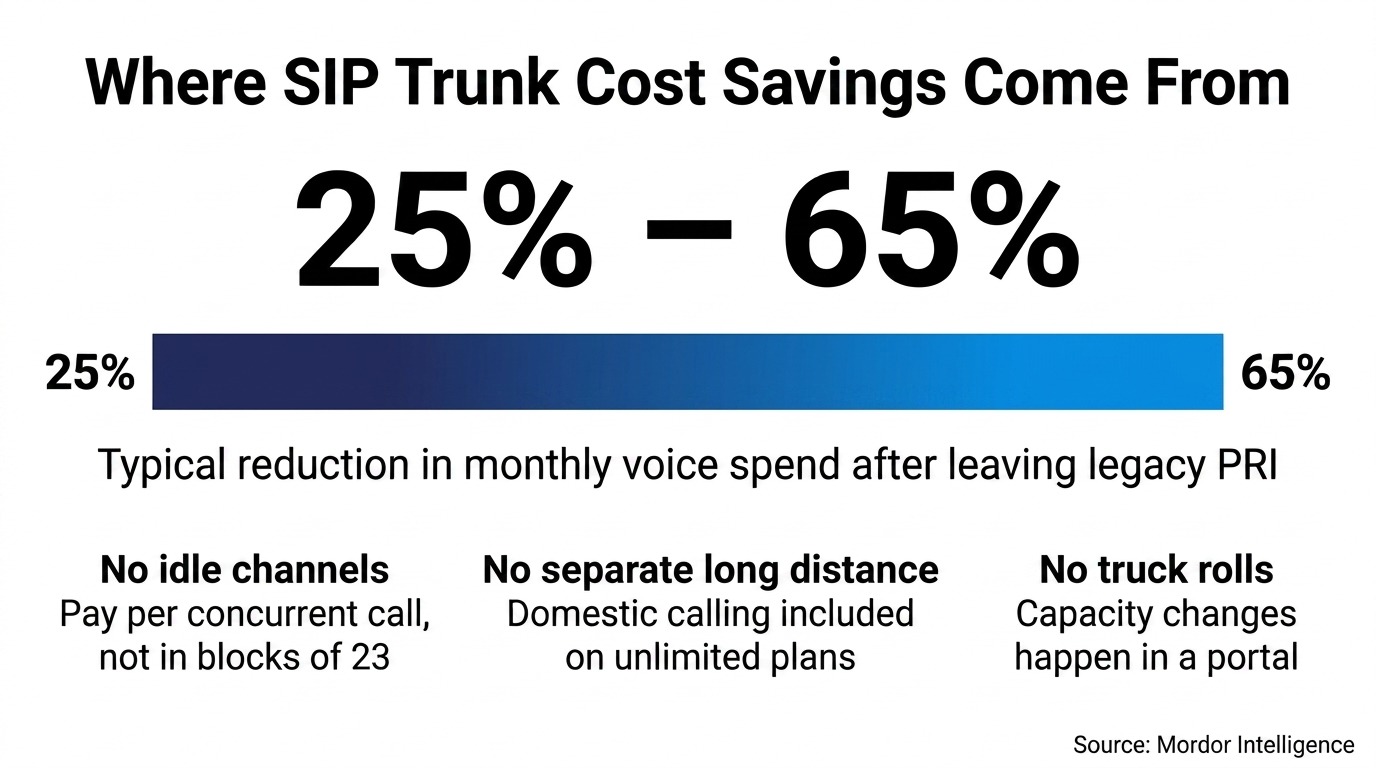
- Companies migrating off legacy PRI report reductions between 25% and 65% on monthly voice spend, driven largely by eliminating fixed-capacity circuits and bundled long-distance charges.
- Per-channel billing removes the 23-channel purchase block that forces businesses to buy capacity they will never use.
- Total cost of ownership is the only fair comparison. Circuit fees, maintenance contracts, technician visits, and per-feature add-ons all belong in the calculation.
- The decision window is narrowing as carriers accelerate copper retirement and regulators clear the path.
Pull your last three phone bills, count your peak simultaneous calls, and run the four-step calculation below before your next contract renewal.
You’ve probably already decided that internet-based voice makes sense. What you need now is a defensible number: how much you’ll save, how fast the switch pays for itself, and what appears on the invoice that nobody mentioned during the sales call.
Market research from Mordor Intelligence attributes savings between 25% and 65% over legacy PRI lines as the strongest economic driver behind adoption. That’s a wide band, and where you land inside it depends on variables you control. This guide covers the pricing models, the line items buyers overlook, and a calculation you can run against your own invoices to size your SIP trunk cost savings. It also helps to know what a modern SIP trunking service includes, so you have a baseline to measure incoming quotes against.
What Drives SIP Trunk Cost Savings Compared to Legacy Lines?
Savings don’t come from cheaper minutes alone. They come from a structural difference in how capacity is sold, provisioned, and maintained, and understanding it lets you predict your own numbers instead of borrowing someone else’s.
Where Legacy Systems Waste Money
A Primary Rate Interface circuit delivers 23 voice channels, whether you need 23 or six. Capacity is sold in blocks, so a business with 30 peak simultaneous calls buys two full circuits and pays for 46 channels indefinitely. That mismatch compounds across every site a multi-location business operates.
Legacy circuits also carry costs that never appear on the advertised rate. Long distance is billed by the minute, adding capacity requires physical installation measured in weeks, hardware faults require a technician on site, and support contracts climb at renewal. Businesses often discover the true SIP trunk cost advantage only after totaling these elements across a full year.
How Per-Channel Billing Removes the Waste
SIP trunking bills by the channel, and one channel handles one concurrent call. If your busiest hour involves seven simultaneous conversations, you buy seven channels. Adding an eighth takes minutes in a provider portal rather than a service order and an installation window.
This model is the mechanism behind most communication cost savings. You stop paying for idle capacity, you stop paying separately for domestic long distance on unlimited plans, and you stop scheduling site visits for what are now configuration changes. Voice rides your existing broadband connection, so there is no separate physical network to maintain.
How Does SIP Trunk Pricing Work?
Providers structure quotes in a few recognizable ways, and comparing them fairly means converting each to the same unit: total monthly cost for the capacity you genuinely need. A cheaper headline rate often loses once the full bill is assembled.
Unlimited Channel Pricing
Under this model, you pay a flat monthly rate per channel with domestic calling included. It suits steady, moderate-to-high call volume, and budgeting becomes trivial because the number doesn’t move with usage.
The tradeoff is that light callers subsidize capacity they don’t consume. Comparing published per-channel and DID pricing against your actual call detail records is the fastest way to test which side of that line you fall on.
Metered and Blended Models
Metered billing charges by the minute, which favors low or highly seasonal volume. Blended plans pair a smaller per-channel fee with a block of included minutes, then bill overage. Each can be cheapest for a particular profile, and none is universally best.
Pull three to six months of call records first and look at total minutes, peak simultaneous calls, and month-to-month variance. A breakdown of how these pricing models compare helps if your usage is irregular.
The Line Items Buyers Forget
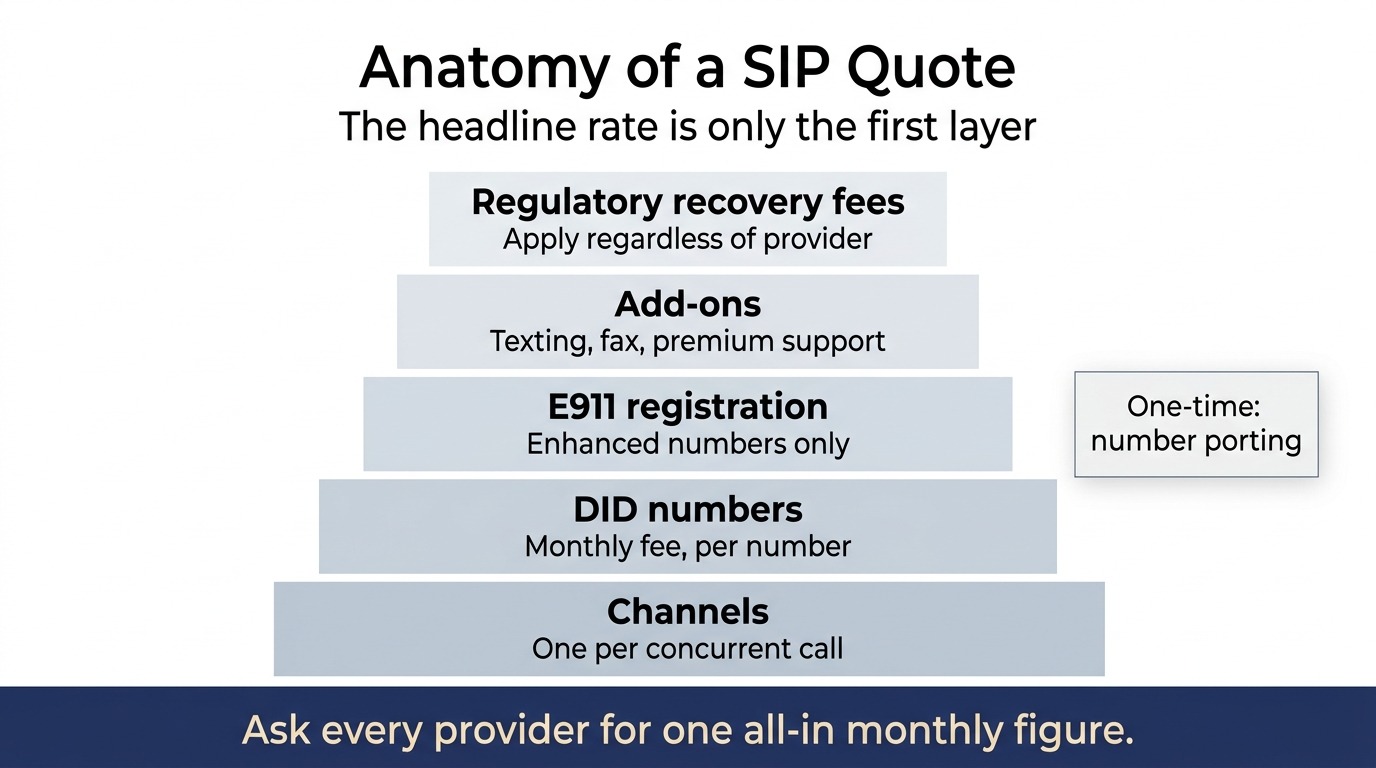
Base channel pricing is rarely the whole SIP trunk cost. Direct inward dial numbers carry a small monthly fee each, enhanced numbers with registered E911 addresses cost slightly more, porting is a one-time per-number charge, and federal regulatory recovery fees apply regardless of provider.
Add-ons such as business texting, fax, and premium support sit outside base pricing too. None of these is unreasonable, but a quote that omits them is not comparable to one that includes them. A walkthrough of what you are really paying for helps you normalize competing proposals.
How Do You Calculate Your SIP ROI?
You don’t need a financial model to get a credible answer. You need four numbers from documents you already have, and the exercise takes less time than a single vendor call.
The Four-Step Savings Calculation
Step one: total your current annual voice spend. Add 12 months of circuit charges, long-distance billing, support contracts, technician visits, and per-feature fees. Use the full invoice, not the base rate.
Step two: determine your real channel requirement. Find your peak simultaneous calls from your call records. This figure is almost always far lower than headcount, and a 20-person office commonly peaks around six to eight concurrent calls.
Step three: build your projected annual cost. Multiply channel count by the quoted monthly rate, add DID fees for every number you keep, plus any needed services, then multiply by 12. Track one-time porting charges separately.
Step four: subtract and divide. Current annual spend minus projected annual cost equals yearly savings. Divide one-time migration costs by monthly savings for your payback period.

A Worked Example
Assume a firm pays $1,400 monthly across circuits, long distance, and a maintenance contract, totaling $16,800 annually. Its records show a peak of eight simultaneous calls across 22 numbers.
Its recurring SIP cost is eight channels plus 22 DIDs plus regulatory fees. Even at the upper end of typical market rates, that lands well below the legacy figure, and porting is a one-time charge recovered within a month or two. The SIP ROI here is not marginal, and it repeats every year.
Multi-site organizations see these savings amplified because each location previously required its own circuit and contract. Consolidating under one provider eliminates duplicate access charges and produces a single bill, which is where the largest SIP trunk cost savings appear.
Which SIP Trunk Cost Savings Levers Matter Most?
A handful of decisions determine whether you land near the bottom or the top of the reported savings range.
- Right-size channels to peak concurrency, not headcount. The largest lever by far. Buying a channel per employee reproduces the overprovisioning problem you’re leaving behind.
- Match the pricing model to your call pattern. Unlimited plans reward consistent volume, metered plans reward light or seasonal usage, and guessing wrong costs money every month.
- Consolidate locations under one provider. Multi-site businesses drop per-site circuits and negotiate from a single volume position.
- Keep your existing PBX if it is SIP-capable. Most modern systems are, and analog equipment can connect through an adapter. Avoiding hardware replacement removes the highest one-time cost.
- Audit your DID inventory before porting. Businesses routinely carry numbers nobody uses, and every retired number is a recurring fee removed permanently.
- Confirm fraud protection is included, not an add-on. Toll fraud can erase a year of savings in a weekend.
Applied together, these choices separate a modest reduction from the figures that make migration worth prioritizing. They also let you reduce business phone costs without compromising call quality, which is the tradeoff buyers rightly worry about.
What Should You Verify Before Signing?
A quote is a starting position. What protects your projected savings is the set of commitments behind it, and these questions are fair to put to any provider.
Questions Worth Asking
Ask whether the network uses Tier-1 upstream carriers because voice quality problems create costs that never appear as telecom line items. Ask whether contracts are required, what happens if you reduce channels, which fees sit outside the quoted rate, and how fast capacity can be added during a spike.
Provisioning speed matters too. Self-service provisioning means you’re not paying for lead time, and a free trial lets you validate call quality against your own PBX before committing. Smaller organizations benefit most from testing first, and this complete guide for small business owners covers evaluation in more depth.
Red Flags in a Quote
Be cautious with unusually low per-channel rates. Voice quality depends on carrier interconnects, and rates well below market often signal lower-tier routing that produces jitter and dropped calls. The productivity cost of poor audio regularly exceeds the attractive savings.
Long contract terms deserve scrutiny too. A core advantage of internet-based voice is scaling capacity down as easily as up, and a multi-year commitment with termination penalties removes it.
Why the Timing Argument Is Stronger Than It Was
The cost case has always been solid. What has changed is that staying put is no longer a stable choice. The FCC has been accelerating the transition away from copper networks and the legacy services they carry, clearing regulatory barriers that once slowed carriers from retiring those facilities.
Market direction reinforces the point, with Fortune Business Insights projecting the VoIP market to expand to $388.97 billion by 2034. Businesses that migrate on their own schedule control the timeline, the provider, and the cost. Those who wait for a carrier notice decide under pressure.
Run the Numbers Before Your Next Renewal
The calculation above takes an afternoon and produces a figure you can defend in a budget conversation. Gather three months of invoices, identify your peak concurrent calls, price the equivalent channel count, and compare annual totals. For most organizations still on legacy circuits, the communication cost savings are large enough that the harder question becomes why the migration has not happened already.
Give yourself room to validate before committing because instant provisioning and a no-obligation trial let you test call quality against your existing PBX with no contract and no risk to your current service. SIP.US offers exactly that, including a free trial with 60 minutes of calling and a self-service control panel that puts channel and number management in your hands. Start your free trial and see your own numbers.
Frequently Asked Questions
How much can a business realistically save by switching to SIP trunking?
Reported reductions fall between 25% and 65% of monthly voice spend, depending on how much excess capacity you carry and what you pay for long distance. Businesses on underused PRI circuits with separate long-distance billing reduce business phone costs the most.
How many SIP channels does my business actually need?
Count your peak simultaneous calls, not your employees. Most offices peak at a fraction of headcount because staff are rarely all on the phone at once. Your call records show this figure, and it’s the number to build your quote around.
What is the typical payback period on a SIP migration?
Because ongoing costs drop immediately and one-time expenses are usually limited to number porting, most businesses recover migration costs within the first month or two. Organizations needing a hardware adapter for legacy equipment may take slightly longer.
Will I need to replace my existing phone system?
Usually not. Any SIP-enabled IP-PBX connects directly, and most systems sold in the past decade qualify. Older analog systems connect through an analog telephone adapter, preserving existing handsets and avoiding a hardware refresh.
Are there hidden fees I should watch for in SIP trunk pricing?
The common ones are per-number monthly fees, E911 registration charges, one-time porting costs, and federal regulatory recovery fees. None are unusual, but not every quote includes them. Ask for an all-in monthly figure so that you can compare equivalent numbers.

Mitch leads the Sales team at BCM One, overseeing revenue growth through cloud voice services across brands like SIPTRUNK, SIP.US, and Flowroute. With a focus on partner enablement and customer success, he helps businesses identify the right communication solutions within BCM One’s extensive portfolio. Mitch brings years of experience in channel sales and cloud-based telecom to every conversation.
Free SIP Trunk in 60 Seconds
Related Posts

What Is a DID Number? Direct Inward Dialing Explained
Unlock the potential of your communication system with our Beginner’s Guide to DID Numbers and SIP Trunks, offering cost-effective, scalable solutions for modern businesses and individuals.

What Is SIP? A Complete Guide to Session Initiation Protocol
Discover everything about SIP and how it revolutionizes communication. Learn what is SIP, its benefits, and how to implement it in your business for better connectivity.

What Is Internet Protocol? IP Definition and How It Works
Internet protocol is the addressing and routing system that gets every business call, email, and…