

The True Cost of SIP Trunking: Pricing Models Explained
Understanding SIP trunk pricing helps businesses avoid overpaying for communication services while ensuring they get the features and capacity they need.
- Unlimited plans typically cost $15 to $30 per channel monthly and eliminate billing surprises for businesses with consistent call volumes.
- Metered pricing charges per minute and works best for organizations making fewer than 1,000 minutes of calls each month.
- Hidden costs, including DID fees, E911 charges, regulatory fees, and setup costs, can add to your base monthly rate.
- Channel requirements follow a general rule of one channel for every three to four employees, though call-intensive businesses may need more.
Calculate your true monthly cost by factoring in all fees before committing to any provider.
Small and mid-size businesses switching from traditional phone systems to SIP trunking often report savings on their monthly communication expenses. VoIP solutions can reduce telecom costs by up to 45% compared to traditional phone services. Yet understanding exactly what you will pay requires looking beyond the advertised per-channel rate. SIP trunk pricing involves multiple components that determine your total cost of ownership. With the SIP trunking market projected to reach $30.65 billion by 2029, businesses are evaluating this technology as an alternative to expensive legacy phone infrastructure.
This guide breaks down how SIP costs work, compares the most common pricing models, and helps you identify the hidden costs that can impact your monthly bill. Whether you are calculating your first SIP trunking budget, building a SIP trunk cost calculator, or comparing providers for a switch, understanding these pricing fundamentals will help you make a confident decision.
What Determines SIP Trunk Pricing?
Before examining specific numbers, it helps to understand the variables that shape what your business will pay. SIP trunk pricing rarely appears as a single line item on your invoice. Instead, it reflects a combination of infrastructure requirements, usage patterns, and service features that together define total cost.
The primary driver is the number of concurrent call channels your business needs. Beyond channels, providers typically charge for phone numbers, premium features, and various regulatory compliance fees. Some providers bundle these costs into simple all-inclusive packages, while others itemize each component separately.
How Do Channels Affect Your Monthly Cost?
Channels are the core unit of SIP trunk pricing. Each channel supports one concurrent call, whether inbound or outbound. A business that regularly handles ten simultaneous conversations needs ten channels. Underestimating channel requirements leads to busy signals. Overestimating means paying for capacity you will never use.
The standard guideline suggests one channel for every three to four employees. A company with 40 employees would typically need 10 to 13 channels to comfortably handle peak call volumes. However, this ratio varies by industry and business model. A sales organization may need a one-to-one ratio, while a professional services firm, where employees spend most of their day in meetings, might need only one channel per eight to ten staff members.

Reviewing your current phone system data reveals peak concurrent call volumes. Understanding your PBX requirements helps establish a reliable baseline for channel planning.
Which Additional Fees Should You Expect?
Beyond the per-channel cost, several ancillary fees affect your final invoice. Direct Inward Dial (DID) numbers, which are the actual phone numbers customers use to reach you, typically add $1 to $5 monthly each, depending on the provider and number type. Local numbers generally cost less than toll-free numbers, and toll-free numbers often include per-minute charges even on unlimited calling plans.
E911 compliance, which ensures emergency calls route correctly and display your business address to dispatchers, adds another monthly fee per enabled line. This service is essential for any business phone system but adds another cost that some providers include while others charge separately.
Regulatory recovery fees, including contributions to the Federal Universal Service Fund and Telecommunications Relay Services, appear as additional line items. These fees comply with federal requirements and pass through industry-wide charges to end customers. While providers have some flexibility in how they present these costs, you will see them on your bill regardless of which provider you choose.
How Do Different SIP Trunking Plans Compare?
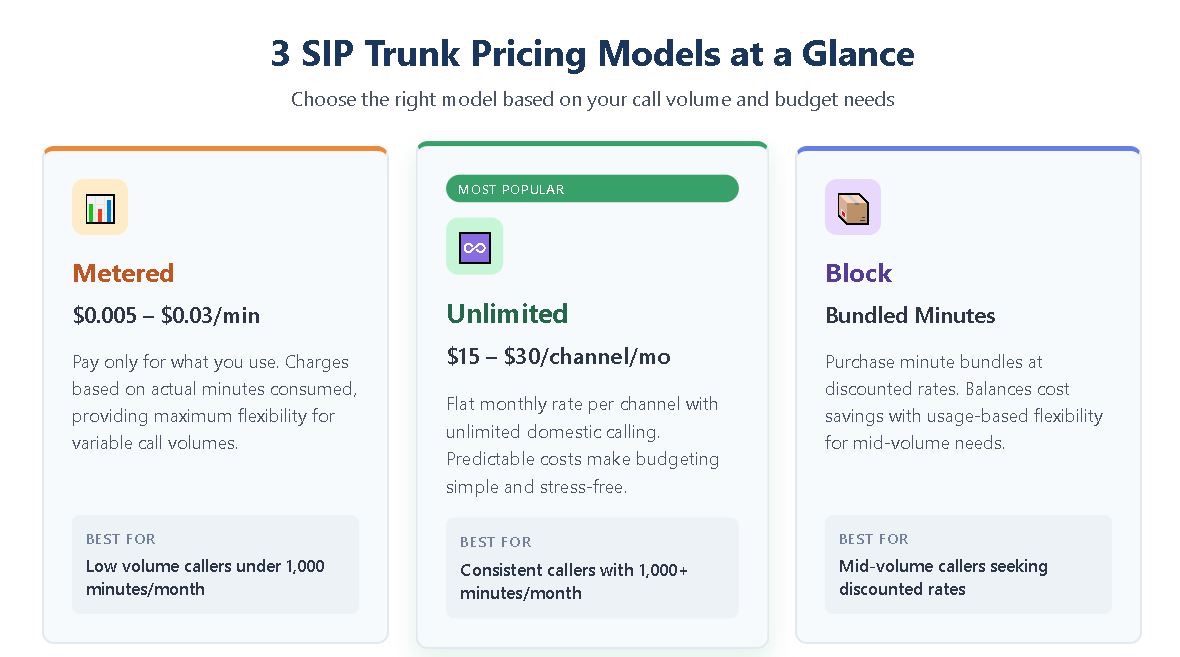
Selecting the appropriate VoIP trunking price structure requires matching your operational reality to the model that delivers the best value. The three primary pricing structures each serve different use cases, and recommending the wrong one can cost your business money or leave you exposed to unexpected charges.
When Does Metered Pricing Make Sense?
Metered pricing charges you based on actual usage, typically measured in minutes. This model works well for businesses with low or unpredictable call volumes. Organizations making fewer than 1,000 minutes of calls monthly often find per-minute billing more economical than paying for unlimited capacity.
Per-minute rates typically range from half a cent to three cents, depending on the destination and provider. The advantage of metered pricing is that you pay only for what you use. The disadvantage is budgeting uncertainty, as costs can spike during unexpectedly busy periods.
Metered plans suit seasonal businesses, organizations just starting out, or companies with primarily email-based communication. If your monthly call volume fluctuates dramatically, metered pricing provides flexibility without locking you into capacity you may not need.
Why Do Many Businesses Choose Unlimited Plans?
Unlimited SIP trunking plans deliver predictable monthly expenses regardless of call volume. For businesses with consistent calling activity, this model simplifies financial planning and eliminates the anxiety of watching minutes accumulate.
Most unlimited plans cover domestic calls within the continental United States and Canada. Calls outside this area incur per-minute charges based on destination. Typical unlimited channel pricing ranges from $15 to $30 monthly, with variations based on provider, term commitments, and included features.
The unlimited model resonates with small business owners who want a phone system that works without constant monitoring. For organizations making more than 1,000 to 1,500 minutes of calls per channel monthly, unlimited plans almost always prove more economical than metered alternatives.
What Is Block Pricing, and Who Benefits?
Block pricing offers a middle ground between metered and unlimited models. Providers sell bundles of minutes at discounted rates, such as 2,500 minutes for a fixed monthly fee. You pay less per minute than with pure metered pricing while maintaining some usage-based cost control.
This model works well for mid-volume callers who want predictability without committing to fully unlimited service. The primary risk involves unused minutes, which typically expire at the end of each billing period. Analyzing three to six months of historical calling data helps determine whether block pricing offers genuine savings.

What Does SIP Trunk Pricing Look Like by Business Size?
Different organizations have distinct communication requirements, and those differences translate directly into pricing. Approximately 65% of companies in North America have now adopted SIP trunking as part of their communication strategy. Segmenting by company size provides useful benchmarks for budgeting purposes, though your specific needs may vary based on industry and communication patterns.
Small businesses with 1 to 25 employees represent the most price-sensitive segment. These organizations typically need 3 to 8 channels and prioritize simplicity over advanced features. Monthly costs generally fall between $50 and $200 for the SIP trunk service itself, plus additional fees for phone numbers and compliance features.
Mid-size organizations with 25 to 100 employees occupy a sweet spot for SIP trunking value. Channel requirements typically range from 8 to 25, with monthly costs between $200 and $750. At this scale, volume discounts may become available depending on the provider and commitment level. Mid-size organizations also tend to require more sophisticated SIP trunk provider features, including auto-attendants, call queues, and integration with business software systems.
Larger operations with more than 100 employees deploy 50 or more channels across potentially multiple locations. Monthly costs range from $1,500 to over $10,000, depending on scale. Custom pricing becomes common at this level, with per-channel costs decreasing for organizations committing to high channel counts.

What Hidden Costs Can Affect Your VoIP Trunking Price?
Transparent pricing builds trust, and understanding the full picture helps you avoid unexpected charges. The most common hidden costs in SIP trunking include several categories that don’t always appear in provider advertising.
Setup and activation fees, while increasingly rare, still appear in some arrangements. These one-time charges can range from nothing to several hundred dollars, depending on deployment complexity.
Number porting fees apply when moving existing phone numbers to a new SIP trunk service. Keeping your established business numbers maintains continuity for customers. Porting fees typically range from $10 to $25 per number, with some providers offering volume discounts.
Premium feature add-ons can accumulate quickly. Call recording, advanced analytics, and specialized integrations may require additional monthly fees. Understanding which features you actually need prevents paying for capabilities your business will never use.
How Can You Calculate Your True SIP Trunk Cost?
A practical SIP trunk cost calculator approach involves listing all expense categories and estimating your requirements for each. Start with the number of channels you need based on concurrent call requirements. Multiply by the per-channel rate for your chosen pricing model.
Add the cost of the phone numbers you require. Most businesses need at least one main number plus potentially additional direct lines or toll-free numbers. Include E911 fees for each location. Factor in estimated regulatory fees, which typically add 10% to 20% to your base costs.
Consider the value of features included in different packages. A slightly higher per-channel rate that includes robust features may prove more economical than a low base rate plus multiple add-on charges.

For businesses evaluating SIP trunking plans across multiple providers, creating a simple spreadsheet that captures all cost categories enables genuine comparison. The low-cost SIP provider on paper may not remain the least expensive option once all fees are factored into the analysis. Understanding how to choose a SIP provider involves evaluating total cost alongside reliability, features, and support quality.
Frequently Asked Questions About SIP Trunk Pricing
How many SIP channels does a typical small business need?
Most small businesses need one channel for every three to four employees. A company with 20 employees would typically require 5 to 7 channels to handle peak concurrent call volumes. Businesses with high phone activity, such as sales organizations or customer service teams, may need a higher ratio of channels to employees.
What is included in unlimited SIP trunk pricing?
Unlimited plans typically include unlimited calling to the continental United States and Canada at a flat monthly rate per channel. Phone numbers, toll-free service, and calls to destinations outside the covered area usually incur additional charges. Regulatory fees and E911 services may be included or charged separately, depending on the provider.
Can I switch between metered and unlimited pricing models?
Most providers allow you to change pricing models, though the process varies. Some permit mid-cycle changes while others require waiting until your next billing period. Review your service agreement for specific terms regarding plan modifications and any associated fees.
Are there setup fees for SIP trunk service?
Many providers have eliminated setup fees to compete for new customers. Always ask about setup costs before committing, as this one-time expense affects your first-month costs.
How do regulatory fees affect my total SIP trunk cost?
Regulatory fees, including Federal Universal Service Fund contributions and Telecommunications Relay Services charges, typically add 10% to 20% to your base monthly cost. These fees comply with federal requirements and appear on bills from all providers, though how they are presented varies between itemized charges and bundled pricing.
Start Saving on Business Communications Today
Understanding SIP trunk pricing empowers you to make informed decisions about your business communication. The right pricing model depends on your call volume patterns, growth trajectory, and preference for predictability versus usage-based billing. Most small and mid-size businesses find that unlimited plans deliver the best combination of value and simplicity.
SIP.US offers transparent pricing with no contracts, no setup fees, and unlimited channels starting at competitive rates. The platform supports any SIP-enabled PBX system and provides a self-service control panel that puts you in complete control of your communication services. Get started with a free trial and experience firsthand how affordable reliable business communications can be.

Mitch leads the Sales team at BCM One, overseeing revenue growth through cloud voice services across brands like SIPTRUNK, SIP.US, and Flowroute. With a focus on partner enablement and customer success, he helps businesses identify the right communication solutions within BCM One’s extensive portfolio. Mitch brings years of experience in channel sales and cloud-based telecom to every conversation.
Free SIP Trunk in 60 Seconds
Related Posts

What Is SIP? A Complete Guide to Session Initiation Protocol
Discover everything about SIP and how it revolutionizes communication. Learn what is SIP, its benefits, and how to implement it in your business for better connectivity.

What Is Internet Protocol? IP Definition and How It Works
Internet protocol is the addressing and routing system that gets every business call, email, and…

Analog Telephone Adapter: How to Choose an ATA for SIP
A single inexpensive device can keep your existing analog phones, faxes, and paging equipment working…