

How to Become a VoIP Reseller
The VoIP reselling opportunity has never been stronger, with the global market projected to reach $179 billion in 2026.
- Businesses continue shifting from legacy phone systems to internet-based voice solutions, creating steady demand for knowledgeable resellers.
- White-label VoIP programs offer self-service management, predictable pricing, and rapid deployment without infrastructure investments.
- SIP trunking delivers the reliability, security, and flexibility that small and mid-sized businesses require from their communications providers.
Building a VoIP reselling business today means positioning yourself for recurring revenue in a market showing double-digit annual growth.
Businesses across every industry are actively searching for affordable, reliable voice solutions that work with their existing systems. This demand creates opportunities for entrepreneurs, managed service providers, and IT professionals who want to expand their service portfolios. The path to becoming a successful VoIP reseller starts with understanding the business model, choosing the right partner program, and developing strategies to attract and retain customers.
The VoIP services market continues to expand as organizations recognize the limitations of traditional phone infrastructure. The global VoIP market reached $161.79 billion in 2025 and is growing at a CAGR of 11.04% through 2034. For resellers, this growth translates into a sustainable business model built on recurring monthly revenue rather than one-time sales.
This guide walks through everything you need to know about starting a VoIP reselling operation in 2026, from evaluating your readiness to selecting the features that matter most to your future customers.
What Does It Mean to Become a VoIP Reseller?
A VoIP reseller partners with a service provider to sell voice communication services under their own brand or as a value-added offering. Rather than building and maintaining telecommunications infrastructure, resellers leverage an established provider’s network while focusing on customer acquisition, support, and relationship management.
The reselling model works because it creates value at every level. The upstream provider handles complex technical operations, including network maintenance, regulatory compliance, and platform development. The reseller brings local market knowledge, personalized customer service, and bundled solutions that combine voice services with other IT offerings. End customers benefit from working with a trusted local partner who understands their specific business needs.
Understanding How to Sell VoIP to Business Customers
Learning how to sell VoIP services depends on your ability to communicate tangible benefits to potential customers. Business owners care about reliability, cost savings, and features that improve their operations. They want to know their phone system will work during critical moments and that their investment will deliver measurable returns.
Effective resellers focus conversations on business outcomes rather than technical specifications. Instead of explaining codec compression ratios, discuss how SIP trunking reduces communication costs by 25% to 65% compared to traditional phone lines. Rather than detailing failover protocols, emphasize that redundant network architecture means their customers can always reach them. This translation of features into benefits separates successful resellers from those who struggle to close sales.

Is 2026 the Right Time to Start a SIP Trunking Business?
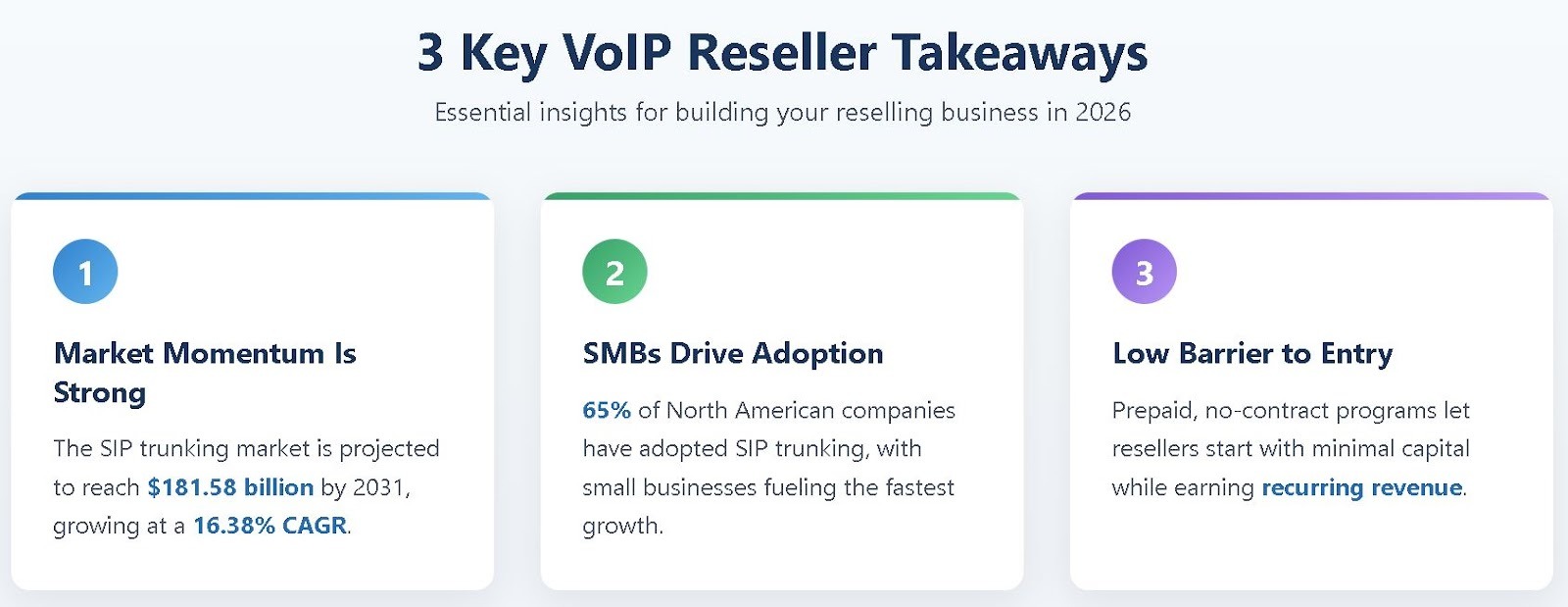
The market indicators strongly support entering the VoIP reselling space now. The SIP trunking market stands at $85.07 billion in 2026 and is projected to reach $181.58 billion by 2031, advancing at a 16.38% CAGR.
Several factors drive this acceleration. Traditional telephone infrastructure is aging, and carriers are actively decommissioning legacy networks. Businesses that haven’t yet transitioned face increasing pressure as maintenance costs rise and service quality declines. Simultaneously, remote and hybrid work arrangements have become permanent fixtures in many organizations, creating demand for flexible communication systems that work regardless of employee location.
The Small Business Opportunity
When you start a SIP trunking business, the first step is to know your audience. Small and mid-sized businesses are a fast-growing segment of VoIP adopters. These organizations often lack dedicated IT staff to independently evaluate and implement communication solutions. They need trusted advisors who can recommend appropriate solutions, handle implementation, and provide ongoing support.
Approximately 65% of companies in North America have adopted SIP trunking or plan to implement it as part of their communication strategy. While this figure translates to substantial market penetration, it also means millions of businesses still rely on outdated systems. Resellers are facing a large addressable market of companies actively seeking alternatives to expensive, inflexible legacy phone services.

VoIP Reseller Readiness Checklist
Before investing time and resources into building a VoIP reselling business, evaluate your current position against these success factors. This assessment helps identify areas requiring attention before launch.
Business Foundation Requirements
Your existing business infrastructure determines how quickly you can begin offering VoIP services:
- Legal business entity established with appropriate licensing for your jurisdiction
- Professional liability insurance that covers technology services and advice
- Accounting systems capable of tracking recurring revenue and managing customer billing
- Customer relationship management tools for tracking prospects and managing ongoing accounts
- Technical support processes, including ticketing systems and escalation procedures
Knowledge and Skills Assessment
Successful VoIP resellers combine technical understanding with sales and business management capabilities:
- Understanding of SIP trunking fundamentals, including how voice traffic traverses IP networks
- Familiarity with common PBX systems, such as Asterisk, FreePBX, 3CX, and similar platforms
- Knowledge of business telephony requirements, including call routing, voicemail, and auto-attendant features
- Sales experience or training with demonstrated ability to conduct needs assessments and close deals
- Customer service orientation with commitment to responsive support and problem resolution
Market and Competitive Analysis
Understanding your target market guides product selection and marketing strategy:
- Defined target customer profile specifying industry, company size, and geographic focus
- Competitive landscape assessment identifying other providers serving your target market
- Pricing research establishing market rates and acceptable margins for your region
- Partnership opportunities with complementary service providers who could refer customers
How Can You Sell VoIP Services Successfully?
Closing VoIP sales requires a consultative approach that uncovers customer pain points before proposing solutions. Businesses don’t buy SIP trunks because they want SIP trunks. They buy because they need reliable communication that costs less than their current system while supporting the way their team actually works.
Building Your Sales Process
Develop a repeatable process that moves prospects from initial contact through closed sale:
Discovery conversations should reveal current phone costs, system limitations, growth plans, and decision-making timelines. Ask about specific frustrations with their existing service. Find out what happens when their phone system goes down. Understand how employees work when they’re away from the office.
Solution presentations connect what you learned in discovery to specific capabilities. If a prospect mentioned difficulty adding phone lines when hiring seasonal workers, emphasize how SIP trunking scales instantly without hardware changes or long-term commitments. When budget concerns arise, present detailed cost comparisons showing monthly savings.
Proof and validation reduce the perceived risk for buyers evaluating unfamiliar technology. Offer free trials that let prospects experience service quality firsthand. Provide references from similar businesses in your customer base. Share case studies demonstrating successful implementations and measurable results.

Targeting the Right Customers
Not every business makes an ideal VoIP customer. Focus your efforts on organizations most likely to benefit from and purchase your services.
Mid-sized businesses with 20 to 200 employees are often an optimal target. They’re large enough to generate meaningful monthly revenue but small enough to lack internal telecom expertise. Industries with high call volumes and multiple locations, including healthcare practices, professional services firms, and retail operations, typically see the greatest return on their VoIP investment.
What Should You Look for in a White-Label VoIP Partner Program?
Your choice of upstream provider impacts your profitability, customer satisfaction, and operational efficiency. The right partner enables your success, while the wrong choice creates ongoing headaches that drain resources and damage relationships.
Essential Program Features
Evaluate potential partners against these critical criteria:
Network reliability and redundancy ensure your customers experience consistent call quality and minimal downtime. Look for providers operating on Tier-1 carrier networks with geographically distributed infrastructure. Ask about uptime guarantees and examine service level agreements carefully.
Self-service management capabilities let you handle routine tasks without submitting support tickets or waiting for provider assistance. The best programs offer comprehensive control panels where you can provision services, manage phone numbers, and adjust configurations instantly. This autonomy speeds your response time to customer requests and reduces operational friction.
Transparent, predictable pricing allows accurate quoting and maintains healthy margins. Avoid programs with complex pricing structures, hidden fees, or usage-based charges that create billing surprises. Prepaid models with flat monthly rates per channel simplify financial planning for both you and your customers.
Flexible contract terms protect your business from lock-in and allow adjustments as market conditions change. Programs requiring long-term commitments or imposing penalties for cancellation limit your flexibility and increase risk. The ability to add or remove services without penalties gives you room to experiment and adapt.
Fraud protection and security features safeguard both you and your customers from threats. International call fraud can generate thousands of dollars in charges within hours. Effective providers implement real-time monitoring that detects suspicious patterns and automatically blocks unauthorized usage before damage occurs.
White-Label VoIP Branding Options
True white-label programs let you present services entirely under your own brand. Customers interact with your company name, your support contacts, and your billing systems. They shouldn’t know or care who provides the underlying infrastructure.
Evaluate how completely you can customize the customer experience. Can you brand the control panel with your logo? Will customer-facing communications come from your domain? Does the provider handle billing in your name or theirs? The answers determine whether you’re building your own business or merely referring customers to someone else’s platform.
Seven Steps to Launch Your VoIP Reselling Business
Follow this sequence to move from decision to revenue as efficiently as possible.
1. Select your niche and define your ideal customer. Attempting to serve everyone serves no one well. Choose specific industries or company sizes where you have existing relationships, relevant expertise, or competitive advantages.
2. Research and compare partner programs. Request detailed information from multiple providers. Test their support responsiveness before committing. Evaluate their control panel capabilities and documentation quality.
3. Complete legal and compliance requirements. Depending on your location and service offerings, you may need specific licenses or registrations. Consult with legal counsel familiar with telecommunications regulations in your market.
4. Establish your pricing and packaging strategy. Develop rate cards and service bundles that deliver value to customers while maintaining sustainable margins. Consider offering tiered packages that accommodate different budget levels and feature requirements.
5. Create sales and marketing materials. Develop professional collateral, including one-page overviews, detailed proposal templates, and comparison charts showing advantages versus traditional phone systems. Build a website that clearly communicates your value proposition.
6. Build operational processes. Document procedures for onboarding new customers, handling support requests, and managing billing. Create training materials for any staff who will assist with sales or support functions.
7. Begin prospecting and selling. Start conversations with your warmest leads while continuing to build your prospect pipeline. Track results carefully and refine your approach based on what works in your specific market.
Frequently Asked Questions
What is the difference between a VoIP reseller and a VoIP agent?
A VoIP reseller purchases services wholesale and sets their own pricing, maintaining control over customer relationships and billing. An agent refers customers to a provider in exchange for commissions but doesn’t own the customer relationship. Resellers typically earn higher margins but assume more responsibility for support and customer satisfaction.
How much capital do I need to start a SIP trunking business?
Startup costs vary based on your approach. Resellers using prepaid, no-contract programs can begin with minimal investment beyond marketing and basic business infrastructure. You’re not purchasing inventory or building infrastructure, which keeps initial capital requirements low compared to many service businesses.
Can I become a VoIP reseller without technical experience?
While deep technical expertise isn’t mandatory, a basic understanding of VoIP concepts, network fundamentals, and common phone system types improves your effectiveness. Many resellers partner with technical consultants for complex implementations while handling sales and customer relationships themselves.
How long does it take to generate meaningful revenue as a VoIP reseller?
Timeline varies based on your existing network, sales experience, and market conditions. Resellers with established customer relationships in complementary services often close their first accounts within weeks. Building from scratch typically requires several months of consistent prospecting before revenue reaches meaningful levels.
Take the First Step Toward Building Your VoIP Business
The VoIP reselling opportunity combines favorable market dynamics with a business model that generates predictable recurring revenue. Businesses need reliable, affordable communication solutions, and they prefer working with knowledgeable local partners who understand their needs. Whether you’re an established MSP adding voice services to your portfolio or an entrepreneur starting fresh, the fundamentals remain consistent: choose the right partner, understand your customers, and deliver excellent service.
SIP.US provides resellers with the foundation for success through instant provisioning, an intuitive self-service control panel, and predictable prepaid pricing with no contracts. Our SIP trunking solutions deliver guaranteed uptime on a Tier-1 redundant network, robust fraud protection, and compatibility with virtually any SIP-enabled PBX system. Get started with a free trial today and experience how straightforward VoIP reselling can be.

Mitch leads the Sales team at BCM One, overseeing revenue growth through cloud voice services across brands like SIPTRUNK, SIP.US, and Flowroute. With a focus on partner enablement and customer success, he helps businesses identify the right communication solutions within BCM One’s extensive portfolio. Mitch brings years of experience in channel sales and cloud-based telecom to every conversation.
Free SIP Trunk in 60 Seconds
Related Posts

What Is a DID Number? Direct Inward Dialing Explained
Unlock the potential of your communication system with our Beginner’s Guide to DID Numbers and SIP Trunks, offering cost-effective, scalable solutions for modern businesses and individuals.

What Is SIP? A Complete Guide to Session Initiation Protocol
Discover everything about SIP and how it revolutionizes communication. Learn what is SIP, its benefits, and how to implement it in your business for better connectivity.

What Is Internet Protocol? IP Definition and How It Works
Internet protocol is the addressing and routing system that gets every business call, email, and…