

SIP vs VoIP: What’s the Difference and What Do You Need?
Understanding SIP vs VoIP is essential for any business looking to modernize its communications without overspending or overcomplicating operations.
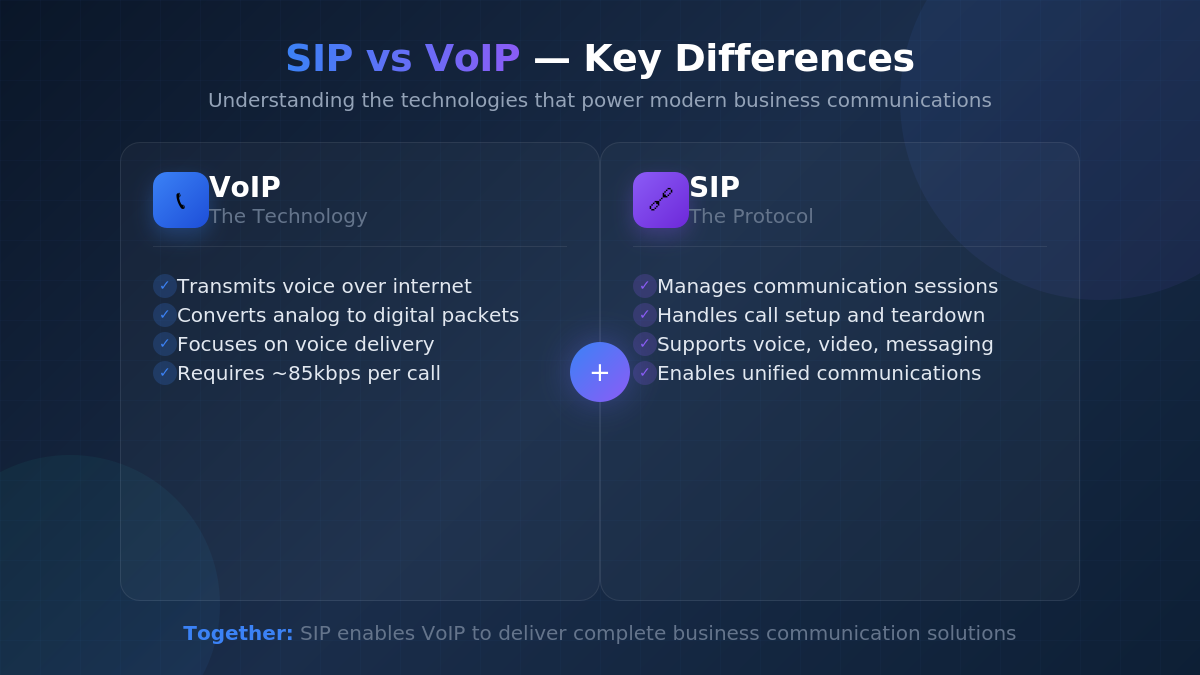
- VoIP is the technology that transmits voice calls over the internet, while SIP is the protocol that manages how those calls are established, maintained, and terminated.
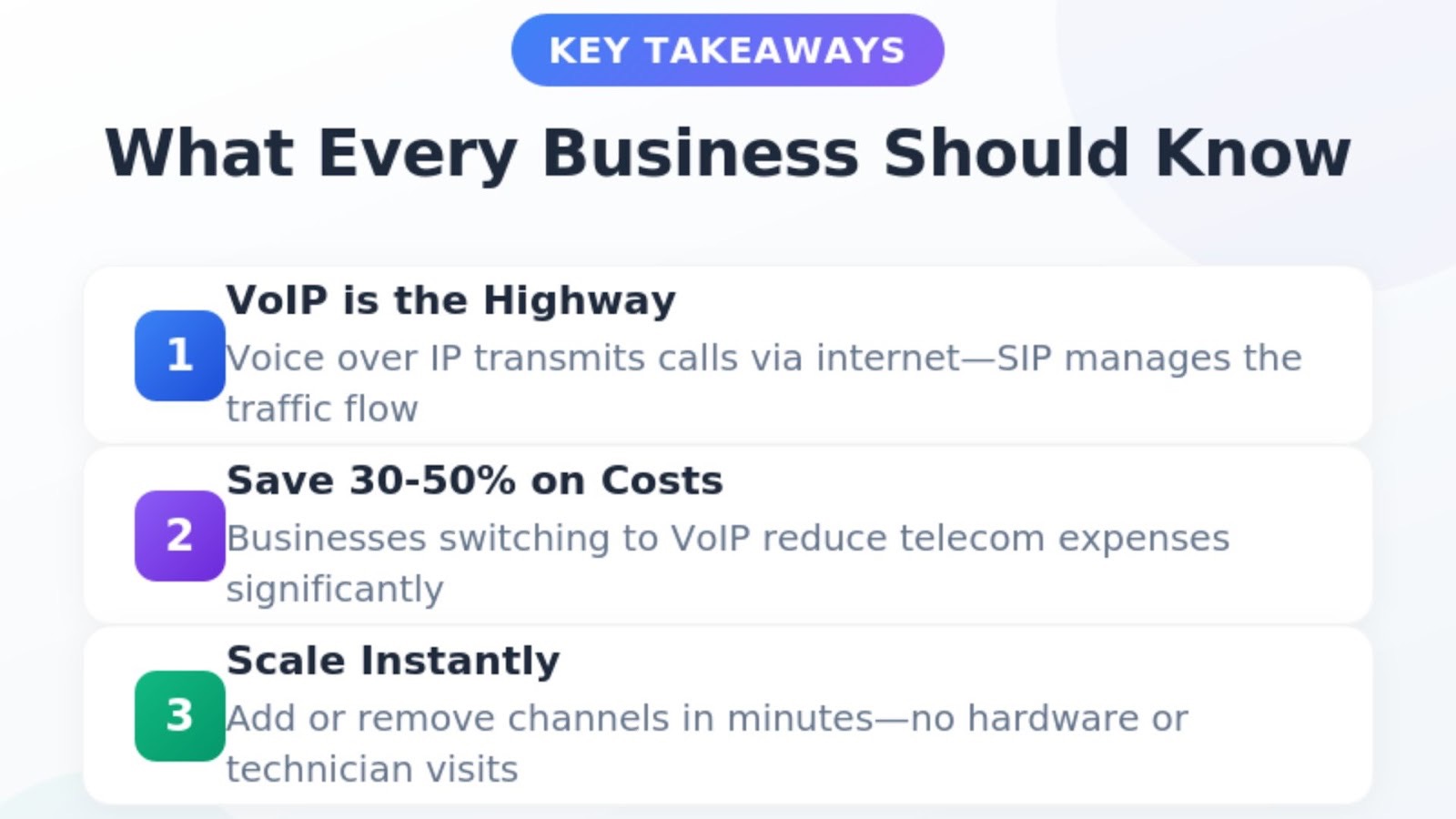
- Businesses using internet-based phone systems typically save between 30% and 50% on communication costs compared to traditional landlines.
- SIP trunking expands VoIP capabilities beyond voice to include video conferencing, messaging, and unified communications through a single platform.
Evaluate your current call volume, remote work requirements, and integration needs before selecting a solution.
Business owners and IT managers frequently encounter the terms SIP and VoIP when researching modern phone systems, yet the distinction between them remains unclear for many decision-makers. This confusion can lead to costly mistakes when upgrading communication infrastructure or negotiating with service providers. The global VoIP market reached $144.77 billion in 2024, with projections suggesting growth to over $326 billion by 2032. This expansion reflects the shift toward internet-based solutions that offer greater flexibility and lower costs.
Getting the terminology right matters because it directly impacts your purchasing decisions. A business that understands how SIP vs VoIP work together can negotiate better contracts, implement more effective solutions, and avoid paying for capabilities that duplicate existing infrastructure. Whether you operate a five-person startup or manage communications for a growing mid-sized company, this clarity saves both money and frustration.
What Is VoIP and How Does It Work?
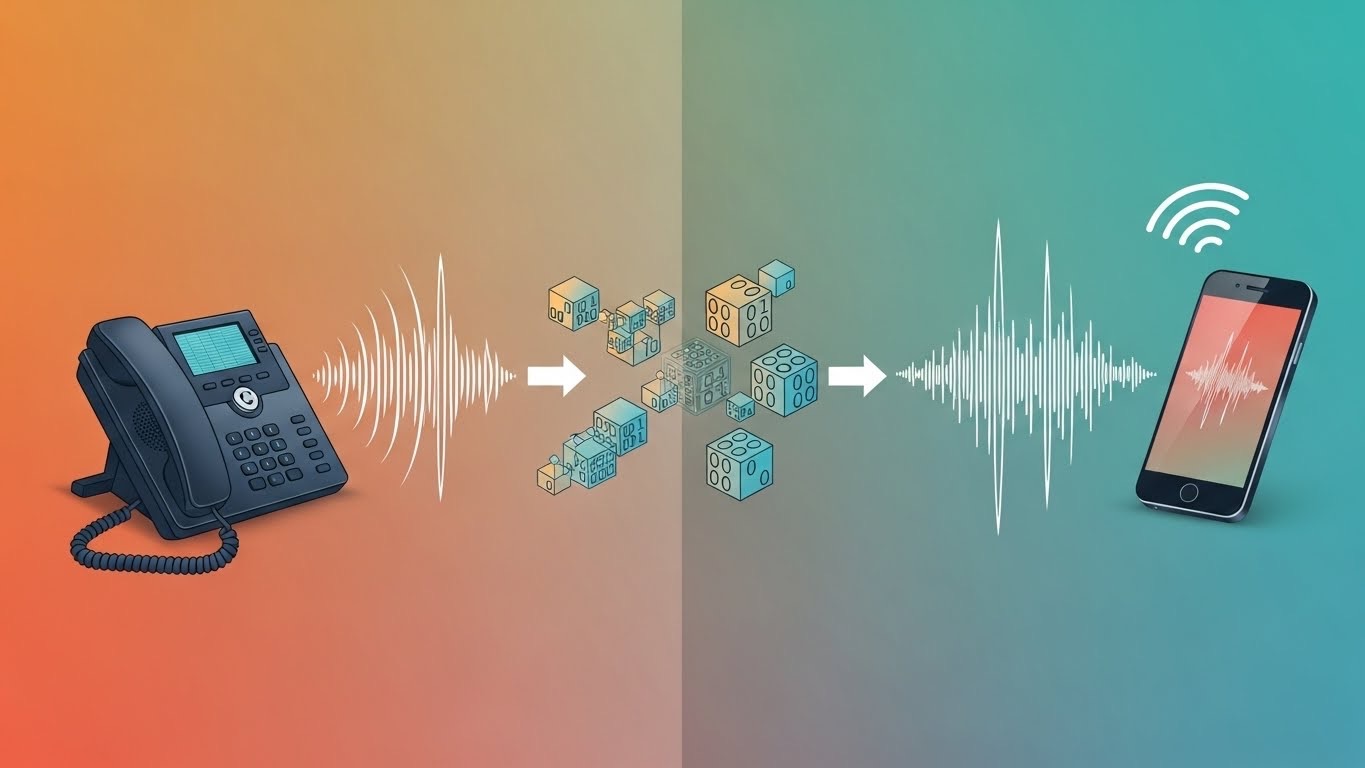
Voice over Internet Protocol allows telephone calls to travel over the internet. Rather than relying on dedicated copper wires and circuit-switched networks, VoIP converts voice signals into digital data packets that travel alongside other web traffic.
The Technical Process Behind VoIP
When you speak into a VoIP-enabled device, your voice undergoes a transformation. Analog sound waves hit the microphone and get converted into digital information through a process called encoding. These encoded voice packets then travel across your internet connection to reach the recipient, where the process reverses and converts the data back into audible sound.
The G.711 codec, one of the most common standards, consumes approximately 85kbps of bandwidth per call. This modest requirement means that businesses with standard broadband connections can typically handle multiple simultaneous calls without quality degradation. For situations where bandwidth is limited, compressed codecs like G.729 reduce this requirement further while maintaining acceptable call clarity.
Why Businesses Choose VoIP Over Traditional Lines
Traditional phone service requires dedicated physical infrastructure, monthly per-line charges, and separate billing for long-distance calls. VoIP consolidates these expenses into a predictable monthly rate that typically includes unlimited domestic calling. Businesses can experience average savings between 30% and 50% after switching to VoIP, with some organizations reporting reductions up to 75% depending on their previous infrastructure.
VoIP delivers flexibility that traditional systems can’t match. Employees can make and receive business calls from laptops, smartphones, or tablets, regardless of their physical location. This capability has become essential as hybrid and remote work patterns continue reshaping how companies operate.
What Is SIP and How Does It Relate to VoIP?
Session Initiation Protocol provides the rulebook that governs how communication sessions get started, managed, and ended. If VoIP is the highway system that allows voice data to travel, SIP is the traffic management system that ensures calls connect correctly, route efficiently, and terminate cleanly.

SIP as the Foundation for Modern Communications
SIP handles the signaling aspects of a call rather than carrying the actual voice data. When you dial a number using a SIP-enabled system, the protocol sends messages that establish who is calling whom, what capabilities each endpoint supports, and how the media stream should be configured. Once the call connects, other protocols like RTP (Real-time Transport Protocol) take over to actually transmit the voice packets.
This separation of signaling from media transmission provides advantages. SIP can simultaneously manage multiple types of communication sessions, including voice calls, video conferences, instant messaging, and presence information. A single SIP session can transition between different media types without requiring separate connections for each.
SIP Trunking: Connecting Your PBX to the World
For businesses operating private branch exchange (PBX) systems, SIP trunking replaces traditional telephone lines with virtual connections. A SIP trunk acts as a bundle of channels that can each handle one concurrent call, whether inbound to your business or outbound to customers.
The beauty of SIP trunking lies in its flexibility. Adding capacity requires no physical installation or technician visits. Businesses can increase their channel count during busy seasons and reduce it during slower periods, paying only for the capacity they actually use. This on-demand scalability was previously available only to large enterprises with significant IT resources.
What Are the Key Differences Between SIP vs VoIP?
While these technologies work together, understanding their distinct roles helps clarify which capabilities matter most for your specific situation. The SIP vs VoIP comparison becomes clearer when examined across several dimensions.
Technology Type and Function
VoIP describes a category of technology rather than a specific implementation. Any system that routes voice calls over internet protocol networks qualifies as VoIP, regardless of the underlying protocols or architecture used. This broad umbrella includes everything from consumer smartphone apps to sophisticated enterprise unified communications platforms.
SIP, by contrast, is one specific protocol among several that can enable VoIP functionality. While SIP has become the dominant standard for business communications, alternatives exist. However, SIP’s flexibility and widespread adoption have made it the de facto choice for organizations seeking interoperability and advanced features.
Communication Capabilities
Basic VoIP implementations focus primarily on voice calling. They successfully replace traditional telephone service for making and receiving calls but may not support additional communication channels. Many consumer VoIP applications fall into this category, offering phone service without extensive additional features.
SIP-enabled systems support unified communications. The same infrastructure can handle video conferencing with multiple participants, real-time chat and messaging, presence indicators showing colleague availability, and file sharing during collaboration sessions. This convergence eliminates the need for separate tools for each communication type.
Five Critical Distinctions for Business Decision-Making
Scope of functionality: VoIP handles voice transmission; SIP manages the entire session lifecycle across multiple media types.
Integration potential: SIP provides standardized interfaces that connect with CRM systems, help desk software, and other business applications. Pure VoIP solutions may lack these integration hooks.
Scalability mechanisms: VoIP scales by adding bandwidth and devices. SIP scales by provisioning additional channels through provider portals, often within minutes.
Vendor flexibility: SIP’s open standards allow businesses to mix equipment and services from different vendors. Proprietary VoIP platforms may lock you into a single ecosystem.
Business continuity features: SIP trunking includes failover capabilities that route calls to backup destinations during outages. Basic VoIP may lack sophisticated disaster recovery options.
What Are the Benefits of VoIP for Small Businesses?
SMBs face unique challenges that make VoIP for small businesses particularly attractive. Limited budgets require maximum value from every technology investment, while growth ambitions demand solutions that can scale without major overhauls.

Immediate Cost Reduction
The most tangible benefit appears on the monthly telecommunications bill. Traditional phone service charges per line, per minute for long distance, and often includes various fees that add up quickly. VoIP consolidates these costs into predictable per-user or per-channel pricing. Businesses with multiple locations particularly benefit, as internal calls between sites typically incur no additional charges.
VoIP eliminates many upfront capital expenses. Traditional phone systems require purchasing and maintaining on-premise PBX equipment, running dedicated wiring to each desk, and contracting with technicians for any changes. Cloud-based VoIP requires only internet-connected devices that most offices already possess.
Professional Image Without Enterprise Budgets
Small businesses can now present the same professional phone experience as much larger competitors. Auto-attendant systems route callers to appropriate departments or individuals without requiring a dedicated receptionist. Hold music and custom greetings reinforce brand identity during every customer interaction.
Call queuing ensures that inbound calls during busy periods never simply ring endlessly or go to voicemail. Customers hear their estimated wait time and can choose to wait or request a callback, improving satisfaction even during high-volume periods.
Remote Work Enablement
The ability to work from anywhere has transformed from a nice perk into a business necessity. VoIP systems treat every device as a potential business phone, whether employees sit at office desks, work from home, or travel to client sites. Calls to business numbers can ring simultaneously on desk phones, mobile devices, and computer softphones.
Businesses can hire talent regardless of geographic location, establish remote customer service operations, or maintain business continuity during office disruptions. The phone system simply follows wherever employees happen to be working.
What Should You Look for in a SIP Trunk Provider?
Selecting the right SIP trunk provider directly impacts call quality, reliability, and overall communication effectiveness. The market includes dozens of options ranging from specialized SIP-only providers to full-service unified communications vendors. Several factors separate adequate providers from excellent ones.
Network Reliability and Redundancy
Voice communications tolerate less disruption than most data applications. A web page that loads slowly frustrates users; a voice call that drops or breaks up damages customer relationships and productivity. Look for providers that maintain Tier-1 network connections with multiple geographic points of presence.
Redundancy should extend beyond the provider’s network to your own implementation. Quality providers offer failover options that route calls to backup destinations, whether alternative PBX systems, mobile phones, or PSTN numbers, when primary connections become unavailable. This capability prevents communication blackouts during internet outages or equipment failures.
Transparent Pricing Without Surprises
SIP trunking pricing models vary between providers. Some charge per minute for all calls, while others offer unlimited domestic calling for flat monthly fees. Neither model is universally superior; the right choice depends on your calling patterns.
Evaluate the total cost of ownership rather than focusing solely on per-channel rates. Setup fees, DID number charges, porting costs for existing numbers, and regulatory recovery fees all affect actual monthly expenses. The most transparent providers publish complete rate schedules and provide accurate quotes before requiring commitments.
Features That Match Your Requirements
Not every business needs every feature, but certain capabilities have become essential for modern operations. E911 support ensures that emergency calls route correctly regardless of where employees make them, a critical consideration for distributed workforces. CNAM (Caller ID Name) services ensure that your business name appears correctly when calling customers.
For businesses using PBX systems, verify compatibility before committing. Quality providers support any SIP-compliant equipment, including popular platforms like FreePBX, 3CX, Asterisk, and commercial systems from major manufacturers. They should also offer configuration assistance to ensure smooth implementation.
Which Technology Is Right for Your Business Phone System?
The SIP vs VoIP decision ultimately depends less on choosing between them than on understanding how they work together to support your business phone system. Most modern implementations combine both technologies, using VoIP for transmission and SIP for session management.
When Basic VoIP Suffices
Small teams with straightforward calling needs may find that hosted VoIP services meet their requirements without the complexity of managing SIP infrastructure. These turnkey solutions typically include softphone applications, basic call routing, and voicemail without requiring on-premise equipment or technical expertise.
This approach works well for businesses with fewer than ten employees, minimal call volume, and no need for advanced integration with other business systems. The simplicity appeals to organizations that prefer to focus on core business activities rather than telecom management.
When SIP Trunking Makes Sense
Organizations operating existing PBX systems find SIP trunking the logical upgrade path from traditional phone lines. Rather than replacing functional equipment, SIP trunking extends its capabilities while reducing costs. The PBX continues managing internal call routing, extensions, and features while SIP handles external connectivity.
Growing businesses also benefit from SIP’s scalability. Adding channels takes minutes rather than days, and capacity can be adjusted up or down as needs change. This elasticity supports seasonal fluctuations, rapid growth, or experimentation with new communication channels without significant capital commitments.
Making the Final Decision
Consider these questions when evaluating your options: How many concurrent calls does your business typically handle? Do you need video conferencing and messaging integrated with voice? Will employees work remotely or from multiple locations? Do you already operate PBX equipment that you want to retain? How important is integration with CRM or other business applications?
Businesses seeking cost-effective, flexible communication infrastructure increasingly find that SIP trunking delivers the best combination of capability and value. The technology has matured to the point where implementation complexity has decreased while feature sets have expanded dramatically.
Frequently Asked Questions
Can I use VoIP without SIP?
Yes, VoIP can function using protocols other than SIP, though SIP has become the dominant standard for business applications. Some consumer VoIP applications use proprietary protocols that work only within their own ecosystems. However, for business use where interoperability, feature richness, and vendor flexibility matter, SIP-based implementations provide advantages over proprietary alternatives.
How much bandwidth do I need for SIP trunking?
Each concurrent call using the standard G.711 codec requires approximately 85kbps of bandwidth in each direction. A business expecting ten simultaneous calls would need roughly 850kbps of dedicated capacity for voice traffic. Most modern business internet connections easily accommodate this requirement, though implementing Quality of Service (QoS) settings helps prioritize voice traffic during periods of heavy data use.
Will SIP trunking work with my existing phone system?
SIP trunking works with any SIP-compliant PBX system, including popular open-source platforms like Asterisk and FreePBX, as well as commercial systems from major manufacturers. Legacy PBX equipment that lacks native SIP support can often connect through gateway devices that convert between SIP and traditional interfaces. Consult with your provider to verify compatibility before implementation.
What happens to my phone service if my internet goes down?
Quality SIP trunk providers offer failover options that automatically redirect calls during internet outages. These can include routing to backup PBX systems at alternate locations, forwarding to mobile phones, or directing calls to PSTN numbers. Configuring these backup destinations in advance ensures that your business remains reachable even during connectivity disruptions.
Start Connecting Smarter Today
The distinction between SIP vs VoIP matters less than understanding how both technologies can serve your organization. Modern business communications require flexibility, reliability, and cost efficiency that traditional phone systems can’t deliver. Companies that embrace internet-based telephony position themselves for growth while reducing operational complexity.
SIP.US provides small and medium-sized businesses with enterprise-grade SIP trunking that transforms how you communicate. Our platform offers instant provisioning, transparent pricing, and the reliability your business depends on. Get started with a free trial from SIP.US and discover why organizations across the country trust us for their communication needs.

Mitch leads the Sales team at BCM One, overseeing revenue growth through cloud voice services across brands like SIPTRUNK, SIP.US, and Flowroute. With a focus on partner enablement and customer success, he helps businesses identify the right communication solutions within BCM One’s extensive portfolio. Mitch brings years of experience in channel sales and cloud-based telecom to every conversation.
Free SIP Trunk in 60 Seconds
Related Posts

What Is a DID Number? Direct Inward Dialing Explained
Unlock the potential of your communication system with our Beginner’s Guide to DID Numbers and SIP Trunks, offering cost-effective, scalable solutions for modern businesses and individuals.

What Is SIP? A Complete Guide to Session Initiation Protocol
Discover everything about SIP and how it revolutionizes communication. Learn what is SIP, its benefits, and how to implement it in your business for better connectivity.

What Is Internet Protocol? IP Definition and How It Works
Internet protocol is the addressing and routing system that gets every business call, email, and…