

AI Call Routing: What It Means for SIP and VoIP
Artificial intelligence is redefining how businesses handle voice communications by making call routing smarter, faster, and more responsive to customer needs.
- AI call routing uses machine learning and real-time data to instantly connect callers with the right person, eliminating frustrating menu trees and hold times.
- When integrated with SIP trunking and VoIP platforms, AI-powered routing reduces operational costs while improving first-call resolution rates.
- Smart assistants, predictive analytics, and sentiment analysis are now standard features in modern business phone systems.
- Businesses that delay adopting AI in telecommunications risk falling behind competitors who deliver faster, more personalized customer experiences.
For companies evaluating their communication infrastructure, understanding how AI transforms SIP and VoIP is essential for staying competitive.
Traditional call routing methods that rely on rigid menu systems and static rules are becoming obsolete as customer expectations shift toward instant, personalized service. The integration of artificial intelligence with SIP trunking is one of the most impactful developments in business telecom, enabling organizations to handle calls with unprecedented intelligence and efficiency.
The VoIP services market is projected to reach $752.41 billion by 2034, with AI-powered features driving much of this growth. The merging of AI call routing with existing phone systems is happening now across industries, from healthcare to financial services, fundamentally changing how companies connect with customers.
What Is AI Call Routing?
AI call routing is an advancement from conventional call distribution methods. Rather than forcing callers through predetermined menu options or routing based solely on agent availability, intelligent systems analyze multiple data points in real time to determine the optimal path for each interaction.
Traditional automatic call distribution (ACD) systems operate on basic rules: the next available agent receives the next call, regardless of context. AI-powered routing considers the caller’s history, intent, emotional state, and the specific expertise required to resolve their issue. This shift from reactive to predictive routing transforms the entire customer experience while simultaneously improving operational metrics.
Customer expectations have evolved. When someone calls a business, they expect immediate understanding and fast resolution. Every transfer, every repeated explanation, and every minute on hold damages satisfaction and loyalty. AI in telecommunications addresses these pain points by matching callers with the exact resources they need on the first try, reducing the friction that has historically plagued voice communication.
Modern AI call routing systems can improve customer service outcomes by analyzing factors that human operators can’t process quickly enough. Consider previous purchase history, current account status, the specific language in a voicemail, or patterns suggesting urgency or frustration. This real-time analysis enables routing decisions that would take humans minutes to make, delivered in milliseconds.
How Does AI Routing Work with SIP and VoIP Systems?
The technical foundation for AI-enhanced voice communication rests on the integration between intelligent software and existing telephony infrastructure. SIP with AI creates a powerful combination where the signaling protocol handles call setup and management while machine learning algorithms make intelligent decisions about call handling.
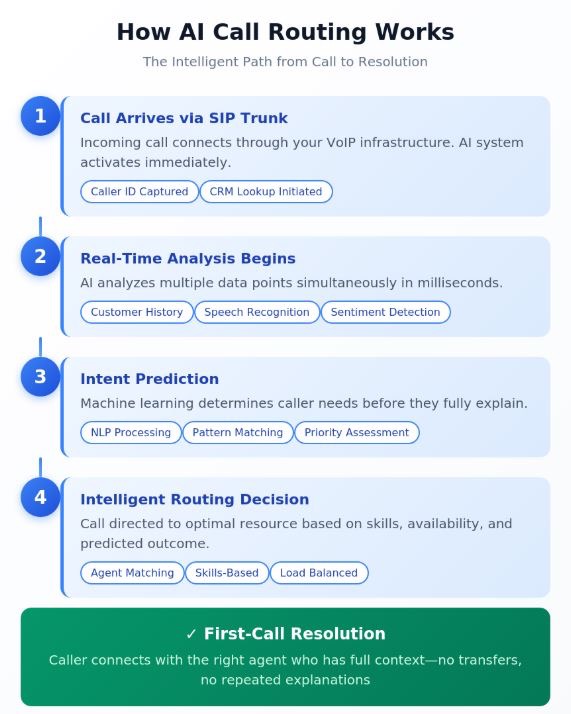
When a call arrives at an organization using AI-powered VoIP, the system immediately begins gathering information. Caller ID data connects to CRM records, pulling account history and previous interaction notes. Speech recognition systems analyze the first few words spoken to determine intent. Sentiment analysis tools assess tone and urgency. All of this happens before the call reaches any human agent.
Machine Learning and Pattern Recognition
Machine learning algorithms excel at identifying patterns in massive datasets, making them ideal for optimizing call routing. These systems learn from every interaction, continuously improving their predictions about which routing decisions lead to successful outcomes.
The patterns ML systems detect go beyond categorization. They identify correlations between call timing, customer segments, agent skills, and resolution success rates. Over time, the system recognizes that certain types of technical issues resolve faster with specific agents, that customers from particular regions prefer different communication styles, or that calls received at certain times require different handling approaches.

This pattern recognition enables predictive routing that anticipates needs before they’re expressed. When a customer who recently made a large purchase calls during business hours, the system might predict a high likelihood of a billing question and route accordingly. When call volume data suggests an impending spike, resources can be reallocated proactively rather than reactively.
Natural Language Processing in Call Flows
Natural language processing (NLP) has transformed interactive voice response systems into conversational interfaces. Rather than pressing buttons to navigate predetermined paths, callers can simply state their needs in natural language.
Advanced NLP systems understand context and nuance in ways that earlier voice recognition technology could not. They distinguish between “I need to pay my bill” and “I have a question about my bill,” routing each to different resources despite the superficial similarity. They recognize emotional indicators in speech patterns, identifying when a caller sounds frustrated or confused and adjusting routing priorities accordingly.
The integration of NLP with SIP VoIP service creates what many describe as conversational AI, systems that can handle entire interactions without human involvement while maintaining natural, flowing dialogue. These capabilities encompass appointment scheduling, basic troubleshooting, account inquiries, and many other common call types.
What Are the Benefits of AI-Powered Call Routing for Businesses?
Organizations implementing AI-powered call routing consistently report improvements across multiple operational and customer experience metrics. The benefits touch every aspect of voice communication.
Reduced Wait Times and Faster Resolution: Intelligent routing eliminates the trial-and-error approach of transferring calls between departments. By immediately analyzing intent and matching callers with appropriate resources from the start, organizations reduce the time customers spend waiting or being transferred. First-call resolution rates typically improve when the right agent handles the call from the beginning.
Improved Customer Satisfaction: Personalized routing demonstrates that a business understands and values each customer relationship. When callers reach agents who already have context about their history and needs, interactions feel more personal and efficient. AI-powered VoIP enhancements can raise customer satisfaction through faster response times and predictive call handling.
Lower Operational Costs: VoIP automation through AI reduces the human resources required for routine call handling while ensuring complex issues receive appropriate attention. Automated systems can entirely handle straightforward inquiries, freeing agents for higher value interactions.Conversational AI will reduce contact center agent labor costs by $80 billion by 2026, indicating the scale of efficiency gains possible.
Enhanced Agent Productivity: When AI handles call routing intelligently, agents receive calls matching their skills and expertise. This alignment improves both efficiency and job satisfaction, as agents spend less time on misrouted calls or issues outside their capabilities. Pre-call information delivered through CRM integration means agents begin conversations with context rather than asking customers to repeat themselves.
Scalable Call Handling: AI call routing systems scale effortlessly during volume spikes that would overwhelm traditional systems. Whether handling normal operations or managing crisis-level call volumes, intelligent routing maintains consistent performance without proportional increases in staffing requirements.

How Are Smart Assistants Changing VoIP Automation?
Virtual assistants powered by AI are the most visible transformation in business voice communication. These systems have evolved from simple automated attendants into sophisticated conversational agents capable of handling complex interactions independently.
Modern smart assistants integrated with VoIP systems perform tasks that previously required human agents. They schedule appointments, process payments, answer product questions, and guide customers through troubleshooting steps. The advanced features available through modern SIP trunking platforms now routinely include AI-powered capabilities that would have seemed futuristic just a few years ago.
The impact on VoIP automation extends beyond customer-facing interactions. AI assistants help businesses manage internal communications, automatically routing calls between departments, providing real-time transcription for accessibility and record-keeping, and analyzing conversations for quality assurance and training purposes. These capabilities transform telephone systems into comprehensive business intelligence platforms.
Smart assistants also address a persistent challenge in voice communication: after-hours coverage. Rather than routing to voicemail or third-party answering services, AI-powered systems can handle many inquiries 24/7 with the same quality as peak-hour human agents. For businesses serving customers across time zones or industries where availability is critical, this capability provides a competitive advantage.
What Should Businesses Consider Before Implementing SIP with AI?
Adopting AI-enhanced voice communication requires thoughtful planning to ensure successful implementation and maximum return on investment. Organizations must evaluate their current infrastructure, security requirements, and operational goals before moving forward.

Infrastructure Requirements
AI call routing systems require robust data infrastructure to function effectively. The real-time analysis that powers intelligent routing demands reliable, high-speed connectivity and integration with existing business systems. Organizations should assess their current PBX and SIP configuration to understand what modifications might be necessary.
Bandwidth considerations are important when implementing AI features. Voice traffic requires a consistent quality of service, and AI processing adds additional data requirements. Most modern broadband connections handle these demands adequately, but organizations with older infrastructure may need upgrades to achieve optimal performance.
Integration with CRM systems, helpdesk platforms, and other business applications determines how effectively AI routing can leverage customer data. Systems that operate in isolation lose much of the contextual advantage that makes AI routing valuable. Successful implementations typically involve comprehensive integration planning that connects voice systems with the broader technology ecosystem.
Security and Compliance
AI in telecommunications introduces additional security considerations that organizations must address. Voice data processed by AI systems may contain sensitive customer information, requiring appropriate encryption, access controls, and retention policies.
Regulatory compliance becomes more complex when AI analyzes conversation content. Industries with specific communication requirements, such as healthcare and financial services, must ensure AI implementations meet applicable standards. Recording and transcription capabilities, while valuable, require clear policies and customer consent where legally mandated.
Fraud detection is an area where AI actually enhances security rather than complicating it. Modern AI systems analyze call patterns in real time, identifying suspicious activity that might indicate toll fraud or social engineering attempts. Organizations tracking SIP trunking industry trends will notice that AI-powered security features have become increasingly standard in enterprise deployments.
Organizations should evaluate potential providers based on their security certifications, data handling practices, and track record with sensitive implementations. The right partner provides guidance on secure deployment and ongoing security management.
Frequently Asked Questions
What is the difference between traditional call routing and AI call routing? Traditional call routing uses static rules and predetermined menu trees to direct calls based on limited criteria like time of day or basic caller input. AI call routing analyzes multiple real-time factors, including caller history, intent recognition, sentiment, and agent expertise, to make intelligent routing decisions that optimize outcomes. The result is faster resolution, fewer transfers, and more personalized customer experiences.
Can AI call routing integrate with my existing phone system? Yes, AI call routing capabilities can integrate with most modern SIP-enabled PBX systems. The technology works through the SIP protocol layer, meaning businesses can often add AI features without completely replacing existing infrastructure. Implementation complexity varies based on the current system configuration and desired AI capabilities.
How does AI call routing improve customer satisfaction? AI call routing improves satisfaction by reducing wait times, eliminating unnecessary transfers, and connecting callers with agents best equipped to resolve their specific issues. When customers reach the right resource immediately and agents have context about their history and needs, interactions resolve faster and feel more personal.
Is AI call routing only beneficial for large enterprises? No, businesses of all sizes can benefit from AI call routing. Cloud-based SIP trunking services have made AI-powered features accessible to small and medium businesses without requiring massive infrastructure investments. Even organizations with modest call volumes can see improvements in customer experience and operational efficiency through intelligent routing.
What data does AI call routing use to make decisions? AI call routing systems analyze various data sources, including caller ID information, CRM records, previous interaction history, real-time speech analysis, sentiment indicators, agent availability and skills, and historical resolution patterns. The specific data utilized depends on system configuration and integration with other business platforms.
Ready to Bring AI-Powered Communication to Your Business?
Organizations that embrace AI call routing, intelligent automation, and smart assistants position themselves to deliver the fast, personalized experiences that modern customers expect while simultaneously improving operational efficiency.
The integration of AI with SIP trunking creates opportunities for businesses of all sizes to access capabilities that were previously available only to enterprises with massive technology budgets. Cloud-based implementations and pay-as-you-go pricing models make sophisticated AI features accessible to small and medium businesses ready to modernize their communication infrastructure.
SIP.US provides the reliable, feature-rich SIP trunking foundation that supports AI-enhanced voice communication. With Tier-1 network redundancy, an intuitive control panel, and seamless integration with popular PBX systems, SIP.US makes it straightforward to build the modern communication infrastructure your business needs. Get started today and discover how the right SIP trunking partner can transform your voice communications.

Mitch leads the Sales team at BCM One, overseeing revenue growth through cloud voice services across brands like SIPTRUNK, SIP.US, and Flowroute. With a focus on partner enablement and customer success, he helps businesses identify the right communication solutions within BCM One’s extensive portfolio. Mitch brings years of experience in channel sales and cloud-based telecom to every conversation.
Free SIP Trunk in 60 Seconds
Related Posts
SIP vs PBX: Which One Works Best for Your Business?
Choosing the right phone system can determine whether your business communicates efficiently or struggles with…

How SIP Trunking Helps Small Businesses Save on Communication Costs
Small businesses switching to SIP trunking typically reduce their telecommunication expenses by up to 50–60%…

The Ultimate Guide to SIP Trunking for Small Business Owners
SIP trunking for small business offers a proven path to lower phone costs, easier scaling,…