
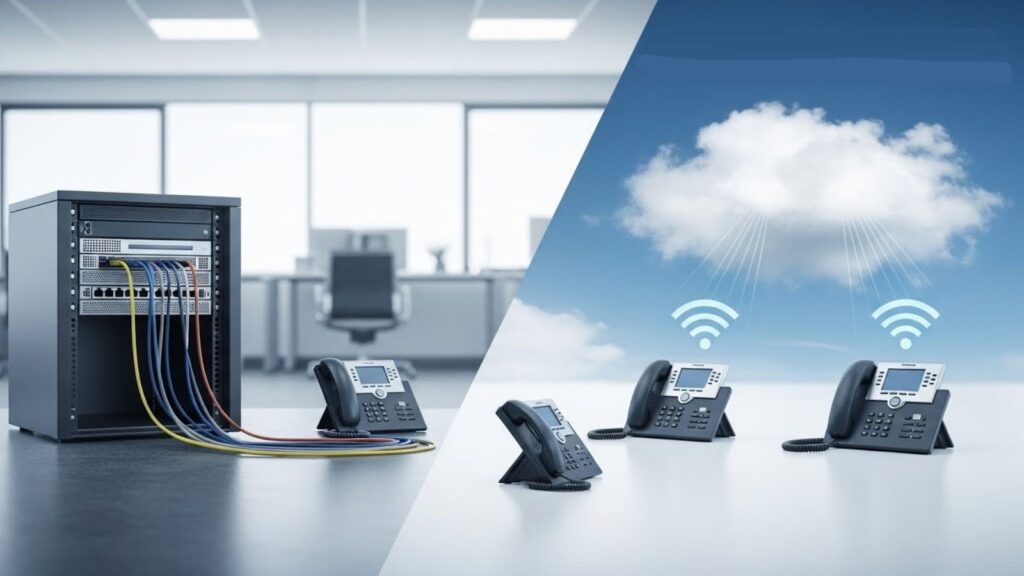
SIP Trunking vs Hosted PBX: Which Is Better for Small Businesses?
Small businesses gain more control and lower costs with SIP trunking, especially when they already have PBX infrastructure in place.
- SIP trunking connects your existing phone system to the internet, giving you ownership over hardware and call routing decisions.
- Hosted PBX eliminates on-site equipment entirely but locks you into a provider’s feature set and pricing structure.
- The right choice depends on your technical comfort level, existing infrastructure, and long-term communication goals.
Businesses seeking flexibility and cost transparency should evaluate SIP trunking before committing to fully managed services.
Choosing between SIP trunking vs hosted PBX is one of the most consequential technology decisions a small business can make. VoIP adoption among small and medium businesses has accelerated, with organizations reporting communication cost reductions up to 50 percent after transitioning from traditional phone lines.
But cost savings tell only part of the story. Your choice shapes everything from daily call management to disaster recovery capabilities. For business owners evaluating SIP trunking services, understanding the differences between these approaches prevents costly missteps and positions your company for sustainable growth.
What Is SIP Trunking, and How Does It Work?
With SIP trunking explained simply, it replaces traditional telephone lines by routing voice calls over your existing internet connection. The technology uses Session Initiation Protocol (SIP) to establish, manage, and terminate voice sessions between your private branch exchange (PBX) system and the public switched telephone network (PSTN).
A SIP trunk is a virtual phone line. Instead of physical copper wires connecting your office to the phone company, digital signals travel through your broadband connection. Your on-premise PBX handles all call management features while the SIP trunk provider handles the connection to outside phone networks.
How SIP Trunking Integrates with Your PBX
When a customer calls your business, the SIP trunk provider receives that call and routes it to your PBX over the internet. Your PBX then directs the call to the appropriate extension, auto attendant, or voicemail system based on rules you configure. Outbound calls work in reverse, with your PBX sending the call to your SIP trunk provider for delivery.
This architecture preserves your investment in existing phone equipment. If your business already operates a PBX system, SIP trunking allows you to modernize connectivity without replacing functional hardware. You maintain control over call routing, voicemail configuration, and every other aspect of your phone system.

The technical requirements are straightforward: a SIP-enabled PBX or analog telephone adapter for legacy systems, reliable broadband internet, and sufficient bandwidth for your call volume.
What Is Hosted PBX, and How Does It Differ?
Hosted PBX takes a different approach by moving the entire phone system to the cloud. Instead of maintaining physical PBX equipment at your location, a third-party provider hosts all telephony infrastructure in their data centers. Your business accesses phone services through IP desk phones or software applications that connect to the provider’s systems.
With hosted PBX, the provider manages everything: call routing logic, voicemail storage, auto attendant functionality, and system updates. Your business essentially rents phone service rather than owning the underlying technology.
The Managed Service Model
Hosted PBX appeals to businesses preferring predictable monthly expenses and minimal IT involvement. The provider handles maintenance, security patches, and feature upgrades. When something breaks, you contact their support team rather than troubleshooting the equipment yourself.
This convenience involves tradeoffs. Customization depends entirely on provider offerings. If their system lacks features you need or handles call routing differently than your workflow requires, options are limited to requesting changes or switching providers entirely.
How Do SIP Trunking Vs Hosted PBX Compare for Small Businesses?
Understanding the practical differences of SIP trunking vs hosted PBX helps clarify which approach aligns with your business requirements.
Control and Customization
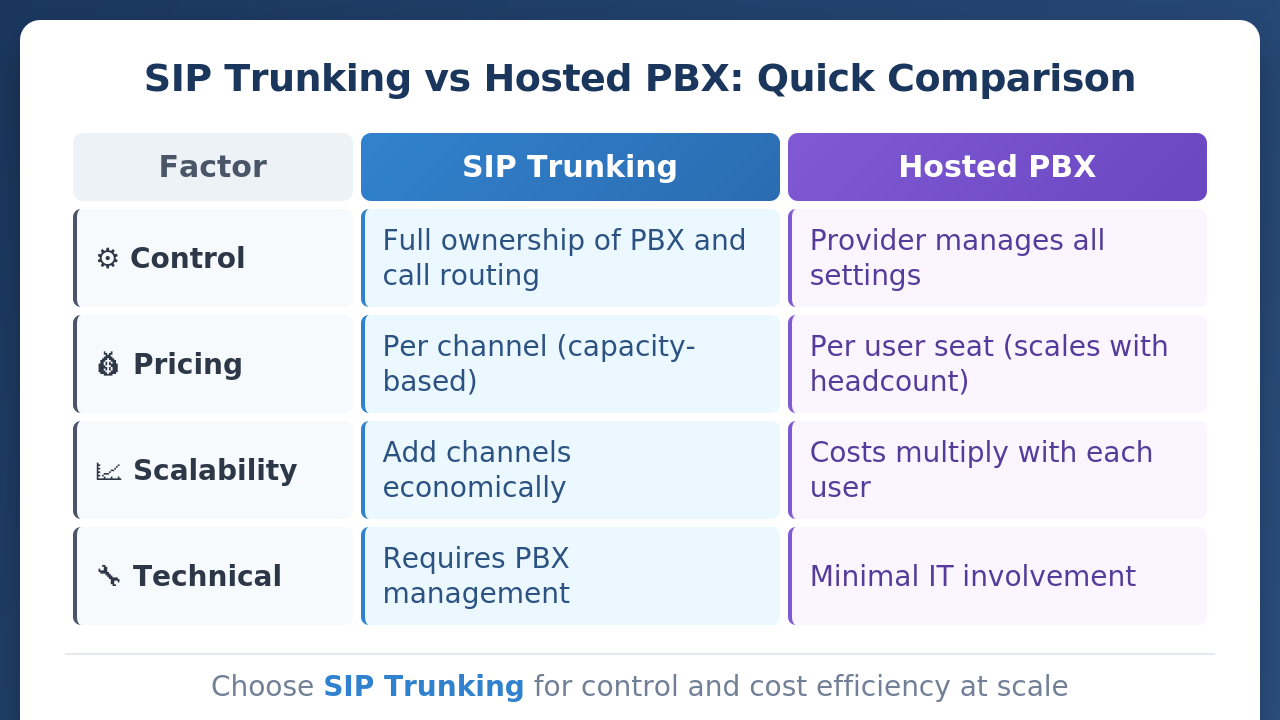
SIP trunking delivers maximum control. You own your PBX and can configure it precisely to your specifications. Complex auto attendants, custom call routing based on time of day or caller ID, and specialized software integrations all live on your equipment under your management.
Hosted PBX provides control within boundaries set by your provider. Standard features like call forwarding, voicemail, and basic auto attendant functionality come standard. Advanced customization depends on the provider’s platform capabilities.
Cost Structure and Transparency
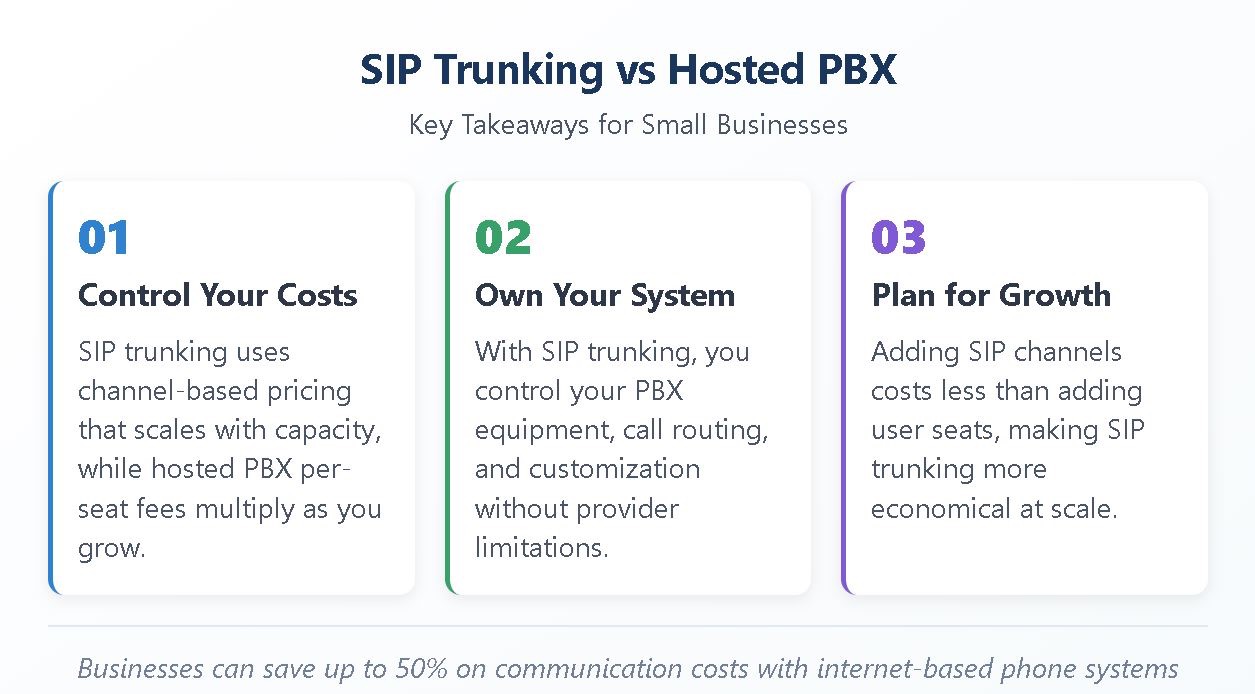
SIP trunking typically involves channel-based pricing. You pay a monthly fee for each concurrent call your system can handle, plus modest charges for phone numbers. This model delivers excellent cost transparency because expenses correlate directly with capacity.
Hosted PBX usually charges per user seat. While this model simplifies budgeting, per-seat pricing can escalate as your team grows. Some providers restrict features to higher-priced tiers, creating pressure to upgrade for capabilities that come standard with SIP trunking.
Technical Requirements and Management
SIP trunking requires someone comfortable managing PBX equipment. This individual might be an internal IT person, a managed service provider, or the business owner in smaller operations.
Hosted PBX minimizes technical demands. The provider handles infrastructure management, reducing the burden on your staff. However, you sacrifice independence and may find troubleshooting options limited when issues arise.
What Are the Real Costs for Small Businesses?
Cost comparisons between SIP trunking and hosted PBX require examining the total cost of ownership rather than monthly fees alone.
Upfront Investment
SIP trunking may require purchasing or upgrading PBX equipment if your current system isn’t SIP-compatible. Many businesses already have SIP-enabled phone systems, in which case, startup costs are minimal. Small businesses often realize ROI within the first year of switching to internet-based phone systems.
Hosted PBX typically requires only IP phones at each desk, though some providers include phone hardware in monthly pricing. This lower entry point appeals to businesses wanting to avoid capital expenditure, but ongoing costs deserve careful scrutiny.
Monthly Operating Expenses
A typical SIP trunking arrangement for a small business includes channel fees for concurrent call capacity, DID (phone number) charges, and internet connectivity that’s often already in place for other business needs.
Hosted PBX monthly costs typically include a per-seat fee multiplied by user count, plus add-on features or usage overages. For a 10-person office, hosted PBX commonly ranges from $200 to $400 monthly, depending on provider and feature tier. SIP trunking with equivalent capacity might run $100 to $200 monthly, plus the cost of maintaining your own PBX.
Small business owner analyzing communication costs and comparing phone system expenses.
Long-Term Financial Considerations
SIP trunking becomes more economical at scale. Adding capacity means purchasing additional channels rather than multiplying per-user fees. Businesses experiencing growth often find hosted PBX costs climbing faster than anticipated, making SIP trunking a more sustainable PBX alternative for growing organizations.
The equipment ownership aspect matters for long-term planning. Your PBX is a business asset you control. If circumstances change or a better SIP provider emerges, switching involves updating the configuration rather than migrating your entire phone system.
Which Option Offers Better Reliability for Small Business VoIP?
Reliability concerns rank high for businesses that depend on phone communication. Both options can deliver excellent uptime, but the factors affecting reliability differ.
SIP Trunking Reliability Factors
Your internet connection becomes the critical link. Quality of service (QoS) configuration ensures voice packets receive priority over other network traffic. Most broadband connections support multiple simultaneous calls without quality degradation when properly configured.
Reputable SIP trunk providers maintain geographically distributed infrastructure to eliminate single points of failure. You can enhance reliability further by configuring your PBX with failover routing to backup destinations.
Hosted PBX Reliability Factors
The quality of your provider’s infrastructure determines your experience. Established hosted PBX vendors invest heavily in redundancy and typically guarantee high uptime percentages. However, your dependency on their systems means their outages become your outages. Internet connectivity still matters, as calls traverse your connection to reach the provider’s cloud infrastructure.
Business Continuity Considerations
SIP trunking offers more options for business continuity planning. You can configure failover rules that automatically route incoming calls to mobile phones, alternate locations, or answering services when your primary PBX is unreachable.
Hosted PBX providers include some failover capabilities, but options depend on their platform. Customizing business continuity scenarios may require expensive add-ons or prove impossible depending on provider limitations.
How Do You Choose Between SIP Trunking and Hosted PBX?
The right choice between SIP trunking vs hosted PBX depends on your specific circumstances. Consider these questions when evaluating PBX alternatives.
Does Your Business Already Have Phone System Infrastructure?
Companies with existing PBX equipment benefit most from SIP trunking. Replacing functional hardware to adopt hosted PBX rarely makes financial sense. SIP trunking lets you modernize connectivity while preserving your current investment.
Businesses starting without phone infrastructure face a different calculation. The simplicity of hosted PBX may outweigh the long-term cost advantages of SIP trunking, particularly for very small teams with limited technical resources.
How Important Is Customization to Your Operations?
If your business has specific call handling requirements, complex routing needs, or integration requirements with other business systems, SIP trunking provides the flexibility to implement exactly what you need.
Businesses with straightforward phone needs may find hosted PBX features sufficient. Standard auto attendant, voicemail, and call forwarding functionality cover most basic requirements.
What Are Your Growth Expectations?
Small business VoIP systems should accommodate growth without punishing your budget. SIP trunking scales economically because adding channels costs less than adding per-seat licenses.
Stable operations with predictable staffing may find either option viable. The growth penalty inherent in per-seat pricing matters less when your user count isn’t increasing.
What Level of Technical Involvement Can You Support?
Be honest about your technical capacity. SIP trunking requires someone capable of basic PBX administration, even if that means occasional consultation with outside experts. If your business truly cannot support any technical involvement, hosted PBX removes that burden entirely.
Many small business owners underestimate their capabilities. Modern VoIP PBX platforms feature intuitive web interfaces that make common tasks straightforward.
Frequently Asked Questions
Can I switch from hosted PBX to SIP trunking without losing my phone numbers?
Yes, phone number portability allows you to transfer existing numbers to a new provider. The process typically takes one to two weeks. Most SIP trunking providers handle the porting process for you after you submit the necessary documentation and authorization.
How many SIP channels does a small business typically need?
A general guideline suggests one channel for every three to four employees, though actual needs vary based on call patterns. Businesses with high call volume need more channels. Most providers allow easy channel adjustments, so starting conservatively and scaling based on actual usage works well.
Does SIP trunking work with my existing desk phones?
SIP trunking works with your PBX system, which connects to your desk phones. If your current phones work with your PBX, they’ll continue working after implementing SIP trunking. The change affects how your PBX connects to outside phone networks, not how extensions connect internally.
What happens to my phone service if the internet goes down?
Most SIP trunking providers offer failover options that route calls to backup numbers when your primary connection is unavailable. Configuring a mobile phone or answering service as a failover destination ensures you never miss important calls during outages.
Start Building Your Communication Infrastructure Today
The SIP trunking vs hosted PBX decision comes down to how much control you want over your business communications. Hosted PBX trades flexibility for convenience, while SIP trunking rewards businesses willing to manage their own systems with lower costs and greater customization.
For small businesses with existing phone equipment, technical aptitude, or growth ambitions, SIP trunking frequently emerges as the superior choice. The combination of cost transparency, operational control, and scalability aligns well with how small businesses need to operate.
SIP.US provides reliable SIP trunking services designed specifically for small business needs, with straightforward pricing, instant provisioning, and no long-term contracts. Get started with a free trial and discover how SIP trunking can transform your business communications.

Mitch leads the Sales team at BCM One, overseeing revenue growth through cloud voice services across brands like SIPTRUNK, SIP.US, and Flowroute. With a focus on partner enablement and customer success, he helps businesses identify the right communication solutions within BCM One’s extensive portfolio. Mitch brings years of experience in channel sales and cloud-based telecom to every conversation.
Free SIP Trunk in 60 Seconds
Related Posts

What Is a DID Number? Direct Inward Dialing Explained
Unlock the potential of your communication system with our Beginner’s Guide to DID Numbers and SIP Trunks, offering cost-effective, scalable solutions for modern businesses and individuals.

What Is SIP? A Complete Guide to Session Initiation Protocol
Discover everything about SIP and how it revolutionizes communication. Learn what is SIP, its benefits, and how to implement it in your business for better connectivity.

What Is Internet Protocol? IP Definition and How It Works
Internet protocol is the addressing and routing system that gets every business call, email, and…