

SIP Trunking Providers: What’s the Difference?
Choosing among SIP trunking providers comes down to network ownership, contract terms, reliability guarantees, and how well a provider fits the phone system you already run.
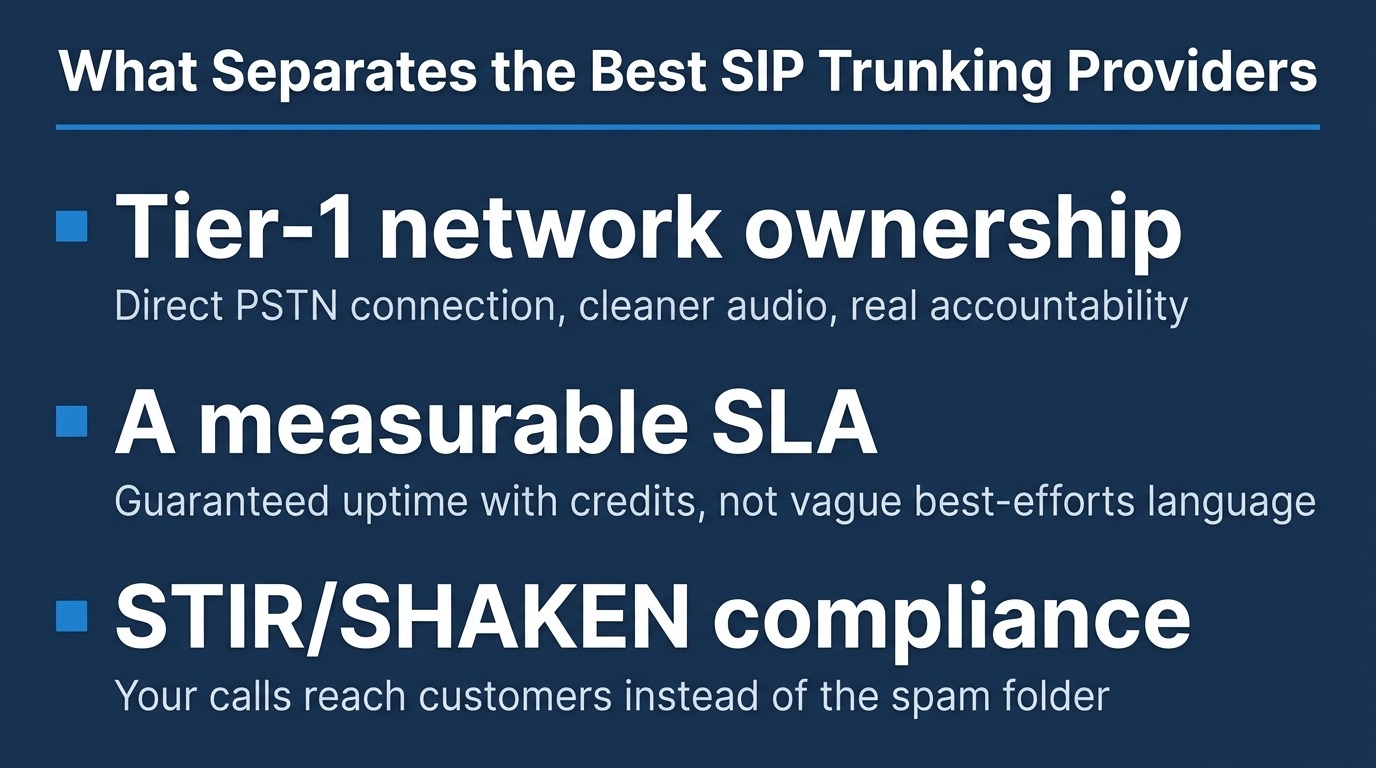
- The strongest providers operate their own Tier-1 networks, which means cleaner audio, lower latency, and direct accountability when something goes wrong.
- A meaningful service level agreement states uptime in measurable terms and defines the credits you receive when those commitments aren’t met.
- Deployment flexibility matters because on-premises, cloud, and hybrid models each suit different stages of growth and different IT capabilities.
- Compliance with federal call authentication rules separates legitimate carriers from providers whose calls get blocked or flagged as spam.
Before you compare price quotes, score each option against the reliability, deployment, and support criteria below so you pick a partner that fits today’s needs and tomorrow’s growth.
Business phone systems have moved decisively off copper lines and onto the internet. Industry research values the SIP trunking market at $73.14 billion in 2025, with a path to $181.58 billion by 2031. That growth has produced a crowded field of SIP trunking providers, each promising low rates, strong reliability, and a long list of features.
Price is usually the first thing buyers compare, and it’s tempting to sort the list by the lowest per-channel rate. That’s rarely the smartest filter. Providers that look identical on a rate sheet can differ sharply in network quality, contract flexibility, and the support you get when a call fails at the worst possible moment. This guide breaks down what actually separates one option from another, so you can match a provider to your business instead of chasing the cheapest line item.
What Should You Look for in SIP Trunking Providers?
Evaluating SIP trunking providers starts with a short list of factors that shape day-to-day performance and long-term cost. Work through each one before you request a quote because the answers often reveal more than any pricing page can.
How Important Is the Provider’s Network?
The quality of the underlying network determines call clarity, latency, and uptime more than any feature list does. The strongest providers run a Tier-1 network with gateways in multiple, geographically separate locations, which limits the chance that a single data center failure cuts off your calls. When you evaluate a SIP provider, ask who actually owns the network and where its points of presence sit, since many resellers can’t answer that question directly.
Can You Bring Your Own Connectivity?
Some vendors require you to buy internet access from them, bundling connectivity into the deal. That’s a profitable line of business for the provider, yet it limits your ability to shop for the best price and performance in your area. A provider that lets you choose your own broadband, whether cable, fiber, or Metro Ethernet, puts you in control of both cost and quality.
How Flexible Is Channel Scaling?
Business demand rarely holds steady, so you want to add or remove channels as call volume shifts. Look for a SIP trunk provider that supports month-to-month terms and self-service changes, rather than one that locks you into a multi-year contract for capacity you may not need. The ability to right-size quickly is one of the core advantages SIP holds over fixed PRI lines.
What Does the Pricing Actually Include?
A low headline rate can hide setup charges, toll-free fees, DID costs, and porting fees that change the real total. Read the full pricing structure before you commit, and confirm what’s bundled into each channel. Two providers with the same per-channel cost can land at very different monthly totals once every line item is counted.
Will It Work with Your Existing PBX?
Your provider has to support the IP-PBX you already run, or the migration becomes harder than it needs to be. Most modern systems are SIP-capable, and the leading open-source PBX platforms like Asterisk and FreeSWITCH work smoothly with quality trunks. Confirm compatibility early, and ask whether the provider will help configure the connection rather than leaving you to do it alone.
How Do SIP Trunk Providers Differ on Reliability?
Reliability is where SIP trunk providers separate themselves most clearly, and it’s harder to judge from a marketing page than price or features are. Three things deserve a close look: the carrier tier behind the service, the service level agreement, and the redundancy built into the network.
What Separates Tier-1, Tier-2, and Tier-3 Carriers?
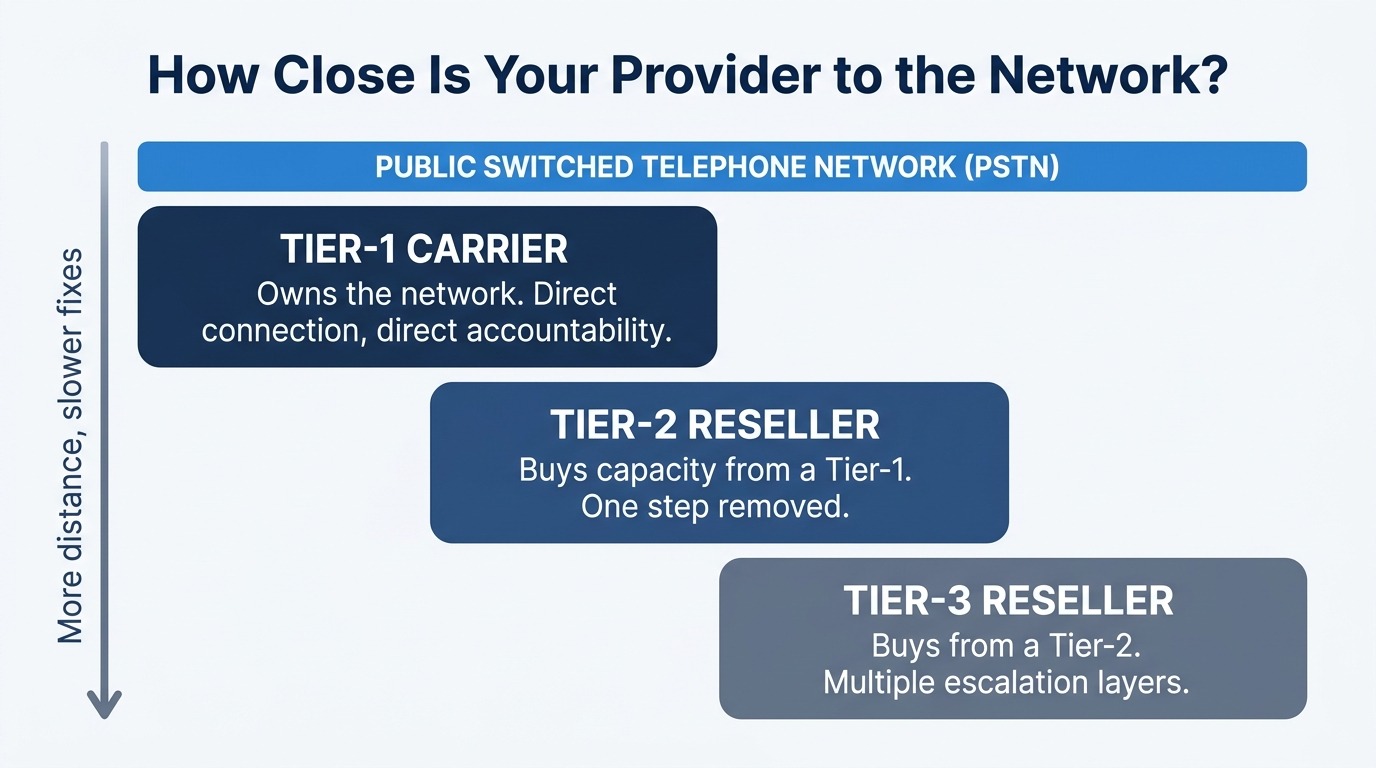
Carrier tier describes how close a provider sits to the public telephone network. A Tier-1 carrier owns its network and connects directly to the PSTN, which means fewer hops, better call quality, and direct accountability when you open a ticket. Tier-2 providers resell capacity from a Tier-1, and Tier-3 providers resell from a Tier-2, so each step adds distance and slows problem resolution. The table below shows how those differences play out.
| Factor | Tier-1 carrier | Tier-2 reseller | Tier-3 reseller |
| Network ownership | Owns the network | Buys from a Tier-1 | Buys from a Tier-2 |
| Call quality control | Direct | Indirect | Limited |
| Support accountability | Handles issues directly | Must escalate to the carrier | Multiple escalation layers |
| Typical pricing | Competitive at scale | Variable | Often lowest, with trade-offs |
What Should a Strong SLA Guarantee?
A service level agreement turns reliability promises into measurable commitments. Look for a specific uptime percentage, a clear method for how it’s measured, and defined credits when the provider misses the mark. A 99.99% uptime guarantee allows roughly 52 minutes of downtime a year, while 99.9% permits more than eight hours, so the decimals matter. Vague “best-efforts” language offers far less protection than numbers tied to remedies, and our guide on how to compare providers walks through how to weigh those terms side by side.
How Do Failover and Redundancy Protect You?
Even the best network needs a backup plan. Strong providers route inbound calls to a primary trunk, then a secondary trunk, and finally to a PSTN number if both fail, so one outage doesn’t silence your lines. Geographic redundancy across multiple data centers adds another layer, automatically shifting traffic when a single location has trouble. You can read more about how automatic failover and redundancy keep communications running during disruptions.

Why Does STIR/SHAKEN Compliance Matter?
Reliability now includes whether your calls actually reach the people you’re dialing. Under FCC rules, voice providers must authenticate calls using the STIR/SHAKEN framework to confirm caller ID and curb illegal spoofing. Calls from non-compliant providers are increasingly blocked or labeled as spam, which directly hurts your ability to connect with customers. Confirm that any provider you consider is registered and compliant because this aspect has become a baseline requirement for business SIP trunking.
Which Deployment Model Fits Your Business?
SIP trunking providers support several deployment models, and the right fit depends on your existing hardware, your IT resources, and how much control you want to keep in-house. Most businesses land in one of three approaches.
On-Premises PBX with SIP Trunks
If you already own an IP-PBX, connecting SIP trunks to it lets you keep that investment while replacing costly PRI lines. You retain full control over call routing and configuration, which appeals to teams with in-house technical expertise. The trade-off is that you’re responsible for maintaining the on-site equipment.
Cloud SIP Provider Deployments
A cloud SIP provider hosts the infrastructure for you, removing the need for on-premises servers and delivering instant scale. This model suits businesses that want disaster-recovery failover and rapid provisioning without managing hardware themselves. Our cloud SIP provider decision guide covers how to weigh these options in detail.
Hybrid Approaches
Many growing companies keep a primary PBX in-house while routing branch-office or remote calls through cloud-based trunks. This hybrid setup balances the control of on-premises equipment with the agility of the cloud. It’s a practical middle path for businesses modernizing in stages rather than all at once.
| Deployment model | Best for | Key advantage | Consideration |
| On-premises PBX | Teams with IT expertise and existing hardware | Full control over configuration | You maintain the equipment |
| Cloud SIP | Businesses wanting fast scale and minimal hardware | Instant provisioning and built-in failover | Relies on a strong internet connection |
| Hybrid | Multi-site or phased migrations | Balances control and agility | More moving parts to manage |
How Do You Compare SIP Trunking Providers? A 7-Point Checklist
Once you understand the categories that matter, a short checklist keeps your comparison consistent. Score each candidate against these questions before you sign anything.
- Network ownership. Does the provider run a Tier-1 network with redundant gateways or resell someone else’s capacity?
- SLA specifics. What uptime is guaranteed, how is it measured, and what credits apply when it’s missed?
- Contract terms. Are you locked into a long agreement, or can you scale channels month to month?
- Pricing transparency. Are setup, DID, toll-free, and porting fees disclosed up front?
- PBX compatibility. Will the service work with your current system, and will the provider help configure it?
- Failover design. Does the provider offer secondary trunk routing and PSTN backup?
- Compliance. Is the provider STIR/SHAKEN compliant and registered with the FCC?
Working through this list turns a confusing field of options into a side-by-side comparison you can defend. For a more detailed framework, our SIP provider checklist expands on each point.
Frequently Asked Questions
What’s the difference between a SIP provider and a SIP trunk provider?
The terms are often used interchangeably. Both refer to a company that supplies the SIP trunking service connecting your phone system to the public telephone network. Some providers also bundle additional unified communications features, so it’s worth confirming exactly what’s included before you compare prices.
How many SIP channels does my business need?
You need one channel for every simultaneous call. A practical starting point is to match your current number of analog lines or PRI channels, then add a small buffer for growth. Many providers let you adjust channel counts on demand, so you can refine the number as you learn your real usage patterns.
Are cloud SIP providers more reliable than on-premises setups?
A cloud SIP provider often includes built-in redundancy and failover that would be expensive to replicate on-site. Reliability ultimately depends on the provider’s network and your internet connection, so review the SLA and confirm the redundancy design either way.
What should I check before switching SIP trunking providers?
Confirm PBX compatibility, review the SLA and contract terms, verify STIR/SHAKEN compliance, and understand the full pricing, including any porting fees. Asking these questions up front prevents the most common and costly migration surprises.
Choose a Provider That Works for You, Not the Other Way Around
The cheapest option rarely turns out to be the best value once reliability, support, and contract terms enter the picture. Decide how hands-on you need your provider to be, whether you’re comfortable with a long-term contract, and how much your call volume is likely to change. When you take the time to weigh these factors, you protect your business from hidden costs and avoidable downtime.
If you’re ready to see what a Tier-1, contract-free option looks like in practice, SIP.US delivers business SIP trunking with no setup fees, self-service scaling, and a redundant network built for reliability. Get started with a free trial and test the service before you commit.

Mitch leads the Sales team at BCM One, overseeing revenue growth through cloud voice services across brands like SIPTRUNK, SIP.US, and Flowroute. With a focus on partner enablement and customer success, he helps businesses identify the right communication solutions within BCM One’s extensive portfolio. Mitch brings years of experience in channel sales and cloud-based telecom to every conversation.
Free SIP Trunk in 60 Seconds
Related Posts

SIP Trunks for Small Business: The Complete Buyer’s Guide
Small businesses are replacing phone lines with SIP channels because the pricing, scaling model, and…

How to Choose the Best Business Phone System for a Growing Small Business
Choosing the best business phone system comes down to three questions: how much control you…

SIP Trunk Cost Savings: A Buyer’s Guide to Pricing and ROI
Most businesses still running legacy voice circuits are overpaying every month, and the math to…