
The 5 Best PBX Systems for Your Business
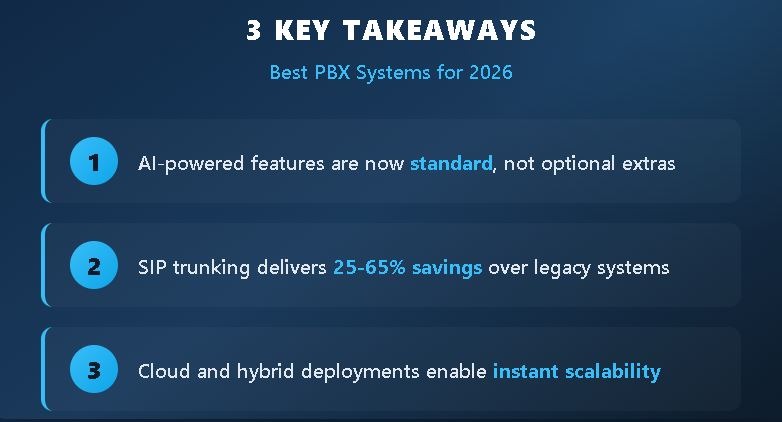
The business PBX market has transformed, with AI-powered features and cloud deployment becoming standard rather than optional.
- Cloud-based PBX adoption continues to accelerate, with the majority of enterprises planning full cloud migration within the next few years.
- AI integration delivers real-time transcription, intelligent call routing, and sentiment analysis across leading platforms.
- Businesses switching to modern IP PBX systems report telecommunications cost reductions of 25–65% compared to legacy circuits.
- The right business PBX eliminates hardware headaches while enabling seamless remote and hybrid work.
If your phone system still requires on-site maintenance or lacks unified communications capabilities, now is the time to modernize.
Selecting the right PBX system for your organization requires understanding how business communications have evolved. The VoIP market has grown to over $176 billion, with hosted IP PBX solutions driving the fastest expansion across businesses of all sizes. Traditional hardware-dependent systems are rapidly giving way to software-defined communication platforms that deliver enterprise-grade capabilities without enterprise-level complexity.
Modern PBX systems function as unified communication hubs that integrate voice, video, messaging, and collaboration tools into cohesive platforms. This consolidation reflects broader industry movement toward Unified Communications as a Service, where disparate communication tools combine into single, manageable solutions.
What Are the Best PBX System Options?
Business PBX solutions fall into distinct categories, each serving different organizational needs, technical capabilities, and budget considerations. Understanding these categories helps decision-makers identify which approach aligns with their operational requirements.
1. 3CX: Best Overall for Small to Mid-Sized Businesses
3CX has established itself as a leading choice for organizations seeking comprehensive functionality without enterprise-level complexity. The platform operates as an open-standards software PBX, allowing businesses to deploy on Windows or Linux servers, host through major cloud providers, or utilize 3CX-managed hosting.
The platform’s pricing model stands out in the industry. Rather than charging per user, 3CX licenses are based on simultaneous call capacity, making it exceptionally cost-effective for growing organizations. A business with 50 employees but typically only 10 concurrent calls pays for 10 channels rather than 50 user licenses.
Recent platform updates have introduced AI-powered features, including call transcription, AI receptionists, and intelligent analytics. The system integrates directly with popular CRM platforms, Microsoft 365, and offers native mobile applications. For businesses seeking modern capabilities without abandoning existing hardware investments, 3CX supports a wide range of SIP phones and integrates seamlessly with SIP trunking services from providers they choose.
2. FreePBX: Best for Technical Teams Seeking Customization
FreePBX, developed by Sangoma, is the most popular open-source IP PBX platform available. Built on the Asterisk communications framework, FreePBX provides a graphical interface for managing what would otherwise require command-line configuration.
The platform’s primary appeal lies in its flexibility and cost structure. The core software carries no licensing fees, allowing technically capable organizations to deploy sophisticated phone systems for hardware costs only. FreePBX excels in environments where unique requirements demand custom development. Call centers, managed service providers, and technical organizations regularly choose FreePBX for the ability to build precisely the communication flows their operations require.
However, this flexibility comes with corresponding technical requirements. Organizations without in-house expertise may find deployment and ongoing management challenging.
3. Grandstream UCM: Best Budget-Friendly On-Premise Solution
Grandstream’s UCM series delivers remarkable value for organizations preferring on-premise equipment without significant capital investment. These appliances provide comprehensive VoIP and IP PBX capabilities, including voicemail, call recording, interactive voice response, and video conferencing without recurring licensing fees.
The UCM platform scales from small installations handling a handful of extensions to mid-sized deployments supporting several hundred users. Organizations choosing Grandstream typically value predictable costs and physical control over their communication infrastructure. Retail locations, small professional offices, and healthcare facilities frequently deploy UCM systems for their combination of reliability, feature depth, and ownership economics.
4. Yeastar P-Series: Best for Growing Organizations
Yeastar positions its P-Series as a converged communication system purpose-built for small and medium enterprises. The platform unifies voice, video, applications, and collaboration tools while offering deployment flexibility across cloud, on-premise, or software-based installations.
The platform emphasizes ease of use for organizations lacking dedicated telecom staff. Visual call flow design, one-click provisioning for supported phones, and intuitive administration interfaces reduce the learning curve typically associated with business PBX management. Yeastar has invested heavily in mobile capabilities, with companion applications providing full extension functionality, including video calling, instant messaging, and presence information.

5. Microsoft Teams Phone: Best for Microsoft-Centric Organizations
Organizations heavily invested in Microsoft 365 increasingly consider Teams Phone as their business PBX solution. The platform integrates telephony directly into the Teams collaboration environment, creating unified experiences where calling, messaging, meetings, and document collaboration exist within single applications.
Teams Phone supports multiple connectivity options, including Microsoft Calling Plans, Direct Routing with existing SIP trunking relationships, and Operator Connect with certified carriers. The integration advantages prove substantial for Microsoft-focused organizations, with click-to-call functionality from Outlook contacts, voicemail transcription delivered to email, and automatic meeting bridge provisioning.
However, Teams Phone licensing adds costs beyond standard Microsoft 365 subscriptions. Organizations should evaluate total investment, including calling plans and phone number provisioning, against dedicated business PBX alternatives.
Where SIP.US fits. SIP.US is not a PBX. It is the SIP trunk service that connects a PBX to the phone network, so it works alongside the systems on this list instead of replacing them. 3CX, FreePBX, Grandstream UCM and Yeastar P-Series all connect to standard SIP trunks, and SIP.US is a 3CX certified SIP trunk partner.
How Do Different PBX Types Compare?
Understanding the fundamental differences between PBX architectures helps organizations match solutions to their specific circumstances and strategic priorities.
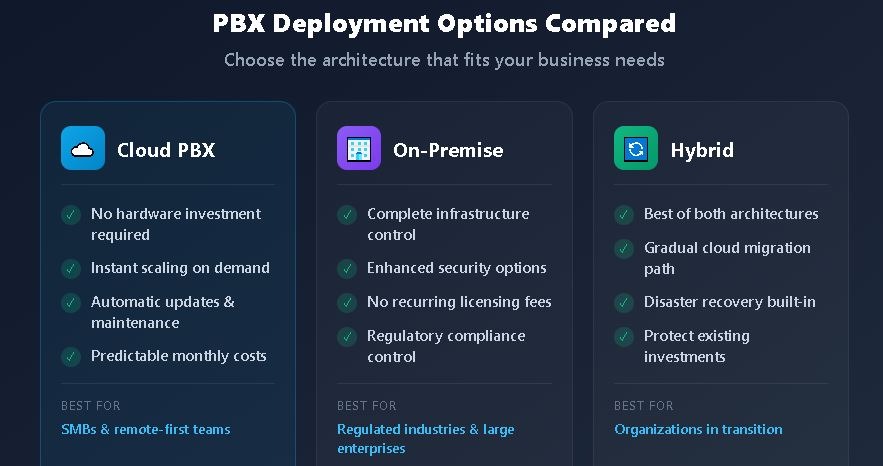
Cloud-Hosted PBX Systems
Cloud PBX platforms deliver communication capabilities entirely through internet-connected services managed by external providers. Organizations gain sophisticated features without purchasing, installing, or maintaining physical equipment beyond phones or softphone applications. Predictable monthly costs replace large capital investments, converting communication infrastructure from a fixed asset to an operational expense. Scaling becomes trivial since adding capacity requires subscription adjustments rather than hardware procurement.
On-Premise IP PBX Systems
On-premise deployments place communication infrastructure within organizational facilities under direct IT control. This architecture suits organizations with specific security requirements, regulatory constraints, or existing infrastructure investments worth preserving. Understanding the relationship between PBX and SIP becomes particularly important for on-premise deployments. SIP trunking connects on-premise systems to public telephone networks through internet connections, replacing costly traditional circuits.
Hybrid PBX Architectures
Hybrid approaches combine on-premise and cloud elements to address specific organizational requirements. A common configuration maintains core PBX functionality on-premise while utilizing cloud services for disaster recovery, remote worker support, or specialized capabilities. These architectures often serve organizations transitioning from legacy systems toward cloud-native infrastructure.
Why AI Integration Has Become Essential
Artificial intelligence has moved from an experimental feature to a foundational capability in business PBX platforms. Leading systems incorporate AI-powered call transcription, real-time language translation, and predictive call routing that learns from historical patterns to optimize call handling.
For businesses evaluating the best PBX systems, AI capabilities have become a primary differentiator between platforms that simply handle calls and those that actively enhance communication effectiveness.
What Benefits Does the Right Business PBX Deliver?
Selecting appropriate PBX systems generates advantages extending beyond basic calling capabilities.
Significant Cost Reduction. Modern business PBX platforms consistently deliver substantial savings compared to traditional telephony. Organizations switching from legacy circuits to SIP trunking commonly report cost savings between 25% and 65% over legacy PRI lines, with high-volume multi-site users seeing the greatest benefit. Cloud PBX solutions eliminate capital investment requirements, shifting from capital expenditure to predictable operational expense.
Enhanced Professional Presence. Business PBX systems project organizational professionalism that individual phone lines can’t match. Automated attendants greet callers appropriately, intelligent routing connects inquiries to the correct departments, and features like ring groups ensure calls receive prompt attention even during busy periods.
Seamless Scalability. Growth no longer requires phone system overhauls. Cloud and modern IP PBX systems add capacity through configuration changes rather than hardware installations. Seasonal businesses particularly benefit from scalable communications, adjusting channel capacity without paying year-round for peak requirements.
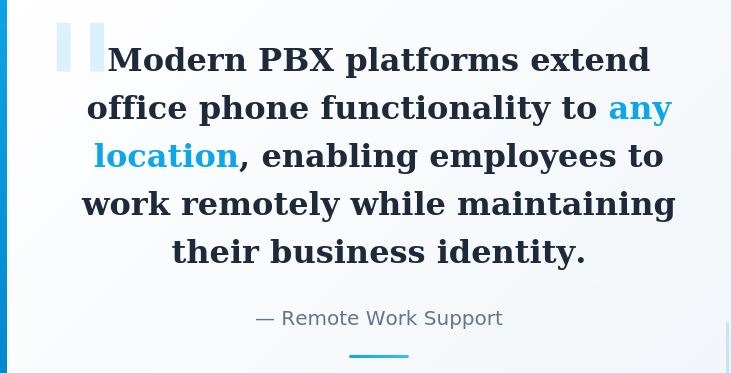
Remote Work Support. Modern PBX platforms extend office phone functionality to mobile applications, softphones, and home office setups. Employees working remotely maintain their business phone numbers, access company directories, and participate in call queues as though physically present. For organizations evaluating SIP trunking for small businesses, this flexibility proves essential for supporting distributed workforces.
How Should You Choose Your PBX System?
Evaluating business PBX options systematically helps organizations identify solutions matching their requirements.
- Assess your current and projected call volumes. Understanding concurrent call requirements determines capacity needs and influences pricing. Organizations with significant seasonal variation should evaluate how easily systems scale capacity.
- Evaluate technical capabilities honestly. Some platforms require substantial telecommunications expertise. Organizations without dedicated IT staff should prioritize systems offering managed services or exceptionally intuitive administration.
- Consider integration requirements carefully. CRM integration, calendar synchronization, and connections to collaboration platforms improve workflow efficiency. Verify that prospective platforms support your essential business applications.
- Calculate total ownership costs. Initial pricing comparisons often mislead. Factor in implementation services, ongoing support, required hardware, and training investments.
- Verify reliability and redundancy capabilities. Understand how prospective platforms handle failures through geographic redundancy, automatic failover, or backup routing options.
- Plan for future requirements. Platforms supporting open standards like SIP offer greater flexibility for future enhancements than proprietary solutions that lock organizations into specific vendor ecosystems.
Keep Your PBX and Add SIP Trunks Instead
You do not have to replace a phone system that works to lower your phone bill. If your business already runs a PBX, SIP trunking can take over the job of your PRI or analog lines. Your phones, extensions and call flows stay the same. Only the connection to the phone network changes.
This fits businesses that have money in a PBX and no reason to rip it out: hotels with a front desk and guest room phones, auto dealers with busy sales and service lines, and IT shops and MSPs that run phone systems for their clients. Instead of buying a new platform, you buy SIP channels, one for each call you need to handle at the same time, plus the phone numbers (DIDs) you want to keep or add.
SIP.US works with SIP-enabled PBX systems, including 3CX, where it is a certified SIP trunk partner. You can bring your existing numbers with you and add or remove channels online as your call volume changes.
What Industry Trends Are Shaping PBX Technology?
Several developments are reshaping business communications in ways that influence PBX decisions.
UCaaS and CCaaS
Unified Communications as a Service and Contact Center as a Service increasingly merge into integrated platforms. Modern platforms unify these functions, providing consistent experiences across all communication types while simplifying administration. Features traditionally reserved for dedicated call centers now appear in general business PBX platforms, including skills-based routing, real-time analytics, and quality monitoring.
AI-Driven Automation
AI receptionists can greet callers, understand inquiries, and route appropriately without human intervention. Predictive analytics help organizations staff appropriately by forecasting call volumes based on historical patterns. These capabilities, historically computing-intensive and expensive, are now deployed through cloud services accessible to organizations of all sizes.
The Shift from Hardware to Software
Softphone applications on computers and smartphones deliver equivalent functionality to desk phones without hardware costs. Web-based calling through browser interfaces requires no client installation. This software-defined approach accelerates deployment, simplifies remote work support, and reduces equipment expenses while enabling organizations to provision new employees immediately.
Frequently Asked Questions
What is the difference between hosted PBX and on-premise PBX?
Hosted PBX runs on provider-managed infrastructure accessed through internet connections, eliminating hardware purchases and maintenance responsibilities. On-premise PBX deploys equipment within organizational facilities, providing direct control but requiring capital investment and technical management.
How many SIP channels does my business need?
SIP channel requirements depend on concurrent call volumes rather than total employees. Organizations typically need one channel per simultaneous call plus buffer capacity for unexpected spikes. Most SIP providers enable easy adjustments as needs change.
Can I keep my existing phone numbers when switching to a new PBX?
Yes, number porting transfers existing business phone numbers to new providers. The process typically requires one to three weeks, depending on your current carrier cooperation. Most organizations port numbers to maintain customer contact continuity.
What internet speed do I need for VoIP-based PBX systems?
Each concurrent call using the standard G.711 codec requires approximately 85kbps of bandwidth in each direction. A business supporting 10 simultaneous calls needs roughly 850kbps dedicated to voice traffic.
Build Your Communications Foundation Today
The best PBX systems combine reliable calling capabilities with modern features that enhance productivity, support flexible work arrangements, and reduce communication costs. Whether your organization requires sophisticated call center capabilities, seamless remote work support, or more professional handling of customer calls, today’s PBX market offers more capable and affordable options than ever before.
For businesses ready to modernize their communications infrastructure, selecting the right SIP trunking provider proves equally important as choosing PBX platforms. SIP.US delivers the reliability, transparent pricing, and self-service control that organizations need from their communication foundation. With no contracts, instant setup, and unlimited calling options, you can start your free SIP trunk account and experience why thousands of businesses trust their communications to our service.
Last updated: October 2026

Mitch leads the Sales team at BCM One, overseeing revenue growth through cloud voice services across brands like SIPTRUNK, SIP.US, and Flowroute. With a focus on partner enablement and customer success, he helps businesses identify the right communication solutions within BCM One’s extensive portfolio. Mitch brings years of experience in channel sales and cloud-based telecom to every conversation.
Free SIP Trunk in 60 Seconds
Related Posts

What Is a DID Number? Direct Inward Dialing Explained
Unlock the potential of your communication system with our Beginner’s Guide to DID Numbers and SIP Trunks, offering cost-effective, scalable solutions for modern businesses and individuals.

What Is SIP? A Complete Guide to Session Initiation Protocol
Discover everything about SIP and how it revolutionizes communication. Learn what is SIP, its benefits, and how to implement it in your business for better connectivity.

What Is Internet Protocol? IP Definition and How It Works
Internet protocol is the addressing and routing system that gets every business call, email, and…