

The Ultimate Guide to SIP Trunking for Small Business Owners
SIP trunking for small business offers a proven path to lower phone costs, easier scaling, and modern communication features without the complexity of enterprise systems.
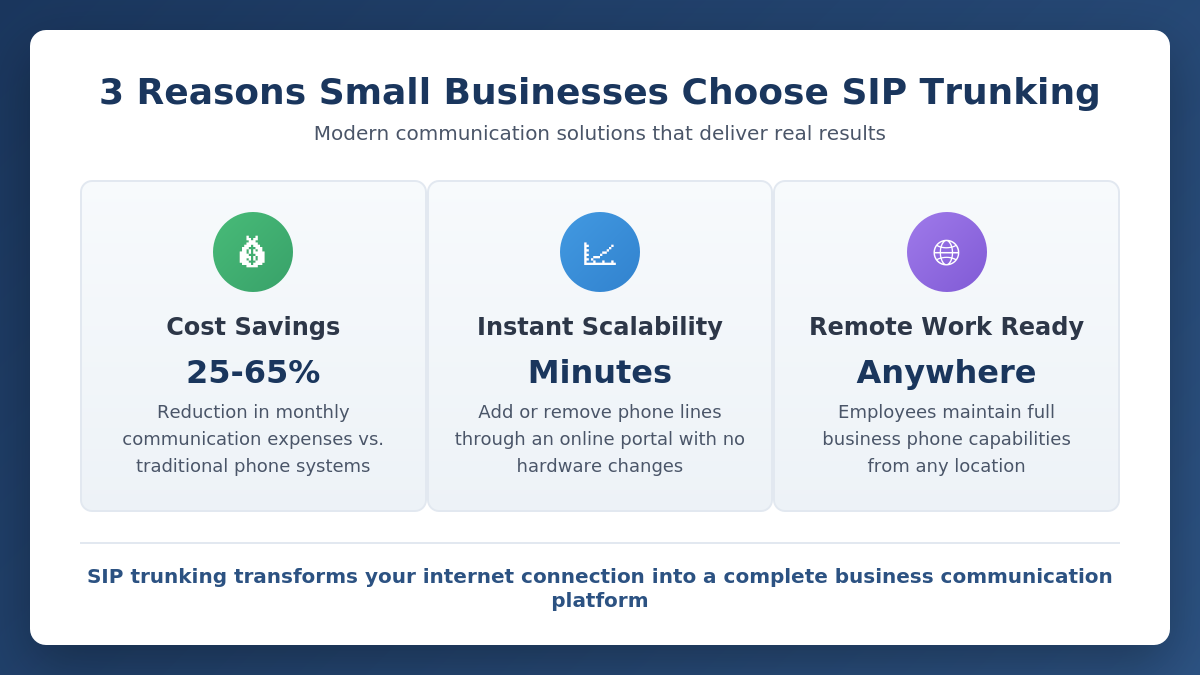
- Small businesses can save 25–65% on monthly communication expenses by switching from traditional phone lines to SIP trunking.
- The technology works with your existing internet connection and IP-PBX equipment, eliminating costly hardware investments.
- Adding or removing phone lines takes minutes instead of weeks, giving growing companies the flexibility they need.
- With the SIP trunking market projected to reach nearly $158 billion by 2030, this is mainstream technology backed by proven reliability.
If your small business still relies on legacy phone systems, evaluating SIP trunking could be the smartest communication decision you make this year.
Small business owners face a communication dilemma. Traditional phone lines drain budgets through expensive per-line charges, long-distance fees, and maintenance costs while limiting flexibility for teams that work from multiple locations. The solution that modern businesses are adopting transforms your existing internet connection into a comprehensive communication platform. The SIP trunking market reached $73.14 billion in 2025 and continues expanding at a 16.64% compound annual growth rate. Companies of all sizes are rethinking how they approach business communications.
SIP trunking for small business has moved beyond early-adopter territory into mainstream acceptance. The technology delivers enterprise-grade capabilities at prices that make sense for companies watching every dollar. Whether you operate a five-person startup or a fifty-employee regional business, understanding how SIP trunking works and what it offers can help you make informed decisions about your communication infrastructure. This small business phone guide covers everything owners need to know, from basic concepts to implementation steps.
How Does SIP Trunking for Small Businesses Work?
Session Initiation Protocol (SIP) trunking replaces traditional phone lines with virtual connections that transmit voice calls over the internet. Instead of paying for physical copper lines that connect your office to the telephone network, SIP trunking converts your voice into digital data packets and sends them through your existing broadband connection. The process happens instantaneously, and most users report call quality that matches or exceeds traditional phone service.

A SIP trunk is a virtual container that holds multiple communication channels. Each channel supports one active call at a time. A small business that typically has three employees on phone calls simultaneously would need three channels. The prominent advantage here is flexibility. When your call volume increases during busy seasons, you add channels through an online portal in minutes. When volume decreases, you reduce channels and lower your monthly costs accordingly.
The technology works with SIP-enabled PBX systems, which most modern phone systems support. Your existing desk phones, softphone applications, and mobile devices can connect through SIP trunking, maintaining a unified communication system regardless of where your team members work. For businesses without SIP-enabled equipment, affordable adapters bridge the gap between legacy systems and modern SIP infrastructure.
Why Are Small Business Owners Choosing SIP Trunking?
The rapid adoption of SIP trunks for small businesses reflects practical benefits that directly impact operations and finances. Small business owners consistently cite two primary motivations: immediate cost reduction and the ability to scale communications without complications.
Cost Savings That Impact Your Bottom Line
VoIP for SMB operations typically reduces communication expenses by 25–65% compared to traditional phone systems. These savings come from multiple sources. First, you eliminate per-line charges that accumulate quickly as your team grows. Second, long-distance and many international calls are included in your service rather than billed separately at premium rates. Third, you avoid the maintenance contracts and equipment replacement costs associated with legacy phone systems. Cloud-based communication providers can slash costs while leveraging data and innovation to increase performance.
A small business paying $400 monthly for traditional phone service might reduce that expense to $150–200 through SIP trunking while gaining additional features. Those savings compound over time and free up capital for growth initiatives, marketing, or improving your bottom line.
Scalability That Grows With Your Business
Traditional phone systems require planning, lead time, and technician visits to add new lines. PBX vs SIP for startups presents a clear contrast here. With understanding your PBX and SIP options, growing companies can add phone capacity the same day they hire new employees. This flexibility proves invaluable for businesses experiencing rapid growth, seasonal fluctuations, or project-based staffing changes.
The scalability extends beyond just adding lines. SIP trunking seamlessly supports remote workers, allowing employees to maintain their business phone numbers and professional communication capabilities from home offices, client sites, or anywhere with reliable internet access.
What Are the Pros and Cons of SIP Trunking for SMBs?
Every technology decision involves trade-offs. Understanding both the advantages and considerations helps small business owners make choices aligned with their specific circumstances.
Advantages of SIP Trunking:
- Worthwhile cost reduction on monthly communication expenses
- Instant scalability that adds or removes lines without hardware changes or service appointments
- Enhanced features, including call routing, voicemail-to-email, and video conferencing capabilities
- Support for remote and hybrid work arrangements through consistent communication access
- Integration with business software, including CRM systems and collaboration platforms
Considerations Before Switching:
- Dependence on internet connectivity means communication quality ties directly to your broadband reliability.
- Initial setup requires some technical knowledge, though quality providers offer configuration assistance.
- Emergency calling (911) requires proper address registration to function correctly.
The considerations are manageable for most small businesses. Reliable internet connections are standard in most commercial locations, and reputable SIP providers offer support resources that simplify implementation. The emergency calling requirement simply means providing accurate location information during setup, which responsible providers guide you through.

How Does SIP Trunking Compare to Traditional Phone Systems?
Traditional phone systems and SIP trunking serve the same fundamental purpose but approach it very differently. Legacy systems require physical infrastructure, dedicated phone lines from telecom carriers, and on-site equipment that depreciates and eventually fails. Changes to these systems often mean scheduling technician visits and paying hourly rates for relatively simple modifications.
SIP trunking virtualizes this entire infrastructure. Your internet connection becomes the pipeline for voice communication, your phone system connects to service providers through software configuration, and management happens through web-based control panels. The comparison becomes stark when examining SIP trunk pricing models against traditional per-line costs.
Small business phone guides consistently show SIP trunking delivering more features at lower costs. Traditional systems might charge separately for voicemail, call forwarding, auto-attendants, and similar capabilities that SIP providers typically include in base pricing. The total cost of ownership favors SIP trunking for virtually any small business that has adequate internet connectivity.
What Features Should Small Businesses Look for in a SIP Provider?
Choosing the best SIP for small business operations requires evaluating several key factors. The provider you select becomes a partner in your business communications, making careful evaluation worthwhile.
Reliability and Uptime Guarantees
Your phone system offers a direct connection to customers and business opportunities. Providers using Tier-1 network infrastructure with redundant connections across multiple data centers offer the reliability small businesses need. Look for uptime guarantees of 99.99% or higher, backed by service level agreements that demonstrate commitment to consistent availability.
Quality providers maintain geographically distributed servers that provide automatic failover if one location experiences issues. This redundancy ensures your business communications continue functioning even when technical problems occur somewhere in the network.
Transparent Pricing Models
Hidden fees frustrate small business owners and complicate budgeting. The best SIP trunk provider features include straightforward pricing without setup charges, long-term contracts, or surprise fees for standard features. Unlimited calling plans work well for businesses with consistent, high call volumes, while metered options suit companies with variable or lower usage patterns.
Evaluate pricing based on your actual usage patterns. A provider offering slightly higher per-channel costs but including all domestic calling might prove more economical than a lower-priced option that charges separately for long-distance calls.
Ease of Use and Self-Service Tools
Small businesses typically lack dedicated IT staff for managing communication systems. Providers offering intuitive control panels that allow non-technical users to manage phone numbers, adjust call routing, and review usage data provide practical value. Self-service provisioning means you can make changes when you need them rather than waiting for support tickets to be processed.
Look for providers offering comprehensive knowledge bases, configuration guides for popular PBX systems, and responsive support teams accessible through multiple channels, including phone, email, and live chat.
How Do You Set Up SIP Trunking for Your Small Business?
Implementation concerns prevent some small business owners from exploring SIP trunking. The reality is that setup is remarkably straightforward, especially with providers focused on serving smaller organizations.
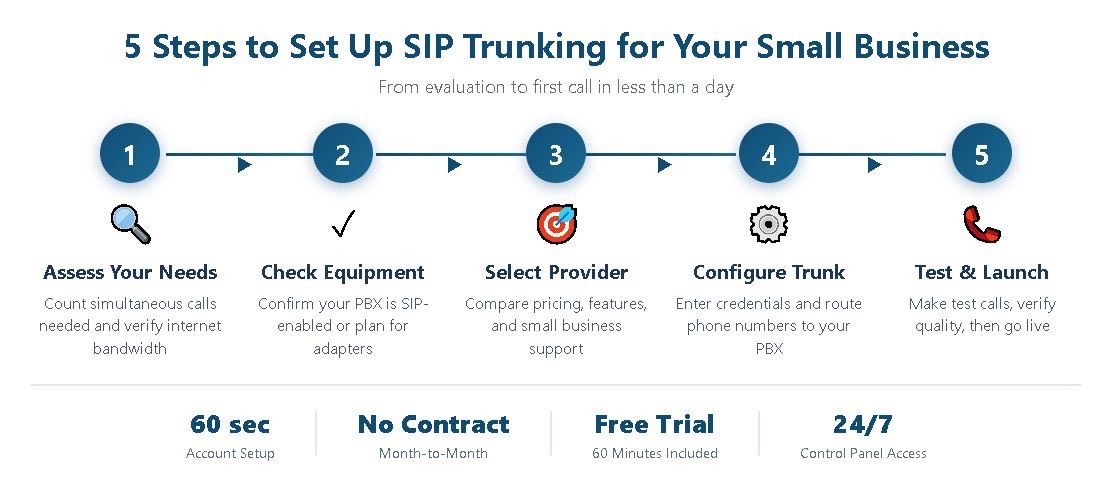
Step 1: Assess Your Current Infrastructure
Determine whether your existing phone system supports SIP connections. Most PBX systems manufactured in the last decade include SIP capability. If you’re unsure, check your equipment documentation or contact your current phone vendor. Systems without native SIP support can often connect through gateway devices that bridge analog equipment to SIP trunking services.
Step 2: Evaluate Your Internet Connection
Each simultaneous call requires approximately 85kbps of bandwidth in both directions. A business expecting five concurrent calls needs reliable bandwidth of at least 500kbps upstream and downstream, with headroom for other internet usage. Most business internet connections easily accommodate these requirements. Quality of Service (QoS) settings on your router can prioritize voice traffic to ensure call quality remains consistent even during heavy data usage.
Step 3: Choose Your Provider and Plan
Select a provider offering the features, reliability, and pricing model that fits your business. Consider starting with a free trial to test call quality and system compatibility before committing to paid service.
Step 4: Configure Your System
Provider knowledge bases typically include specific configuration instructions for popular PBX systems, including Asterisk, FreePBX, 3CX, and many others. Configuration usually involves entering authentication credentials and server addresses into your phone system’s SIP trunk settings. Many providers offer configuration assistance for businesses needing technical support.
Step 5: Port Your Numbers and Go Live
Transfer your existing business phone numbers to your new SIP provider to maintain continuity for customers and contacts. The porting process typically takes one to two weeks, depending on your current carrier. During this period, you can test your new system with temporary numbers before switching your main business lines.
Is VoIP the Same as SIP Trunking?
This question deserves a clear explanation because the terms often create confusion. VoIP (Voice over Internet Protocol) describes the broad technology category of transmitting voice communications over internet connections. SIP trunking is a specific implementation of VoIP technology designed for business telephone systems.
Think of VoIP as the highway system and SIP as the specific traffic rules that ensure vehicles reach their destinations efficiently. Consumer VoIP applications like Skype or WhatsApp use VoIP technology but don’t provide the business features, phone number portability, or system integration that SIP trunking fundamentals deliver.
For small business owners, SIP trunking offers the VoIP benefits of internet-based calling combined with professional capabilities, including local phone numbers, call routing, integration with existing phone equipment, and the reliability businesses require for customer communication.
Frequently Asked Questions
How much bandwidth does SIP trunking require?
Each active call uses approximately 85kbps of bandwidth in both directions when using the standard G.711 codec. A small business with five simultaneous calls needs about 425kbps dedicated to voice traffic. Most business internet connections provide sufficient capacity, though prioritizing voice traffic through QoS settings optimizes call quality during periods of heavy internet usage.
Can I keep my existing business phone numbers?
Yes, number porting transfers your current phone numbers to your new SIP provider. The process typically takes one to two weeks, depending on your current carrier’s procedures. During porting, your business maintains service continuity on existing numbers while you can test your new SIP system with temporary numbers provided by your new carrier.
What happens to my phone service if the internet goes down?
Quality SIP providers offer failover options that route incoming calls to backup numbers during connectivity outages. You can configure calls to forward to mobile phones, alternate locations, or voicemail systems when your primary connection becomes unavailable. This redundancy ensures you don’t miss important business calls even during technical difficulties.
Do I need special equipment for SIP trunking?
SIP trunking works with any SIP-enabled phone system, which includes most modern PBX equipment. Existing IP phones typically connect without modification. Analog phones require adapters called ATAs (Analog Telephone Adapters) to convert signals for SIP transmission. Many businesses also use softphone applications on computers and mobile devices, eliminating hardware requirements entirely for some users.
Transform Your Business Communications Starting Today
Small business owners who understand SIP trunking gain a competitive communication advantage without the enterprise-level complexity or cost. The technology has matured to the point where implementation is straightforward, savings are substantial, and reliability meets professional standards.
The decision to modernize your phone system ultimately comes down to whether continuing to pay premium prices for limited capability makes sense when better alternatives exist. For businesses ready to reduce costs while gaining flexibility and features, SIP trunking for small business is a logical next step.
SIP.US provides the combination of competitive pricing, reliable infrastructure, and easy-to-use control panels that small businesses need. With instant provisioning, no long-term contracts, and support resources designed for non-technical users, getting started takes minutes rather than weeks. Start your free trial today and experience the difference modern business communications can make.

Mitch leads the Sales team at BCM One, overseeing revenue growth through cloud voice services across brands like SIPTRUNK, SIP.US, and Flowroute. With a focus on partner enablement and customer success, he helps businesses identify the right communication solutions within BCM One’s extensive portfolio. Mitch brings years of experience in channel sales and cloud-based telecom to every conversation.
Free SIP Trunk in 60 Seconds
Related Posts

What Is a DID Number? Direct Inward Dialing Explained
Unlock the potential of your communication system with our Beginner’s Guide to DID Numbers and SIP Trunks, offering cost-effective, scalable solutions for modern businesses and individuals.

What Is SIP? A Complete Guide to Session Initiation Protocol
Discover everything about SIP and how it revolutionizes communication. Learn what is SIP, its benefits, and how to implement it in your business for better connectivity.

What Is Internet Protocol? IP Definition and How It Works
Internet protocol is the addressing and routing system that gets every business call, email, and…