

Small Business VoIP vs SIP Trunking: Which is Better in 2026?
Choosing between hosted VoIP and SIP trunking comes down to whether you want a fully managed phone system or more control over your existing PBX, with both options delivering cost savings over legacy phone lines.
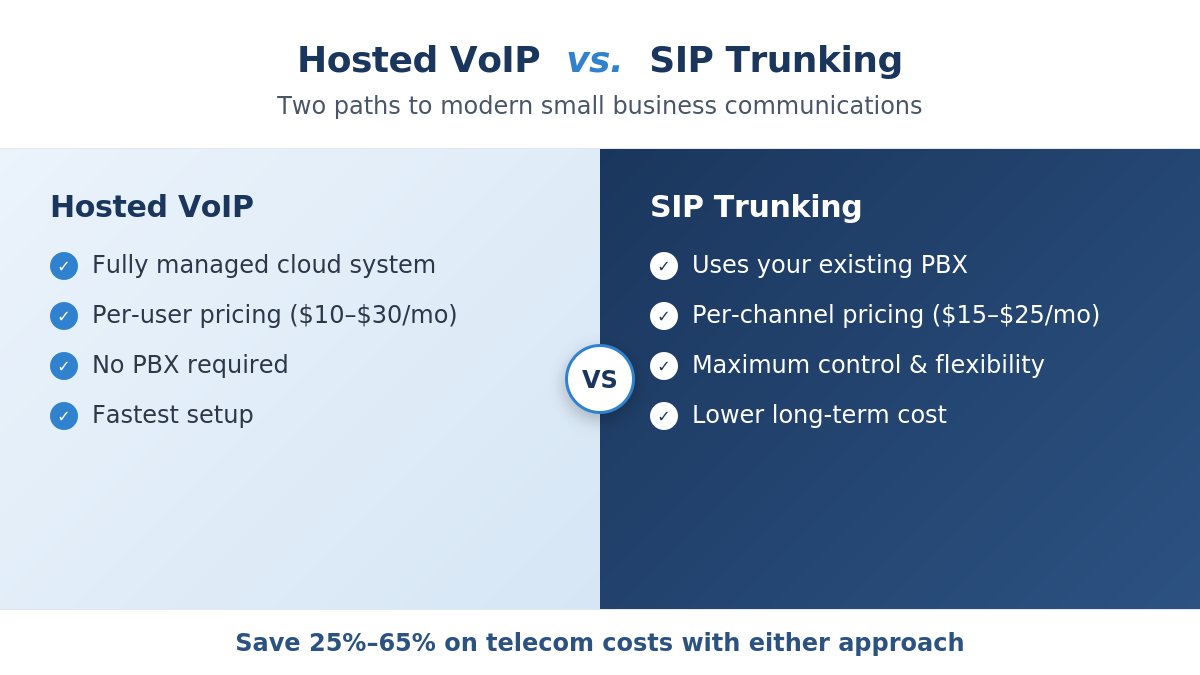
- Hosted VoIP delivers an all-in-one cloud phone system with minimal setup, ideal for businesses without existing infrastructure.
- SIP trunking connects an on-premise or cloud PBX to the public phone network, giving you maximum control and lower per-channel costs.
- Small businesses typically reduce telecom expenses by 25% to 65% with either approach, depending on call volume and infrastructure.
- The right choice depends on whether you already own a PBX, how technical your team is, and how much customization you need.
For most small businesses with no PBX investment, hosted VoIP offers faster onboarding, while SIP trunking wins on long-term cost and flexibility.
With the global VoIP market projected to grow from $176 billion in 2025 to $195 billion in 2026, according to Fortune Business Insights, internet-based calling has become the default rather than the alternative. The question for small businesses is which modern approach best fits your company.
For owners and IT decision-makers evaluating small business VoIP solutions, the choice between hosted VoIP and SIP trunking can feel confusing because both use the internet to carry voice calls. The terms get used interchangeably, but they describe different deployment models with meaningful differences in cost, control, and complexity.
What Are Small Business VoIP Solutions?
Voice over Internet Protocol (VoIP) is the underlying technology that transmits voice calls as digital data packets across internet networks instead of through copper phone lines. When marketers talk about “VoIP service,” they typically mean hosted or cloud VoIP, which is a fully managed phone system delivered as a subscription.
With hosted small business VoIP solutions, the provider handles everything. PBX functionality, call routing, voicemail, auto-attendants, and feature management all live in the cloud. You access the system through desktop apps, mobile apps, or IP desk phones. There is no on-site hardware to maintain beyond the phones and your internet router.
How Hosted VoIP Works for Small Businesses
The simplicity of hosted VoIP is its biggest appeal. You sign up, configure your account through a web portal, plug in compatible phones or download softphone apps, and start making calls. The provider manages all upgrades, security patches, and infrastructure behind the scenes. This approach works well for businesses without a current PBX investment, those with limited IT resources, and teams that prioritize predictable monthly billing over granular control.
What Is SIP Trunking for Small Business?
SIP trunking is a specific method for delivering VoIP service to an organization that already has a PBX or wants to deploy one. Session Initiation Protocol (SIP) is the signaling protocol that establishes, manages, and terminates voice calls over IP networks. A SIP trunk is the virtual connection that carries those calls between your PBX and the public telephone network.
If you compare hosted VoIP to a furnished apartment, SIP trunking is more like buying a house and choosing your own furniture. You keep control over your PBX (on-premise or cloud-hosted), your phones, and how calls are routed internally. The provider supplies the connection to the outside world and the phone numbers.
Why Small Businesses Choose SIP Trunking
SIP trunking for small businesses has become a practical choice for organizations that want lower per-channel costs and more flexibility than bundled hosted VoIP can deliver. Our PBX and SIP basics guide walks through how these technologies fit together.
The appeal is that you pay only for the channels you need, retain administrative control through your own PBX, and avoid the per-user feature pricing that hosted plans rely on. According to Mordor Intelligence, the SIP trunking market is on track to reach $181.58 billion by 2031, with cost savings of 25% to 65% over legacy PRI lines driving adoption.
VoIP vs SIP for Small Business: Key Differences
The practical differences in VoIP vs SIP for small business come down to ownership, cost structure, features, and technical demands.
Cost Structure and Pricing Models
Hosted VoIP is typically priced per user, with monthly fees ranging from $10 to $30 per user for standard plans and $40+ for premium tiers. Every additional employee adds another seat to your bill, even if their phone use is light. Feature upgrades often require moving to a higher plan.
With SIP trunking, instead of paying per user, you pay per channel, with each channel handling one concurrent call. A small business with 30 employees but only 8 simultaneous calls at peak times needs just 8 channels rather than 30 user licenses. You can review specific channel-based pricing options to estimate your monthly investment.
Control Versus Convenience
Hosted VoIP optimizes for ease of management. The provider owns the technical complexity; you own the user experience. This dynamic works well for businesses that want to focus on core operations rather than telecom administration.
SIP trunking optimizes for control. You decide which PBX platform to deploy, how calls route internally, which integrations to build, and what security policies apply. This aspect matters most for businesses with specialized workflows, custom integrations, or compliance requirements.
Features and Integration Flexibility
Hosted VoIP packages include features as part of the subscription: voicemail-to-email, call recording, conferencing, mobile apps, and analytics. The trade-off is that customization is limited to what the provider supports.
SIP trunking puts feature decisions in your hands. You can build the exact phone system your business needs by choosing a PBX platform with the features you want, then connecting it to a SIP trunk provider for outside calling. This setup works well with SIP-enabled PBX systems like 3CX, Asterisk, FreePBX, and others.

How Much Do Small Business Phone Systems Cost?
Pricing varies between hosted VoIP and SIP trunking, and the right comparison depends on your situation. Per-user hosted plans look simpler at first glance, but per-channel SIP trunking can deliver lower costs for the right call patterns.
Hosted VoIP systems typically cost between $10 and $30 per user per month for standard plans, while premium tiers with features like video conferencing, call analytics, and CRM integration can exceed $40 per user. A 25-person business at $25 per user pays $625 monthly before any add-ons like toll-free numbers, call recording, or porting fees. SIP trunking pricing typically runs $15 to $25 per channel, with most small businesses needing fewer channels than employees. That same 25-person business might need only 6 to 10 channels, depending on call patterns.
Which Is the Best Phone System for Small Business? 5 Factors
Choosing between hosted VoIP and SIP trunking for your business phone systems comes down to honest answers about your current setup, technical capacity, and growth plans. Five factors should drive the decision:
- Existing infrastructure. If you already have a SIP-compatible PBX, SIP trunking lets you preserve that investment at a lower cost than replacing the system. If you have no PBX, hosted VoIP eliminates the need to acquire one.
- Technical resources. SIP trunking gives you more control but assumes someone on your team can configure and maintain a PBX. Hosted VoIP requires almost no technical expertise beyond initial setup.
- Call volume patterns. Businesses with high concurrent call volumes relative to employee count typically save more with per-channel SIP pricing. Those with one-to-one user-to-call ratios may find hosted VoIP equally competitive.
- Customization requirements. Deep integrations, specific call routing logic, or compliance configurations call for SIP trunking’s flexibility. If standard features cover your needs, hosted VoIP deploys faster.
- Growth trajectory. SIP trunking scales by adding channels in your control panel, which is fast and cheap. Hosted VoIP scales by adding user seats, which is straightforward but linearly more expensive as headcount grows.
Evaluating your organization based on these five criteria will help lead you to the best phone system for your small business.

When Does SIP Trunking Beat VoIP for Small Business?
SIP trunking pulls ahead of hosted VoIP when a small business has predictable call patterns, an existing or planned PBX investment, and the appetite for slightly more technical involvement in exchange for better economics. The cost advantage compounds over time, particularly for businesses that grow their team faster than their concurrent call volume.
Scenarios Where SIP Trunking Wins
Consider a 15-person professional services firm that handles client calls all day but rarely has more than 5 calls happening at once. With hosted VoIP at $25 per user, the firm pays $375 monthly for 15 seats. With SIP trunking for small business needs at $20 per channel, it pays roughly $100 for the 5 channels in use. That difference adds up to thousands of dollars annually.
Multi-location businesses also benefit from SIP trunking’s ability to consolidate calling across sites under a single account while preserving local presence in each market.
Scenarios Where Hosted VoIP Wins
Hosted VoIP makes more sense when speed of deployment matters most, when the business has no existing PBX, and when bundled features like video conferencing would otherwise require separate vendors. Microbusinesses with just a few employees may find the per-user cost reasonable and the convenience worth more than per-channel savings.
Frequently Asked Questions About Small Business VoIP Solutions
Is SIP trunking cheaper than hosted VoIP for small business?
In most cases, yes. SIP trunking typically costs $15 to $25 per channel compared to $10 to $30 per user for standard hosted VoIP plans, with premium tiers running higher. Because most small businesses need fewer channels than employees, total monthly costs are usually lower with SIP trunking. The exception is very small teams where the channel-to-user ratio approaches one-to-one.
Can you use VoIP and SIP trunking together?
Yes. Many businesses deploy a SIP-enabled cloud PBX and connect it to a SIP trunk provider for outside calls, combining the benefits of both approaches. The PBX provides hosted VoIP features for end users, while the SIP trunk delivers cost-efficient connectivity to the public phone network.
What internet speed do you need for small business VoIP solutions?
Each concurrent call uses approximately 85kbps of bandwidth in both directions when using the G.711 codec. A business with 10 simultaneous calls needs about 850kbps dedicated to voice traffic. Most modern business internet connections handle this easily, though configuring Quality of Service (QoS) on your router helps ensure consistent quality during heavy data use.
Do you need new phones to switch to VoIP or SIP trunking?
Not always. Most phones manufactured in the past decade are SIP-compatible and work with either solution. Legacy analog phones can connect through analog telephone adapters (ATAs), which bridge old equipment to modern IP networks.
What is the best phone system for small businesses in 2026?
The best phone system for small businesses depends on your existing infrastructure, technical resources, and call patterns. Hosted VoIP wins on simplicity and bundled features, while SIP trunking wins on cost-efficiency, control, and scalability.
Make the Switch That Fits Your Business
The right choice between hosted VoIP and SIP trunking depends on your existing infrastructure, technical resources, and how you want to manage your phone system. Both approaches deliver substantial savings over legacy phone lines, and both support the flexible work patterns that define how small businesses operate today. The question is not which technology is universally better, but which fits the specifics of your operation.
If you have a SIP-compatible PBX or want maximum control over costs and customization, SIP trunking is likely the smarter long-term investment. If you want a turnkey phone system with minimal setup and bundled features, hosted VoIP gets you operational fast.
SIP.US delivers SIP trunking with transparent per-channel pricing, instant provisioning, and no contracts, making it easy to test whether the model fits before committing. To explore how it compares to your current setup, start your free trial today and see the difference flexible, channel-based communications can make for your business.

Mitch leads the Sales team at BCM One, overseeing revenue growth through cloud voice services across brands like SIPTRUNK, SIP.US, and Flowroute. With a focus on partner enablement and customer success, he helps businesses identify the right communication solutions within BCM One’s extensive portfolio. Mitch brings years of experience in channel sales and cloud-based telecom to every conversation.
Free SIP Trunk in 60 Seconds
Related Posts

What Is a DID Number? Direct Inward Dialing Explained
Unlock the potential of your communication system with our Beginner’s Guide to DID Numbers and SIP Trunks, offering cost-effective, scalable solutions for modern businesses and individuals.

What Is SIP? A Complete Guide to Session Initiation Protocol
Discover everything about SIP and how it revolutionizes communication. Learn what is SIP, its benefits, and how to implement it in your business for better connectivity.

What Is Internet Protocol? IP Definition and How It Works
Internet protocol is the addressing and routing system that gets every business call, email, and…